

Source: The Conversation – France
KEY TAKEAWAYS
-
The 37th International Geography Festival runs until October 4 in the north-eastern French town of Saint-Dié-des-Vosges.
-
The festival commemorates a historical event: it was in Saint-Dié at the start of the 16th century that the “new continent” was officially named America in a tribute to Amerigo Vespucci.
-
Geographical research from the Vosges region highlights the integration of France’s north-eastern Lorraine region into European scholarly networks.
In 1941, from his American exile, Austrian writer Stefan Zweig, in Amerigo : A Comedy of Errors in History, opened the chapter on the christening of America with this plea for indulgence :
“No one should consider themselves guilty of lacking geographical knowledge if they have never heard of the name of the small town of Saint-Dié.”
Does this introduction still apply to Saint-Dié-des-Vosges today? Apparently not.
Since 1990, the International Geography Festival has commemorated the town’s defining historical event, drawing prominent figures from around the world each October to the “small town” in the Vosges mountains where the New World was officially named.
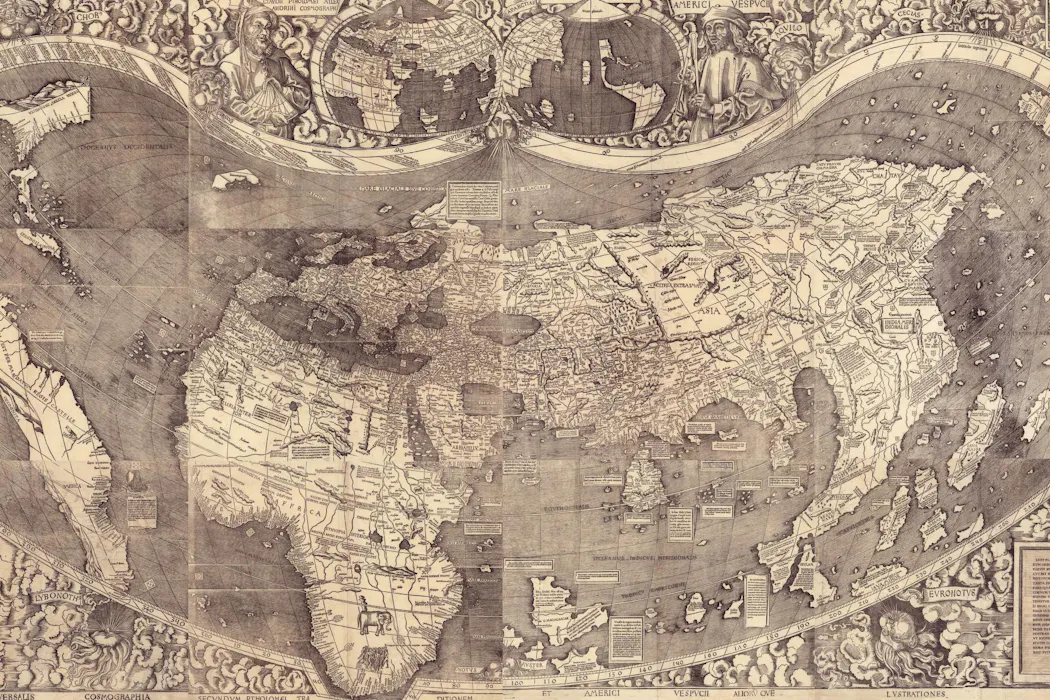
Yet, when the Library of Congress presents the only known copy of German cartographer Martin Waldseemüller’s world map (acquired in 2001), it suggests Strasbourg rather than Saint-Dié as the location where it was printed, making the “small town” invisible once more.
The Vosges Gymnasium, a community of humanist scholars
The choice of the largest library in the world does not do justice to this town in the Vosges. It was here ‘within its walls’ in the early 16th century that the new continent was given the name America. It was here that René II of Lorraine, King of Naples and Jerusalem (1493-1508), who for a time planned to travel to Naples, encouraged the work of the Gymnasium vosgien, a community of humanists who were particularly interested in geography.
The Duke, who had received a French copy of Amerigo Vespucci’s letter recounting his four voyages – The Soderini Letter, dated September 4 1504 from Lisbon, Portugal understood the interest the community might have in their work. This letter, which contained the account of four trips by the Florentine explorer and navigator who was already well-known thanks to his Mondus novus pamphlet, was therefore forwarded to the Saint-Dié Cenacle, who was working on a new edition of Ptolemy’s Geography.
Immediately translated into Latin, German poet and scholar Mathias Ringmann incorporated the letter in the Cosmographiae Introductio (1507) which accompanied the new representation of the world conceived by Martin Waldseemüller and, in homage to Vespucci, it was decided that the new continent would be named America.
The geographical research in the Vosges demonstrates the integration of France’s north-eastern Lorraine region into the scientific networks of Europe. In this regard, the Portuguese provenance of the letter must first be underlined. It shows the interest of René II for what happened beyond the region and its principalities of that time.
The Duke of Lorraine was fascinated by the Portuguese and Spanish seafaring expeditions. Moreover, before coming to settle in the Galilee valley – an old community of communes located in the Vosges –, the scientists who explored the cradle of this world map had studied in various European cities. Basin had attended the University of Bologna. The Hellenist Mathias Ringmann, a former student at Heidelberg, had passed through Paris and Strasbourg and Waldseemüller who studied for a time in Freiburg-en-Brisgau had made connections in Strasbourg and Basel before settling in Saint-Dié. Ideas, books and scholars also ventured beyond the princely networks.
A wider world
Antoine de Lorraine, son of René II, who became Duke in 1508, was also attentive to the broadening of the globe. He showed interest in the progress of geographical science and navigation techniques. Its library, part of which is known thanks to an inventory, bears witness to this. The works of the Vosgien Gymnasium, and the Cosmographiae Introductio, in particular do not appear there, but there are two maps of France (a “large gallican in parchment” and another smaller one), a Livre du compas de la navigation, a printed edition of the New World and finally, another manuscript entitled La Navigation et découverte des Indes supérieures.
The first volume (on the Mediterranean) can be compared to a 15th century manuscript, preserved in Paris at the Bibliothèque nationale de France (ms.fr. 25376), entitled Le Livre du compas, c’est assavoir le livre de navighier. The second is a version of the French translation of Mundus novus, by Amerigo Vespucci, reissued several times from 1515 to 1529. The third is to be compared with one of the four manuscripts in Antonio Pigafetta’s account of Magellan’s expedition around the world to the Moluccas (1519-22) (New-Haven, Beinecke Library, ms. 351). The maps and the Livre du compas could have been inherited from René II, Mundus novus and Pigafetta’s account are, on the other hand, contemporaries of Antoine’s time.
Diplomatic gifts
The latter had the opportunity to confront the materiality of this broadening of (the known) horizons. America was given its official name during the reign of René II, but it was in his son Antoine’s time that the idea that had been an abstraction materialised. He had the privilege of receiving some indigenous artefacts sent from Mexico to Charles V by Hernàn Cortès.
The latter, seeking the support of the Habsburgs in his conquest of the Aztec Empire, had sent them to Spain in 1519. As early as 1520, this treasure was exhibited in Brussels. Albrecht Dürer was able to admire these wonderful objects during his journey through the Netherlands and recorded their memory in his diary.
In 1523, Charles offered his aunt Margaret of Austria, the governess of the Netherlands, a part of this treasure. Seventy-eight “feather accoutrements hailing from the Indies”, transferred from Brussels to Mechelen, were inventoried in the archduchess’s bookshop in 1524. On July 6, 1528, Marguerite gave Antoine de Ville, ambassador to the Duke of Lorraine, fourteen of these precious artefacts as a gift, consisting mainly of military equipment as well as textile items adorned with gold and feathers.
This diplomatic gift came against the backdrop of Charles d’Egmont’s succession pitting the dukes of Cleves and Lorraine against the emperor over the duchy of Guelders. At the end of the 1520s when hostilities with the Kingdom of France resumed, it was imperative for Charles V to find peaceful solutions to this conflict.
The diplomatic activity that then unfolded allowed him, in addition to avoiding the union of François de Lorraine and Anne de Clèves, to conclude with Charles d’Egmont the treaty of Gorinchem (October 1528). Prudently, after the death of Charles d’Egmont (1538), the Duke of Lorraine renounced his Gueldre inheritance, not without concession from the emperor, who granted him veritable autonomy in his duchy under the Treaty of Nuremberg (1542).
Antoine, a descendant of the one who baptised America, did not risk competing with the ruler of New Spain, Peru, New Granada, and the Río de la Plata, among others. By accepting native artefacts and negotiation, the Duke of Lorraine was able to enjoy the largesse of someone who ruled an empire on which the sun never set. He thus continued the work of his father and ensured the sustainability of Lorraine’s principalities. At the dawn of the 21st century, across the Atlantic this is not enough; however, for us to remember the “little town” in Lorraine where America was officially given the name it carries to this day.
Find Jean-Christophe Blanchard’s essay on the subject (in French), entitled “1507 : Saint-Dié, les ducs de Lorraine et l’Amérique” in the book Histoire européenne de la Lorraine en 100 dates by Isabelle Brian and Laurent Jalabert (Strasbourg, La Nuée Bleue, 2025, p. 283-289).

A weekly e-mail in English featuring expertise from scholars and researchers. It provides an introduction to the diversity of research coming out of the continent and considers some of the key issues facing European countries. Get the newsletter!

Jean-Christophe Blanchard ne travaille pas, ne conseille pas, ne possède pas de parts, ne reçoit pas de fonds d’une organisation qui pourrait tirer profit de cet article, et n’a déclaré aucune autre affiliation que son organisme de recherche.
Original source: https://analysis1.mil-osi.com/2026/10/02/the-little-known-story-of-saint-die-des-vosges-humanist-scholars-who-gave-america-its-name/