

Source: The Conversation – Indonesia
Birds calling back and forth in the morning is one of the defining sounds of tropical forests. We’re likely to assume more types of birds we hear or see indicate a healthy forest.
But counting species isn’t the only way to measure a forest’s health. Evolutionary biology asks another question that matters just as much: How closely related are the bird species that live together there?
Higher species diversity points to a forest rich in varied plants and other food sources, creating the ideal conditions for a wider range of species—and unique evolutionary lineages—to persist.
In a study of 422 bird species across 1,410 sites on seven islands in Borneo and the Wallacea region, my team and I found that densely forested areas do not necessarily harbour a greater diversity of bird species.
Our findings show that assessing bird diversity requires more than simply counting species. To conserve these communities and their diversity, we also need to look at their “family tree”.
Tracing birds’ family trees
Imagine all the bird species on Earth connected within one vast family tree. Even species whose ancestors diverged millions of years ago still belong to the same evolutionary tree, although they occupy more distant branches.
At each of our observation points, we compared bird communities with forest conditions. We measured forest cover within a 250-metre radius and tracked the forest cover changes from 2010 to 2022.
We used three “yardsticks” to measure the evolutionary relatedness among the species we recorded:
1) Phylogenetic diversity (PD): Measures how much history is packed into a bird community. The longer the branches on the family tree connecting those species, the more evolutionary history that species holds.
2) Mean pairwise distance (MPD): Measures the average phylogenetic distance between each species and all other species in the community.
3) Mean nearest taxon distance (MNTD): Focuses on the closest relative, measuring how far each bird species is from its nearest “cousin” living alongside it.
On Buru Island in Maluku, where the forests remain relatively undisturbed, different bird species live alongside one another, including the Buru flowerpecker (Dicaeum erythrothorax), Buru racket-tail (Prioniturus mada) and red lory (Eos bornea).
The three species show an intriguing phylogenetic relationship: the Buru racket-tail and red lory share the characteristic hooked-bill morphology of parrots (Psittaculidae), while the Buru flowerpecker (Passeriformes) is connected to them at a much deeper evolutionary level through the Psittacopasseres clade.
But evolutionary ties only tell part of the story. They survived to live alongside one another due to stable forest conditions.
In the Sangihe and Talaud islands of North Sulawesi, bird communities are less diverse. Both islands face higher levels of threat because forest cover has declined since 2010.
The yellow-sided flowerpecker (Dicaeum aureolimbatum) and grey-sided flowerpecker (Dicaeum celebicum) on Sangihe belong to the same genus and forage for small fruits in trees.
Meanwhile, the elegant imperial pigeon (Ducula concinna) and grey imperial pigeon (Ducula pickeringii), both relatively large-bodied species in Talaud that feed on fruit in trees also comes from the same genus.
Baca juga:
From Australia to the Andes, we’re discovering new biodiversity hotspots worldwide
Why does this happen?
The close evolutionary relatedness found in forests can arise through environmental filtering, or the way local conditions determine which species survive.
Dense forests have distinctive vegetation structure, light conditions, food resources and foraging space, making them more suitable for certain groups of birds.
A finding from Buton Island in Southeast Sulawesi adds another layer to this picture. It suggests that the bird community structure is shaped not only by the extent of forest cover, but also by the history of the island and the bird groups that have long been established there.
For instance, the Sulawesi drongo (Dicrurus montanus), black sunbird (Leptocoma sericea) and yellow-sided flowerpecker (Dicaeum aureolimbatum) all belong to the large order Passeriformes.

(William Stephens/Wikimedia Commons), CC BY
Their occurrence in Buton is partly linked to the food resources available there, including insects and nectar.
Buton’s bird community also reflects the island’s biogeographic history: its proximity to Sulawesi, separated only by shallow straits, has helped shape a bird fauna that closely resembles Sulawesi’s. At the same time, Buton’s karst and ultrabasic geology influences vegetation, creating conditions that favour particular bird groups.
Together, these factors show that bird community structure is shaped not only by present-day forest conditions, but also by the island’s history and the bird groups that have long been established there.
In a follow-up study that has not yet been published, we are also examining how isolation between islands may have helped shape these patterns.
Baca juga:
Research: Endemic anoa and babirusa show surprising resilience on small islands
Birds facing two threats
Our study also identified bird species with more evolutionarily distinct lineages and a greater risk of extinction in larger forest areas, using the EDGE (Evolutionarily Distinct and Globally Endangered) metric and the International Union for Conservation of Nature (IUCN) Red List.
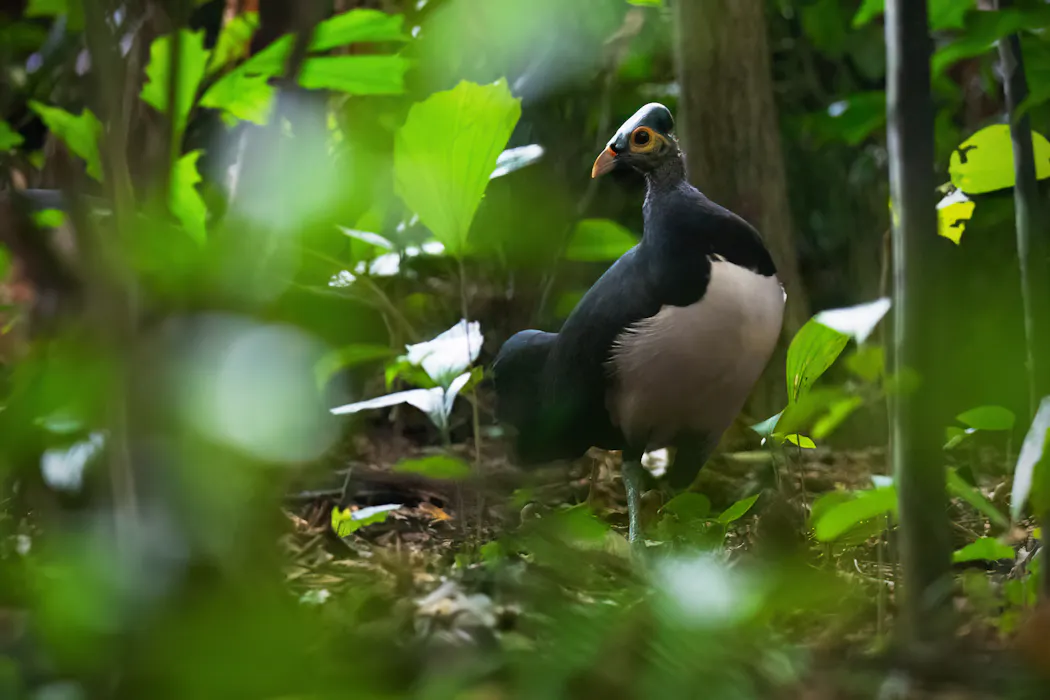
One example is the Sulawesi maleo (Macrocephalon maleo). This endangered species sits on an ancient branch of the evolutionary tree.
The terms “maleo” can refer more broadly to members of the megapode family (Megapodiidae), which is widely distributed across Sulawesi, Maluku, Papua, Australia, New Zealand and the small islands of the Pacific.
However, across the family, nearly half of its species are classified as Vulnerable to Critically Endangered because of habitat loss and egg harvesting.
The Sulawesi maleo is especially important because it is the only surviving species in its genus, making Macrocephalon a monotypic genus. If the wider Megapodiidae family is already under pressure globally, the extinction of the Sulawesi maleo would erase the sole surviving representative of an ancient branch of the genus Macrocephalon, with no close relatives elsewhere in the world.
Baca juga:
After 10 years of work, landmark study reveals new ‘tree of life’ for all birds living today
Why numbers aren’t enough
Environmental analyses based on the number of individuals and species remain important, but they provide only part of the picture. The problem is that many environmental assessments, including environmental impact assessments, stop at these two measures.
Yet two sites with the same species richness can have very different conservation value. One may be dominated by groups with many close relatives that are relatively tolerant of disturbance.
By contrast, another site may have a very different species community.
For this reason, large, well-connected forests are crucial for maintaining communities of high evolutionary and conservation value, particularly across tropical forests worldwide.
On Mount Cameroon, bird communities at both lower and higher elevations are dominated by closely related groups. Researchers have linked this pattern to the history of African forests, which have repeatedly expanded, contracted and become isolated.
Meanwhile, in the Brazilian Amazon, selective logging can prune away some of birds’ evolutionary history. In Colombia, the conversion of forests into pasture is estimated to have erased around 2.3 billion years of avian evolutionary history.
Baca juga:
Seen but not forgotten: How citizen science helps document biodiversity in remote Borneo villages
Assessing evolutionary relatedness does require additional effort. But it offers a deeper understanding of how much of life’s evolutionary history we are actually protecting.
A forest filled with birdsong is certainly a good sign. But to understand just how valuable that forest is, we also need to look at the family tree behind those sounds.

Halvina G Saiya received funding from Beasiswa Pendidikan Indonesia.
Original source: https://analysis1.mil-osi.com/2026/10/02/birdsong-tells-only-part-of-a-forests-story-evolutionary-trees-reveals-the-rest/