

Source: The Conversation – Canada
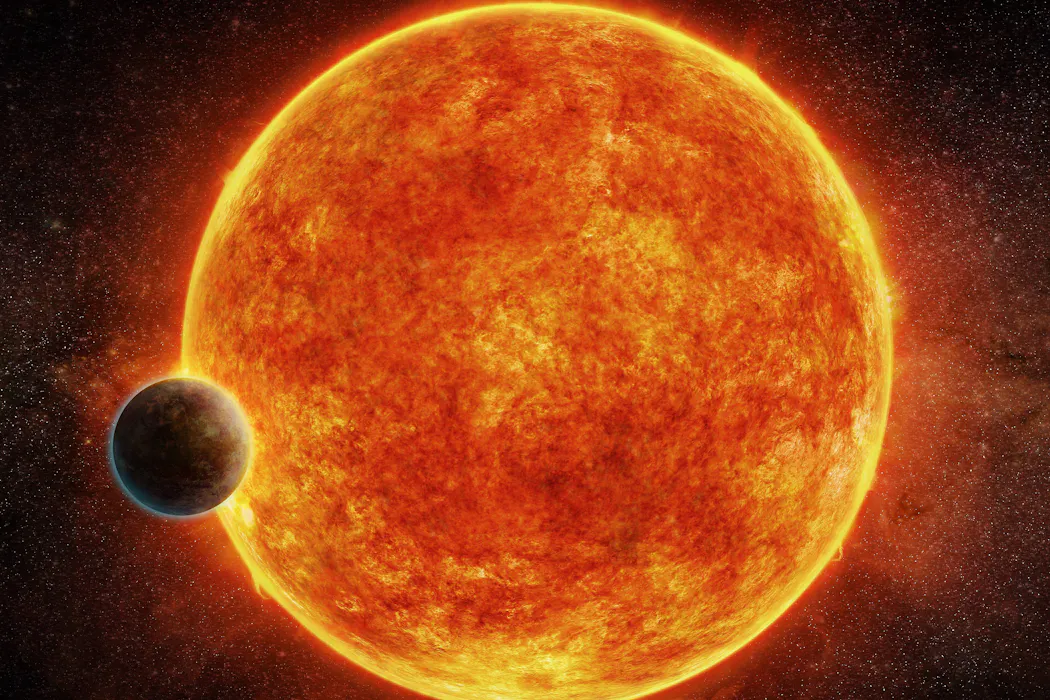
This summer, exoplanet science — the study of planets orbiting stars beyond our sun — took a big step forwards.
Reports of helium gas escaping from the atmosphere of LHS 1140b propelled this exoplanet from the pages of scientific journals into the mainstream media.
LHS 1140b orbits a faint, red star within the constellation of Cetus — named after a whale-like sea monster in Greek mythology — and just next to the easily recognisable “W” of the constellation Cassiopeia. But don’t squint — it appears some 10,000 times fainter than the feeblest star you can see with your naked eye.
This exoplanet is of particular interest because it is a potentially rocky world within the “habitable zone” of the star it orbits. This means it may have a temperature that could allow for liquid water on its surface.
Just possibly, it could support the existence of life.
What does the presence of helium mean?
Previous observations of LHS 1140b with the James Webb Space Telescope ruled out the existence of a hydrogen-rich atmosphere — a so-called “primary” atmosphere that is thought to form in-step with young planets and is soon lost to space.
Astronomers think that all rocky planets may possess a primary atmosphere and then lose it shortly after they form. This is a short, transient phase in their story.
However, the reported observation of helium may indicate a “secondary” atmosphere, thought to be more stable and long-lived. Secondary atmospheres persist around their planets and can be studied by astronomers.
On planet Earth, our secondary atmosphere has been with us for billions of years and its chemical balance reflects the combined effects of geology, chemistry and, ultimately, life.
Super-Earth or mini-Neptune?
LHS 1140b orbits a red dwarf star about one-fifth the mass of our Sun but some 300 times fainter. However, as viewed from Earth, the star dims with a regular dip every 24.7 days.
From the size of the brightness dip, scientists from the team that discovered the planet in 2017 estimated it to be 1.7 times larger than Earth. Subsequent observations indicated the planet to be just over five times bigger than Earth.
Such “super-Earths” are among the least massive planets that we can currently detect and represent some of the best candidates for detecting life beyond our solar system. But accurately labelling such worlds poses a problem for astronomers.
In our own solar system, the next biggest planet compared to Earth is Uranus, which is equal to 14 Earths. Then comes Neptune at 17 Earth masses.

(NASA/JPL)
So is LHS 1140b a super-Earth or a mini-Neptune? We have little idea, mainly because we lack examples of such worlds close to home. This blind spot in our knowledge of planetary physics is a pressing one, as such sub-Neptunian worlds appear to be the most common type of planet out there.
A rocky, Earth-like exoplanet with a detectable atmosphere in the habitable zone of even a dim, red star would be a major scientific discovery because of the potential for it to host life. However, as with all cutting edge science, the devil is in the detail.
Could LHS 1140b host alien life?
Studying the atmospheres of exoplanets is one of the most exciting areas in modern astronomy. Starting 150 years ago, studies of the outer gaseous envelopes of stars — stellar atmospheres — kick-started the science we today call astrophysics.
In a similar manner, studies of the atmospheres of their planets may lead to an answer to the question: Do they host alien life?
As mentioned, LHS 1140b is of particular interest because it lies within the “habitable zone” of its star and may have a surface temperature between the 0 C and 100 C that could allow for the existence of liquid water — and possible life — on its surface.
Care is required with such terms, however. If LHS 1140b absorbs all of the stellar radiation that falls upon it, then it would reach an equilibrium temperature of -30 C, seemingly cold, but well within the range where the greenhouse effect of a thick atmosphere could warm the planet to more clement temperatures.
However, if a more realistic mathematical treatment of the planet is attempted, then LHS 1140b might be as cold as -90 C, comparable to present day Mars.
A tenuous, nuanced result
This is only the second time that astronomers have captured even a hint of an atmosphere around a remotely Earth-like planet. The first time was around the exoplanet Gliese 1214b.

(NASA/JPL)
Rather like the purported atmosphere itself, the result is tenuous and nuanced. A second observation of the planet within the study did not show the presence of helium. As to why this is, we remain unsure.
Furthermore, the numbers that underpin the calculations of the surface conditions on LHS1140b involve significant, untested assumptions.
Yet this is progress, however incremental, towards the goal of atmospheric spectroscopy of potentially habitable worlds. And let us not forget that this single step forwards was the result of years of dedicated effort from the science team responsible. For that, they deserve recognition, respect and future funding.
Nature will teach us the rules
And what of the more lofty goal of detecting life on such worlds from the hints of trace gases in their atmospheres? Which potentially biogenic molecules will offer unambiguous evidence — the so-called “smoking gun” — of life?
Read more:
Are aliens real? Scientists have been hunting for extraterrestrial life since the time of Aristotle
Might the answer lie within our own atmosphere, enriched as it is by molecules of oxygen and methane?
My own answer, and perhaps a frustrating one to those impatient for further discovery, is that we will likely have a much clearer picture once we have observed thousands of exoplanet atmospheres, rather than one or two. We need nature to teach us the rules by which planetary atmospheres work and that work has only just begun.
But if a journey of a thousand planets starts with a single step, then with these recent observations of LHS 1140b we have just taken our second. The journey is underway.

Jon Willis does not work for, consult, own shares in or receive funding from any company or organisation that would benefit from this article, and has disclosed no relevant affiliations beyond their academic appointment.
Original source: https://analysis1.mil-osi.com/2026/09/29/alien-life-why-the-possibility-of-exoplanet-lhs-1140b-emitting-helium-gas-is-so-exciting/