

Source: The Conversation (Au and NZ)
Harry and Susan Burrell were a remarkable 20th century couple. They were Australian vaudeville performers, self-taught naturalists, animal traders and collectors of specimens.
Although Susan’s contributions have largely been overlooked (mainly due to the sexism of the time), Harry Burrell remains a renowned natural scientist. His speciality was monotremes, and his passion was the platypus.
An upcoming exhibit at the Australian Museum shares the incredible story of this self-described “platypoditudinarian”, featuring images and specimens from his collection.
Without further ado, let’s dive into the life of the man who married scientific inquiry with vaudeville theatrics.
A vaudevillian life
Born in Sydney in 1873, Harry Burrell spent several years as a vaudeville comedian travelling in variety shows around the country. In 1901, he married Susan Emily Naegueli and settled on her family’s property in Manilla, New South Wales, where they took up an interest in zoology.
Although biographers mark this vaudeville period as a minor blip in the trajectory of Burrell’s life, his showmanship would go on to saturate his work as a naturalist.
Burrell believed the serious business of scientific research should not be separated from engaging public science education.
Inhabiting the platypusary
One of Burrell’s landmark achievements was to create a “platypusary”: a portable platypus carrier that mimicked platypuses’ burrow networks.

Courtesy Australian Museum archives
To populate his platypusary, Burrell trapped platypuses and their young (called “puggles” today) by digging them out of their burrows along the Namoi River in northern NSW.
This was risky work. Burrell was stabbed by male platypuses’ poisonous spurs. Also, on one occasion in 1927, he became temporarily paralysed after staying in cold water for too long.
In images (like the one above) Burrell seems to perform the role of intrepid adventurer: braving nature’s dangers to bring scientific knowledge to the world.
Posturing aside, this bizarre contraption was the culmination of several scientific breakthroughs.
Burrell was one of the first people to be documented keeping platypuses in captivity – a significant feat since these animals are notoriously difficult to observe in the wild.
Until his experiments, nobody even knew how much a platypus had to eat each day to survive. Such discoveries allowed Burrell to keep platypuses alive in his platypusary, where they could be studied up close.
The platypusary allowed the scientific community to collect data, while also giving the public a chance to see the animals on display.
In 1910, for instance, Burrell displayed a platypus in his platypusary in the Sydney Zoological Garden for three months, before releasing it into a nearby pond.
Some years later, he helped in organising the transport of six platypuses, via a platypusary, to the United States. The sole survivor of this journey was displayed at the New York Zoo for 49 days, before it died.
Merging science and spectacle
The platypusary was by no means Burrell’s only enclosure that married science with spectacle.
A 1920s American education film shows him in a self-designed platypus tank. His head is enclosed in a glass dome protruding into the tank, while his hands reach into the water from the bottom wall. The result is surreal, with disembodied human appendages floating next to a platypus.

Courtesy Australian Museum archives
This tank allowed Burrell to interact with the platypus, through which he demonstrated the animal could not sense underwater using its eyes, ears or nose; only through touch.
This video is the first known footage of a platypus swimming underwater. It marked a huge leap in our understanding of the animal.
For instance, it laid the foundation for the eventual discovery of its rare “sixth sense” of electroreception. This is where platypuses use special receptors in their bills to detect tiny amounts of electricity generated by the muscles of their invertebrate prey.
Lessons from the stage
The Burrells completed their groundbreaking research at a time when the boundaries between science and entertainment hadn’t fully hardened – but changes were afoot.
From the late 19th century, natural history museums increasingly tried to establish themselves as centres of serious rational inquiry, rather than sites for encountering the exotic and curious. But at the same time they also tried to retain public attention.
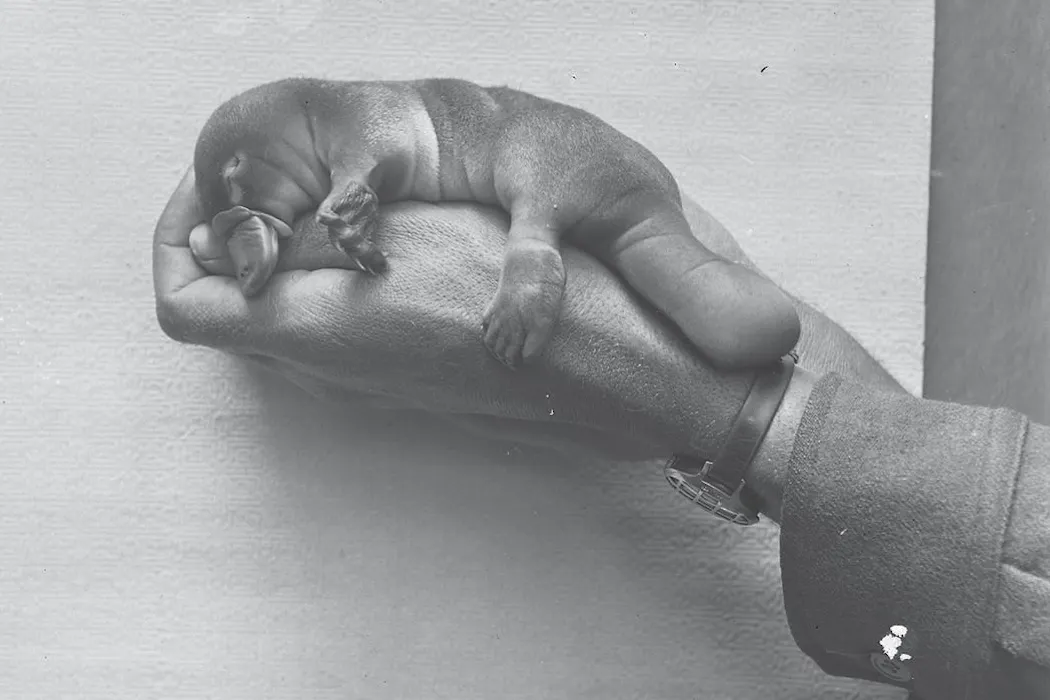
Burrell’s letters to museum curators in Australia and overseas reflect this tension. In them, he moves back and forth between asserting the scientific rigour of his findings, photographing puggles in egg cups, and giving himself titles such as “platypoditudinarian”.
The Burrells’ achievements remind us why a hard boundary between science and creative expression isn’t always helpful. By melding rigorous curiosity with a flair for the dramatic, the Burrells created innovative methods for exploring the natural world.
Perhaps science today could use a little more vaudeville.
Harry Burrell: The Platypus Man is on display at the Australian Museum until March next year.

The authors would like to acknowledge this piece was developed through research with Associate Professor Zoë Sadokierski, Dr Monica Monin and Dr Delia Falconer, as part of the ‘Beyond the Platypus Man’ project, funded by a 2025 UTS Collaboration Scheme grant.
Original source: https://analysis1.mil-osi.com/2026/09/28/meet-platypus-man-harry-burrell-he-transformed-australian-science-and-put-on-quite-a-show/