

Source: The Conversation (Au and NZ)
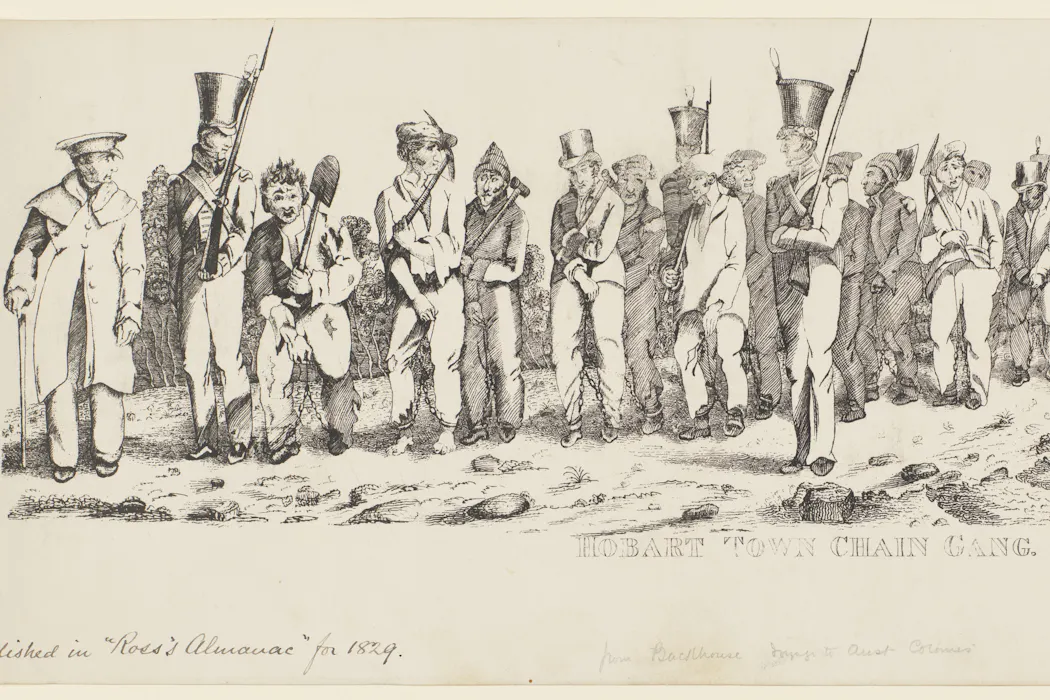
Convictism “left a stain” on Australia’s penal colonies “which time alone will be able to efface”, according to the South Australian Register newspaper in 1856.
Imagine the editor’s astonishment were he to witness the pride many Australians now have in their convict ancestry.
‘The dunghill of England’
Between 1788 and 1868, around 162,000 men, women and children were transported from across the former British empire to Australia’s penal colonies. Many were sent to New South Wales or Van Diemen’s Land, earning these colonies the name of “the dunghill of England”.
After transportation to the colony ended in 1853, Van Diemen’s Land changed its name to Tasmania because “Van Diemen’s Land is associated among all nations with the idea of bondage and guilt”. Changing its name was an attempt to salvage the colony’s tarnished reputation.
Many former convicts followed suit and changed their names too.

National Portrait Gallery of Australia. Purchased 2016
Edwin Rose served time at the Isle of Wight’s Parkhurst Prison for stealing two loaves of bread. The boy was later exiled to Aotearoa New Zealand. Rose got into trouble in 1845 for robbing houses and was one of more than 110 convicts transported from New Zealand to Van Diemen’s Land. In 1852 Rose went to Victoria where he changed his name to William Williams.
However, he remained hungry and was shot dead in 1863 while stealing a pig for food.
The last convicts arrived in the Australian colonies in 1868.
By the 1880s, newspaper commentary denigrated the “disgrace and pollution of a population descended from expirees and emancipists” – that is, ancestors who received tickets-of-leave or pardons from “the accursed and debased convict system”.
But some convicts became esteemed members of their communities, and, according to historian Alison Alexander, avoided the stigma of convictism by reinventing the past.
Former Parkhurst boy, Henry Butler Dowie, married and became a shop owner in Evandale, northern Tasmania. In 1865, he was elected to Evandale’s inaugural municipal council.
When Dowie died in 1889, he was remembered as “an old and respected resident” who “emigrated to Australia at the time of the first gold fever”.
Convicts became so good at this reinvention that, by the 1920s, most Australians descended from convicts had no idea about this history.
Shifts away from shame
But even in the 1920s, Australia’s forgetting was selective.
In 1923, some said there should not be any shame for the descendants of Irish Catholic convicts whose “gallantry and independence” had “brought them within the law”.
In 1926, when Marcus Clarke’s For the Term of His Natural Life was being filmed, a Melbourne commentator claimed:
Pride, and nothing less, should be our feeling toward these [convict] ancestors who had the big souls and the moral courage to drag themselves from the pit of criminality in which English justice had placed them!

Libraries Tasmania
Embracing family histories
The 1960s ushered in new ways of thinking about the past.
Rather than concentrating on Kings, Queens, and their like, a new wave of social historians explored how the lives of everyday people could reveal a lot about societies.
Alan Shaw’s 1966 book, Convicts and the Colonies, and Charles Rowley’s The Destruction of Aboriginal Society, published in 1970, transformed public understandings of Australia’s past.
Then, Australia’s bicentenary was a turning point.
Journalist Robyn Foster wrote about how in 1888 “our convict ancestry was cause for shame while [Aboriginal Australians] were treated with official disregard”. But, she wrote, by 1988 Australians were “proud of their convict links”.
Schools across Australia joined in the commemorations, where students and teachers dressed in historical costumes which featured “pint-sized convicts and soldiers”.

Ian Waldie/Getty Images
The tens of thousands of convicts transported to the Australian colonies were recast from incorrigible rogues and prostitutes to workers who built the nation’s foundations. Key convict sites across New South Wales, Tasmania, Norfolk Island and Western Australia were inscribed on the UNESCO World Heritage List in 2010. The associated paper records were added to the UNESCO Memory of the World International Register.
Ready access to the internet and millions of digitised records has since made family history available at people’s fingertips, and more and more Australians are discovering – and embracing – their convict family histories.
Uncovering hidden pasts
When I offered a course titled Convict Ancestors for the first time in 2016 as part of the University of Tasmania’s fully online Diploma of Family History, more than 1,000 students enrolled. Many explored their own convict ancestry. The few with no convict ancestors “borrowed” convicts from other students. Fascinating biographies resulted.
DNA is transforming family history. I took an Ancestry DNA test to satisfy my curiosity about my origins. Much to my surprise, it confirmed that my maternal two times great grandfather was not who our family thought he was.
I grew up with the Maclachlan tartan in the cupboard, and with a grandmother who exchanged letters with the clan chief. But John Maclachlan was not my biological ancestor. Instead, we are descended from George Landon-Lane.
Landon-Lane’s brother, Samuel, was a 19-year-old sawyer from Hereford, England, when he was transported to Western Australia in 1850 for 10 years for burglary and locked up in Fremantle Prison.
He later worked across various Western Australian goldfields before dying in Wyening, WA, in January 1920.
Almost 20 years after graduating with a doctorate in convict history, I can proudly claim a convict relative of my own.

Kristyn Harman receives funding from the Australian Research Council. She is Lead Chief Investigator on DP230100267 The Inception of Criminal Deportation in Colonial Australia. She is the President of Convict Women’s Press, and the Chair of the Cascades Community Advisory Committee for the Port Arthur Historic Site Management Authority. Kristyn was the inaugural Course Coordinator for the Diploma of Family History at the University of Tasmania.
Original source: https://analysis1.mil-osi.com/2026/09/27/from-disgrace-and-pollution-to-pride-how-australians-came-to-embrace-their-convict-family-ties/