

Source: The Conversation – UK
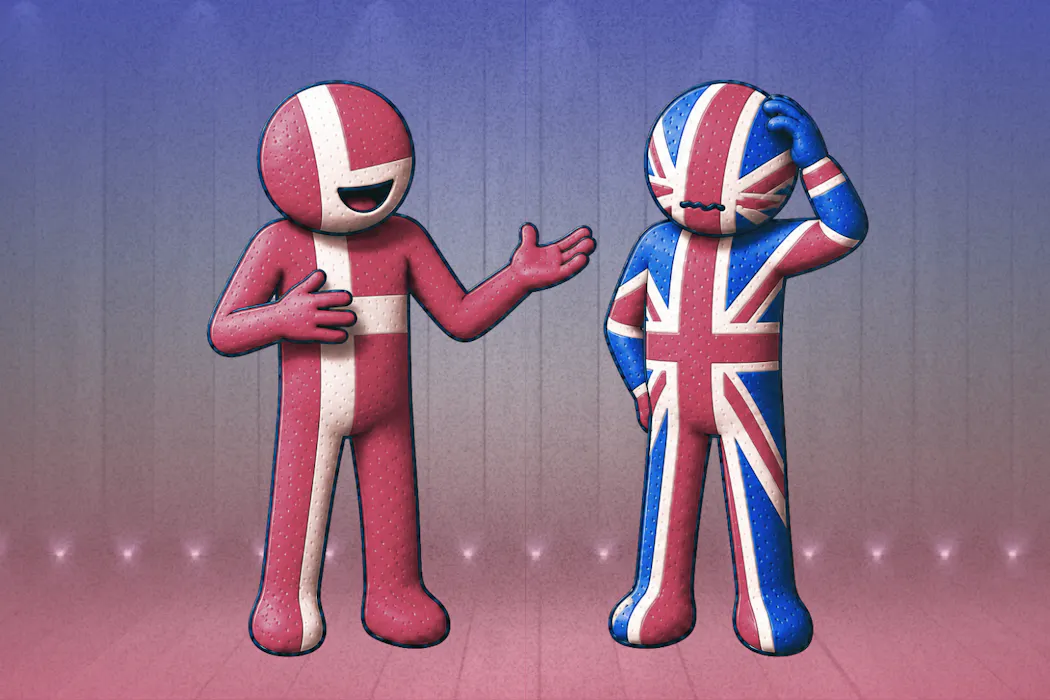
We all like to laugh. Not only is it entertaining and helpful for social bonding, but it also makes us feel good. When we laugh at something we find funny, our bodies release feel-good hormones.
Dopamine floods our system, which has an uplifting effect, and endogenous opioids, which are also naturally released by the brain, can make us feel euphoric.
But humour is often culturally specific. Anyone who has visited another country knows how alienating it can feel to experience another culture’s humour and not get the joke. Even if we may recognise it as humour, the things that make others cry with laughter can leave us uncomprehending.
I research humour, and I live in — and am from — Denmark. Separated by the North Sea yet still close neighbours, Denmark and the UK offer an interesting comparison when it comes to what makes us laugh.
Health Gap / Sundhedskløften is a collaborative series from The Conversation UK and Denmark’s Videnskab.dk exploring what the two countries can learn from each other when it comes to health and wellbeing.
From cycling and alcohol to inequality, healthcare and everyday habits, the series looks beyond hospitals and medical treatment to explore how culture, politics and society shape the way people live – and how healthy they are.
Urine stains vs subtle irony
Indeed, if you want to see culturally specific humour in action, just try watching clips from both the Danish and UK adaptations of the Amazon Prime programme LOL: Last One Laughing.
Here, famous comedians compete to make each other laugh, all while trying to keep a straight face themselves.
In the Danish adaptation, the comedians immediately turn to taboo and transgression, classic hallmarks of Danish humour. Within the first minute, one comedian rips off his pants and reveals a urine stain on his underwear. Sexual advances are made and topics of death and violence prevail. The comedians get up close in each other’s faces to provoke laughter.
By comparison, the British adaptation is a more dignified affair. Here, the comedians are at their best when dryly delivering quick, witty remarks or going off on ironic, absurd tangents.
Joe Wilkinson, for example, delivers an ironic, deliberately bland speech honouring the Royal National Lifeboat Institution. While Richard Ayoade, when asked about his celebrity crush, promptly names Boudica, the ancient British queen who led a failed uprising against the Romans.
What accounts for these differences? Research on humour and culture offers part of the answer.
Danish trust
Denmark is a tiny country, with a population a 12th the size of Britain’s. Historically and to this day, it has been characterised by a high degree of homogeneity, equality and social trust.
In relationships characterised by trust, we can be freer, more transgressive, even insulting in our humour. This is exemplified by the concept of banter, a big part of British culture as well, When two people have a good relationship, they can be mean to each other as a joke – each trusting that the other means no harm.
As Danish linguistics researcher, Lita Lundquist, has documented, internationals who work with Danes often report being shocked or offended by the topics Danes find appropriate to joke about in the workplace – and by the things that are said to them in jest.
When Danish comedy escapes the hermetic bubble of Danish culture, it often causes outrage abroad. Examples include a recent sketch about Greenland from a popular Danish comedy show. And perhaps most infamously, the Muhammad cartoons – a satirical project that caused one of the biggest crises in Danish international relations in recent history.
Although our free and transgressive humour is rightly a source of pride for many Danes, as it reflects a culture characterised by equality and trust, it can also have a downside when we are not aware of the boundaries of others who do not share our sensibilities.
British irony
British humour, on the other hand, proceeds from a culture that places greater emphasis on formality and restraint – and where there is a much bigger preoccupation with class differences and class markers. To this day, the British place greater emphasis on proper behaviour and good manners than the Danes.
This is reflected in the traits associated with British humour. Instead of being wild and outrageous, it is often understated and dry. Although the UK certainly has comedians known for telling offensive jokes, such as Jimmy Carr, the aim of British humour tends to be wit rather than shock.
In particular, Brits are known to pride themselves on their use of irony, an understated and subtle form that other nations are supposedly unable to properly decode or appreciate.
If a charge can be labelled against British humour, it might therefore be that it’s elitist and has a certain sense of its own superiority. Although Danish humour also has its problems, it is remarkably egalitarian in its offensiveness – the humour may be rude, but it is rude to everyone.
However, science does back up Brits’ presumption about the distinctiveness of their irony, at least in part. In one study, British participants found clips from British comedy series significantly funnier than US participants, apparently due to the fact that Americans did not appreciate the clips’ ironic and sarcastic elements to the same extent.
So while it’s the same mechanisms and feel-good chemicals that are triggered in us when we find something funny, what’s clear is that whether we laugh at urine stains, quick wit, or subtle irony, our laughter reflects the wider cultural norms and values that have shaped us.
This series was commissioned as part of a partnership between Videnskab.dk and The Conversation, where articles are published in English and Danish.

Marc Hye-Knudsen does not work for, consult, own shares in or receive funding from any company or organisation that would benefit from this article, and has disclosed no relevant affiliations beyond their academic appointment.
Original source: https://analysis1.mil-osi.com/2026/09/25/what-the-differences-between-danish-and-british-humour-can-teach-us-about-laughter/