

Source: The Conversation – UK
It is tempting to tell a tidy story in which people in Britain take too many pills because they exercise too little and eat too poorly, while Danes stay slim by cycling everywhere. The assumption is that Britain relies on medication to fix lifestyle failures, whereas Denmark relies on prevention.
But are Britons actually more medicine-dependent than the Danes? The honest answer is yes and no.
When it comes to the more routine maintenance of getting older – managing the physical wear and tear of the body – the two countries prescribe in remarkably similar volumes.
But where pills are sought to compensate for what society has failed to provide, Britain reaches for the prescription pad far more readily. And, crucially, the heaviest of that prescribing is concentrated in the UK’s most deprived communities.
Health Gap / Sundhedskløften is a collaborative series from The Conversation UK and Denmark’s Videnskab.dk exploring what the two countries can learn from each other when it comes to health and wellbeing.
From cycling and alcohol to inequality, healthcare and everyday habits, the series looks beyond hospitals and medical treatment to explore how culture, politics and society shape the way people live – and how healthy they are.
If you look purely at drugs prescribed to prevent disease, the stereotype of the overmedicated Briton falls apart.
Take heart disease. Around 13% of the Danish population are prescribed statins to lower cardiovascular risk. In the UK, the figure is nearly identical: the British Heart Foundation estimates 14 to 15% of adults take them.
This pattern holds for polypharmacy (taking multiple drugs regularly), too. Around half of all Danes aged 75 and over take five or more medicines a week; in England, the figure for the same age group is 51%.
So, a retired Dane and a retired Brit are taking roughly the same number of pills for chronic health conditions. Does this undermine the idea that Denmark prevents disease through lifestyle while Britain over-medicates? Not entirely.
Zoom out and the picture changes. In England alone, 1.26 billion prescription items were dispensed in 2024-25 – roughly 22 items per person, a 4% rise on the previous year. The equivalent Danish figure works out at around 13 items per person.
The UK government’s own reviews suggest around 10% of items dispensed in English primary care are overprescribed – meaning a medicine that isn’t needed, is no longer needed, whose harms outweigh its benefits, or that the patient would prefer to swap for a non-drug alternative.
So, if the two countries prescribe heart and blood pressure medications at similar rates, what’s driving Britain’s excess in volume? The answer lies in the drugs most directly tied to pain, anxiety and distress.
Prescribing for despair
The UK prescribes antidepressants at a rate well above the average across OECD countries, a club of mostly high-income nations. In England last year, over 92 million antidepressants were dispensed to nearly 9 million patients – roughly one in six adults.
In contrast, Denmark is the only country in Europe to have successfully reduced its antidepressant consumption in recent years, with a 4% decline between 2010 and 2020.
The story is similar for painkillers. In 2019, the UK had the highest overall opioid prescribing rate in the world. Danish opioid use has fallen by more than a third since 2010.
These are the medicines whose volume responds most directly to the conditions of people’s lives – used to treat chronic pain, mental distress and social isolation. Researchers and the UK Health Security Agency have linked rising prescribing of this kind to widening social and economic disadvantage. It is in these drug classes, rather than in cardiovascular disease or diabetes medicines, that the gap between Britain and Denmark opens up.

Yau Ming Low/Shutterstock.com
This national divergence is mirrored within the UK itself. Conditions like heart disease are more common in deprived areas, driven by higher rates of smoking, obesity, diet and polluted air, so it makes sense that more heart medicines are prescribed there too.
But the bigger gap – one that heart disease alone can’t explain – is in medications for pain, mood, anxiety and sleep.
Antipsychotics are dispensed nearly three times as often in the most deprived parts of England, compared with the least deprived. Opioid prescribing is roughly twice as high in the poorest areas, with nine of the ten highest-prescribing regions in the north of England.
Sleeping pills, anti-anxiety medications and nerve pain drugs are similarly concentrated in deprived populations. Public health officials explicitly link this dependence on prescription medicines to poverty.
Some researchers call this prescribing for “diseases of despair”. The trend aligns with a spike in suicides and alcohol- and drug-related deaths concentrated in these same communities over the last decade.
The illusion of autonomy
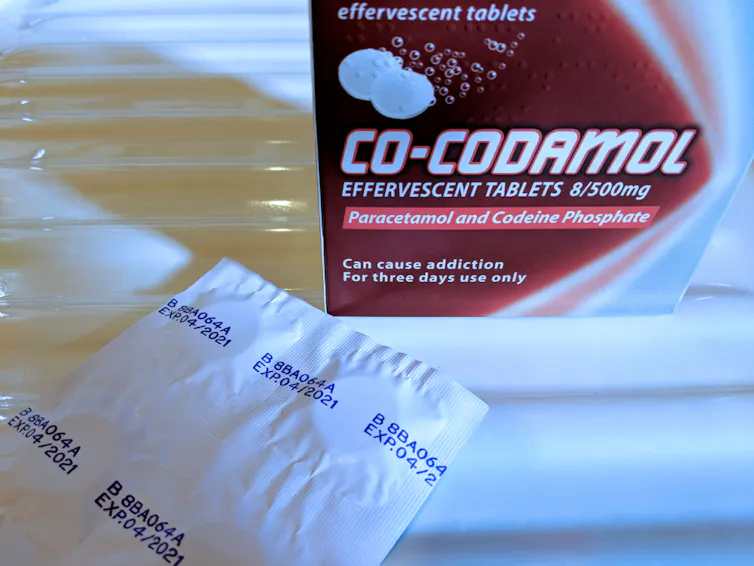
The cultural difference extends beyond the doctor’s office and on to supermarket shelves. In Britain, painkillers like paracetamol and ibuprofen are ubiquitous in corner shops and petrol stations. Co-codamol, a codeine and paracetamol combination, is the country’s second most dispensed painkiller, with millions of packs sold over the counter every year.
In Denmark, supermarket sales of basic painkillers are sharply restricted, and only a single weak codeine combination is available, kept behind pharmacy counters.
In the UK, this easy access is often framed as “patient autonomy” or “self-care culture”. But this framing obscures who bears the harm. When Britain restricted paracetamol pack sizes in 1998, overdose deaths fell by 43% and liver transplants caused by paracetamol poisoning dropped by 61%.
Eddie Jordan Photos/Shutterstock.com
Treating the symptoms of inequality
Britain’s higher prescription rates aren’t just about medicine – they’re rooted in how society is structured. Denmark’s lower use of drugs for pain and psychological distress can’t easily be explained by clinical guidelines alone – it points to the protective effect of stronger social foundations.
With less inequality, a stronger safety net and an environment built to support people’s wellbeing, Denmark simply has fewer of the conditions that hardship and poor surroundings tend to cause.
In the UK, the opposite is true. Over a decade of austerity, widening wealth inequality and fraying public health infrastructure have had profound consequences. Poverty, insecure housing and precarious work don’t just make life harder; they are reliable predictors of chronic distress and long-term illness.
The gap in healthy life expectancy between the richest and poorest in England has widened to 19 years. Extreme inequality manufactures disease, creating populations that inherently need more medication.
This is the practical dilemma of UK general practice. In deprived areas, depression, chronic pain and anxiety are often driven by adverse living conditions. Without the tools to directly alter a patient’s housing or income, reaching for an antidepressant or a painkiller is a rational response to help patients cope. Medical interventions are increasingly deployed to manage structural problems.
The concentration of the UK’s prescription volume in medications for pain and mood disorders suggests this is not a purely clinical issue, but the predictable consequence of widening health inequalities.
Denmark’s lower reliance on medication is not simply a lifestyle choice, but the outcome of deliberate investment in equality, housing and social protection. The comparison with Britain suggests that where these foundations weaken, prescribing rises to fill the gap – a reminder of what such systems help prevent.
This series was commissioned as part of a partnership between Videnskab.dk and The Conversation, where articles are published in English and Danish.

Philip Broadbent receives funding from The Wellcome Trust 223499/Z/21/Z
Original source: https://analysis1.mil-osi.com/2026/09/15/the-real-reason-britons-are-more-medicated-than-danes/