

Source: The Conversation (Au and NZ)
I first fell under the spell of David Hockney’s prints as a student of printmaking and life drawing. Australia had been my home for only a few years and I found a key to my experience of movement and growth in the series A Rake’s Progress (1961–63), completed after Hockney’s first journey from London to New York and back.
There was something about images such as The Arrival – with its promise of a new world, etched in floral plumes of red ink and spidery black lines dancing on the edge of incoherence – that felt so familiar.
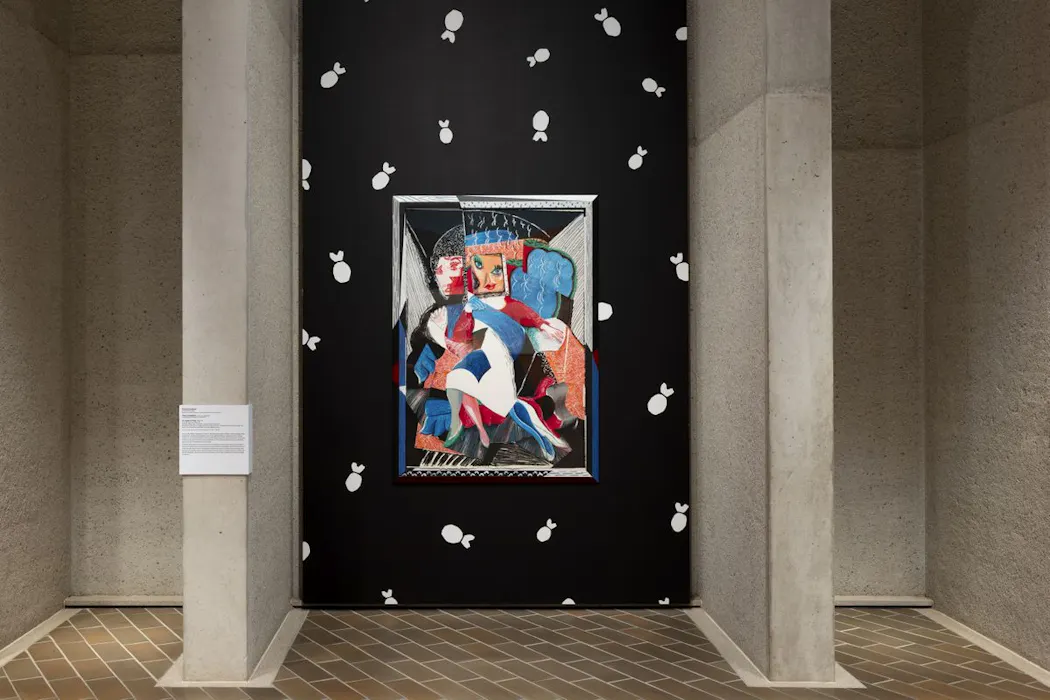
This feeling of familiarity resurfaced as I stepped into David Hockney: Portraits in Print at the National Gallery of Australia (NGA), which features images from that early series of etchings among more than 50 works.
Opening in the wake of Hockney’s death in June, Portraits in Print is an affectionately curated snapshot of three decades in Hockney’s six-decade career.
This is not the only Hockney show in Australia this year, with an “immersive” presentation of his work opening in Sydney in October. But Portraits in Print reveals a lesser-known side to an artist famous for colourful, light-filled paintings, such as Portrait of an Artist (Pool with Two Figures) and the 1960s Splash trio.
© Estate of David Hockney
Portraiture was a key element of Hockney’s practice, however, and the NGA exhibition showcases his ability to capture subtle expressions of self in all their diversity.
The NGA’s Hockney holdings are due in large part to the artist’s collaboration with master print maker Kenneth E. Tyler, who worked with some of the biggest names in the North American art world from the 1960s until 2001. Most of the works in Portraits in Print are drawn from the Kenneth E. Tyler Collection, founded in 1973 when the inaugural NGA director, James Mollison, purchased a set of proofs and drawings from Tyler’s celebrated Gemini G.E.L. print workshop.
Tyler himself appears in a standout lithograph and screenprint Hockney created in the same year, The master printer of Los Angeles, exuding quiet confidence in his aviator sunglasses and printer’s apron.
A master of intimate detail
Portraits in Print also showcases other printers and publishers who worked with Hockney. This is where the deeper appeal of the exhibition starts to emerge. Rather than the familiar eulogy to an individual artistic genius, it takes care to situate Hockney within a larger network of collaborators, friends and loved ones.
The image of Hockney this creates is one mediated through the people, places and moments of his life. Alongside collaborators such as Tyler, we are introduced to romantic partners (curator Gregory Evans, ceramicist Peter Schlesinger), close friends (curator and critic Henry Geldzahler, textile and fashion designer Celia Birtwell) and family (parents Kenneth and Laura Hockney).
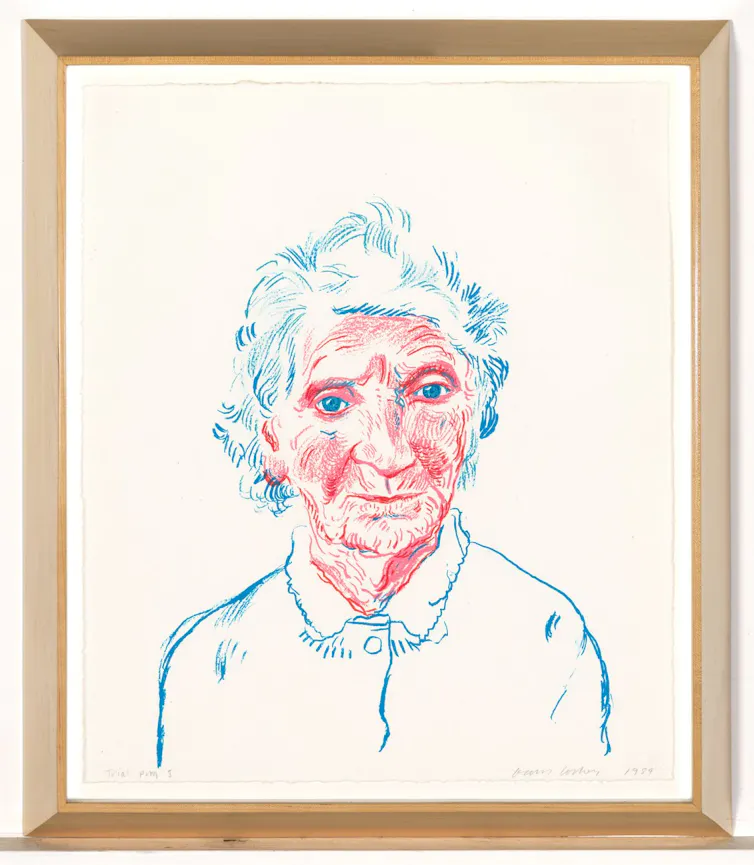
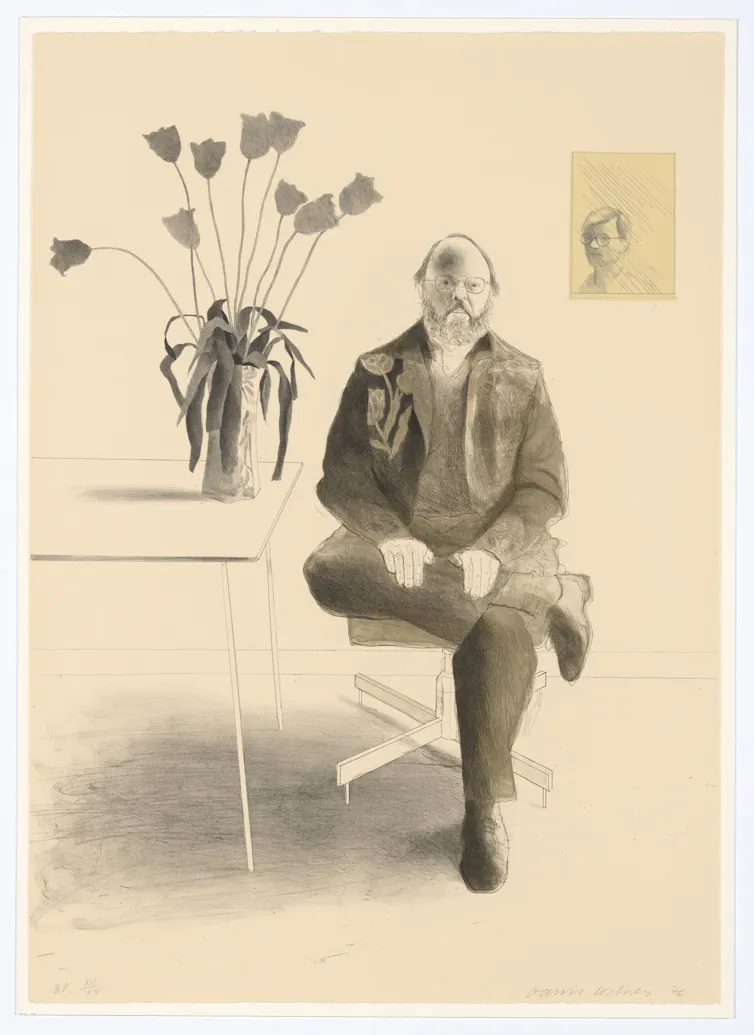
We see these figures through Hockney’s eyes, tracing their individual quirks over the years in a range of media, always with a keen attention to fleeting and intimate detail. Geldzahler’s receding hairline, in the wryly observed Henry with bald patch in the middle of his head (1977). The tender sketch of Laura Hockney’s lined yet enduring face, in Portrait of Mother III (1984–86). The sinuous contours that trace Evans’ youthful physique, in Gregory with gym socks (1976).
© Estate of David Hockney/Gemini G.E.L.
A constellation of influences
This charmed circle extends to Hockney’s artistic influences. Like many artists – but perhaps more self-consciously and deliberately – he felt compelled to study his sources so intimately that he would come to see the world through their eyes and live it through their techniques, gestures and forms.
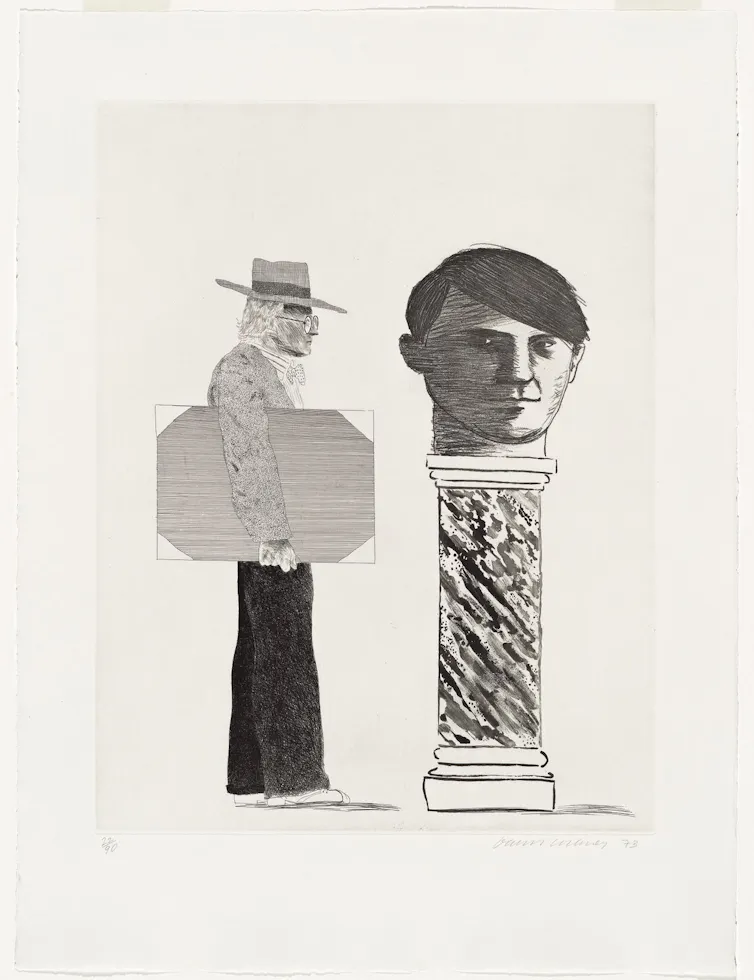
The student: homage to Picasso (1973), an early etching, gives an insight into this process. We see the artist, folio tucked under one arm, standing face to face with a larger than life monument to the Spanish master. Hockney has literally placed Picasso on a plinth, yet he remains at eye level. He studies the likeness intently, perhaps hoping to find a way through his outer features to an inner world.
© Estate of David Hockney
Picasso would remain an enduring presence within Hockney’s printmaking, evident here especially in the monumental collages An image of Gregory and An image of Celia, from the Moving focus series (1984–87), produced with Tyler Graphics.
In these works, Hockney inhabits the style of the old modernist master and makes it his own, working closely with Tyler to share his vision of his lover and his closest friend as vibrant and multifaceted individuals.
Portraits in Print invites us to do the same with Hockney himself. To see the world through his eyes, but also to see ourselves and our loved ones reflected in his work. He remains without a doubt the “people’s artist”, a connoisseur of the intimate, humble and ordinary, who valued connection above all as that which most makes us human.
David Hockney: Portraits in Print is on display at the National Gallery of Australia, Canberra, until February 14 2027.

Alex Burchmore does not work for, consult, own shares in or receive funding from any company or organisation that would benefit from this article, and has disclosed no relevant affiliations beyond their academic appointment.
Original source: https://analysis1.mil-osi.com/2026/09/15/david-hockney-portraits-in-print-reveals-lesser-known-aspects-of-the-celebrated-artist/