

Source: The Conversation – UK
For decades, Sweden has fostered a self-image as something of a world record-holder for peace, celebrating more than two centuries since it was last at war. But this record involves some creative accounting. The narrative, for example, excludes Sweden’s participation in modern-day military operations in Afghanistan and Libya.
Nor has Swedish “peacefulness” been entirely pacifist. The country operated one of the world’s largest air forces during the cold war, for example. But less well known is how far Sweden progressed towards developing nuclear weapons of its own. Despite never producing a bomb, the history of its unrealised nuclear weapons programme offers important insights for understanding security policy today.
Back in 1945, just months after the US had dropped nuclear bombs on the Japanese cities of Hiroshima and Nagasaki, Swedish military researchers began investigating this new weapon. In 1948, the defence staff asked the Swedish National Defence Research Institute (FOA) to examine the possibility of producing atomic bombs in Sweden.
We think we know Sweden – a peaceful nation grounded in social democracy, natural beauty, IKEA and Abba. But in 2026, is this still the real Sweden? Ahead of the country’s general election on September 13, The Conversation UK has teamed up with its Swedish partner universities for a series of articles examining why this small nation remains so fascinating.
The plans progressed rapidly. During the 1950s, FOA – with assistance from the state-owned nuclear energy company AB Atomenergi – conducted detailed studies of nuclear reactions and bomb design. Experimental facilities were built. By the mid-1950s, Swedish researchers believed they knew enough to construct a bomb.
Historian Thomas Jonter has argued that Sweden achieved a “latent” nuclear weapon capability. The main obstacle was access to weapons-grade plutonium and the industrial infrastructure needed to produce it.
Why would Sweden want nuclear weapons?
Behind Sweden’s determination was deterrence. Since the country’s principal strategic threat came from the Soviet Union, and since Sweden could never match Soviet conventional forces, nuclear weapons seemed to offer something compelling for a small state: the possibility to inflict disproportionate damage on a much stronger enemy.
By the end of the 1950s, the commander of the armed forces and much of the military establishment supported the idea. The defence minister and large parts of the political opposition were also in favour. Prime minister Tage Erlander was (cautiously) in favour but for years the issue was deliberately left unresolved. The government refrained from making a commitment, while the military kept its research and technical competence up to scratch in order to to keep the door open.
Opposition, however, grew rapidly. The Federation of Social Democratic Women and the party’s youth wing (SSU) were staunch critics, and foreign minister Östen Undén opposed the programme from within government. Writers, academics and peace activists mobilised external opposition.
Their campaign exposed what many saw as the dark logic of deterrence. If Sweden intended to use nuclear weapons, it had to assume that nuclear weapons would also be used against it, perhaps in a pre-emptive strike.
By the early 1960s, domestic opposition was reinforced by a changing international environment. Negotiations for arms control advanced, and the US opposed proliferation. At the same time, Swedish leaders received informal guarantees from the US in the event of a Soviet attack, which reduced the strategic case for a Swedish bomb. By the mid-1960s, the plans had effectively been abandoned, and when Sweden signed the Nuclear Non-Proliferation Treaty in 1968, the door finally closed.
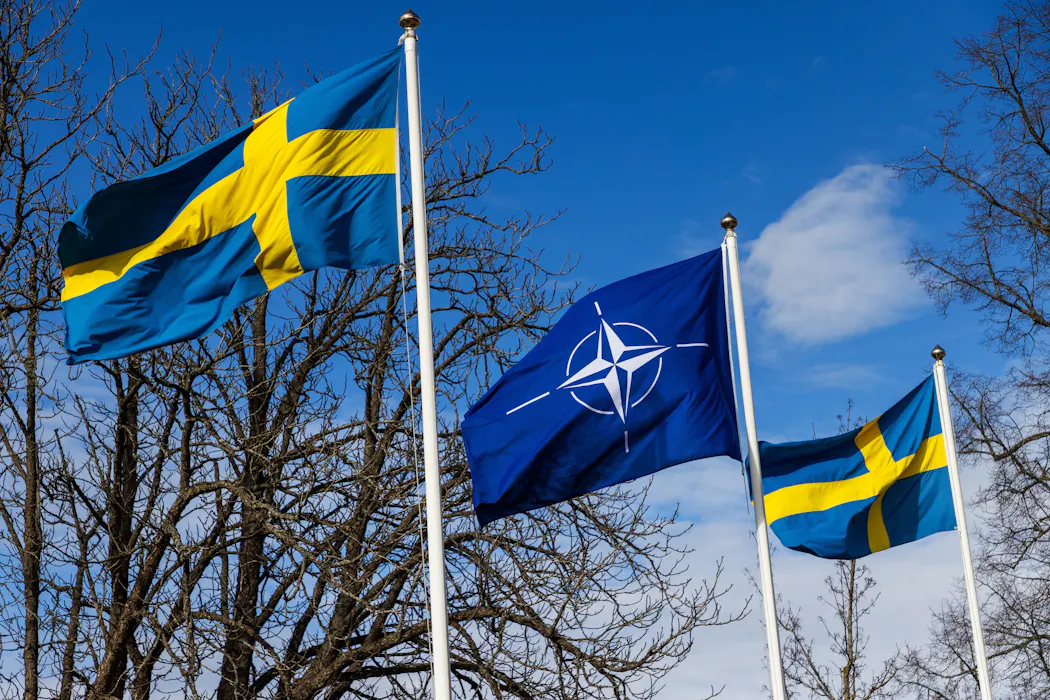
But Russia’s full-scale invasion of Ukraine in 2022 transformed Swedish security policy, culminating in Nato membership in 2024 along with rapidly rising military expenditure. It has also changed Sweden’s relationship to nuclear deterrence. For Nato, nuclear weapons are a central component of its deterrence strategy.

Jeppe Gustafsson/Shutterstock
The consequences are already noticeable in Swedish defence planning. The government’s defence policy for 2025–2030 states that Sweden is now part of Nato’s nuclear deterrence and must participate actively in the alliance’s work in this field. It also calls for Sweden to build knowledge about the role and function of nuclear weapons, echoing the build-up of knowledge from the early cold war.
This time, Sweden has no plans to build its own nuclear weapons – but the developments bring renewed attention to that dark logic of deterrence. After all, nuclear weapons promise security by threatening potential enemies with destruction.
One particularly sensitive question concerns the possibility of stationing nuclear weapons on Swedish territory. Sweden joined Nato without a formal domestic decision on this matter, although the government has stated that it sees no reason to do so in peacetime. For now, the issue is hypothetical.
But history suggests that it may not remain so forever. Seventy years ago, the prospect of Swedish nuclear weapons provoked fierce political conflict and public protest. If nuclear weapons were ever to be based on Swedish territory, the controversial idea of deterrence might stir emotions once again. Provided, of course, that the plans become known to the public.

Björn Lundberg leads two research projects funded by the Swedish Research Council: “Preparing children for war: Swedish preparedness education in transition 1945–2000” (No. 2024-05475) and “Children’s rights and participation in Swedish civil preparedness” (no. 2025-03604).
Original source: https://analysis1.mil-osi.com/2026/09/09/peaceful-sweden-once-sought-nuclear-weapons-that-legacy-still-shapes-defence-planning/