

Source: The Conversation (Au and NZ)
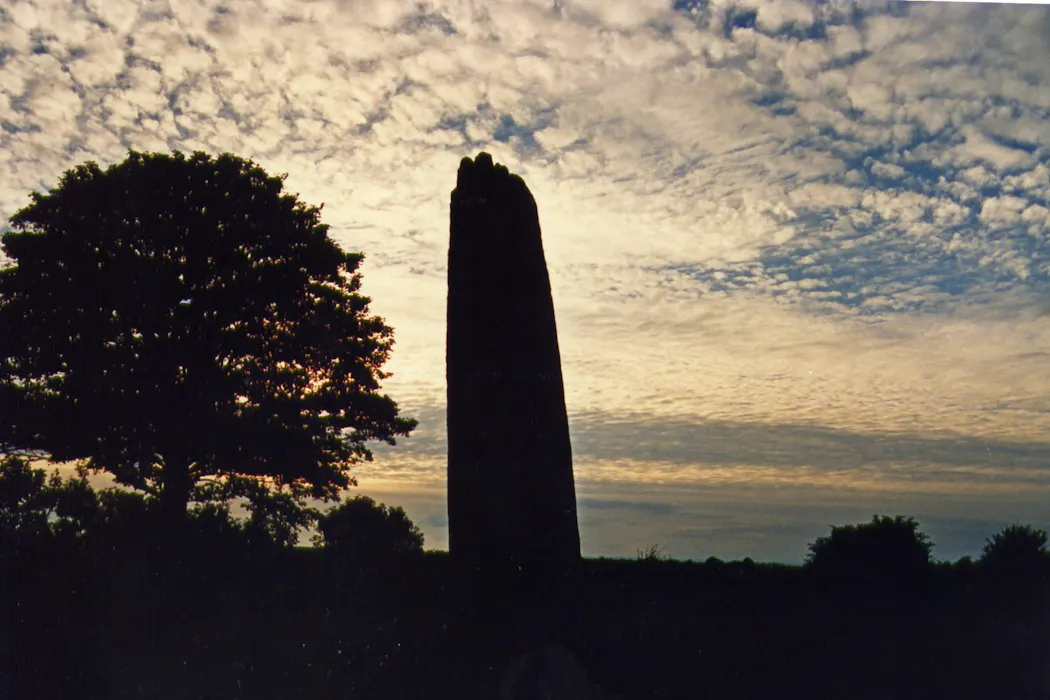
Long ago, the Devil stood on Howe Hill and hurled giant stones towards the town of Aldborough, roaring:
“Borobrigg keep out o’ way, for Auldbro’ town I’ll ding down!”
Fortunately for Aldborough, his aim was poor. The stones fell short, landing outside Boroughbridge instead, where they became known as the Devil’s Arrows. Or so an old Yorkshire legend tells us.
It is a dramatic explanation for one of Britain’s most extraordinary prehistoric monuments: three enormous megaliths, rising to seven metres high and weighing about 25 tonnes each. Together, they form the tallest surviving stone alignment in Britain.
More than 300 years after this legend was first recorded, new evidence points to a rather different explanation for where the stones came from. In research published in Proceedings of the Royal Society A, we traced the geological source of the Devil’s Arrows to an unexpected place about 18 kilometres west of Boroughbridge.

Gordon Hatton/Wikimedia, CC BY-SA
‘Waxing’ the stones
Geologists had long recognised the Arrows as being Millstone Grit, a tough sandstone that forms dramatic outcrops across the nearby Pennine Hills. But the rocks beneath Boroughbridge are completely different, so the Arrows must have come from elsewhere.
Plumpton Rocks seemed the obvious source: just 13 kilometres away, its weathered Millstone Grit bears a striking resemblance to the Arrows. But rocks that look alike are not necessarily from the same place. To identify their source, we turned to microscopic mineral grains locked inside the stone.
How do you sample a protected prehistoric monument that cannot be cut, hammered or drilled?
We pressed strips of tape onto small, inconspicuous areas of each stone. When peeled away, the tape revealed microscopic mineral grains. So, in essence, we “waxed” the Devil’s Arrows.
Even tiny minerals can preserve clues to a rock’s origin. Grains of zircon, in particular, are remarkably durable and can survive repeated cycles of erosion and deposition for billions of years.
By measuring the ages of the minerals we caught on our tapes, we could build a distinctive “fingerprint” and compare it with rocks from possible source areas.

Adam Morgan Ibbotson
A surprising match
Northern England looked very different 320 million years ago. Imagine a vast river delta, something like the Ganges–Brahmaputra today, with powerful rivers constantly shifting course and dumping sand and gravel.
These sediments eventually hardened into the Millstone Grit. Swept along with the sand were tiny zircon crystals eroded from much older rocks.
We analysed over 400 mineral grains from the Devil’s Arrows. All three megaliths produced similar age patterns, suggesting they came from the same geological source.

Adam Morgan Ibbotson
Among the grains we found in the Arrows were zircon ranging from about 377 million to an astonishing 3.7 billion years old. Some likely originated in Greenland, where some of the oldest surviving rocks on Earth are exposed.
We then compared the Devil’s Arrows fingerprint with potential sources from the surrounding Pennine Hills. The result was surprising. Plumpton Rocks did not match. Brimham Rocks did.
Brimham Rocks is a striking, almost otherworldly landscape. Weathering has sculpted the Millstone Grit there into huge towers, overhangs and strangely shaped blocks, some naturally eroded into forms resembling the Devil’s Arrows themselves.
The landscape also reveals traces of prehistoric activity. Just west of Brimham, a three-metre-long gritstone is decorated with cup-and-ring rock art, while faint cup-like markings can also be seen at the base of the northernmost Devil’s Arrow.
Importantly, Brimham is farther away than other Millstone Grit outcrops. The people who built the Devil’s Arrows did not simply take the nearest suitable stone.
Instead, they appear to have selected material from a particular landscape and gone to considerable effort to move these enormous blocks 18 kilometres to Boroughbridge.

Author provided
The missing arrow
Our analysis also revealed that one of the missing Arrows may have been hiding in plain sight for centuries. Historical accounts suggest the alignment once contained more stones, which were later broken up or removed.
The 5.5-metre Battle Cross in nearby Aldborough had been suspected of being fashioned from a lost Devil’s Arrow. The monument commemorates the 1322 Battle of Boroughbridge and was probably created in the 15th century.
Mineral grains from the monument share the same geological fingerprint as the surviving Arrows, supporting the idea that one of the missing megaliths survived by being given a new life as a medieval monument.

Mtaylor848/Wikimedia, CC BY-SA
A practical choice?
Why Brimham mattered to prehistoric people is a harder question to answer. Its unusual rock formations may have made it significant in its own right, while natural fractures in the gritstone produced large, elongated blocks well suited for extraction as monoliths.
The choice of Brimham may therefore have combined practical considerations with the meaning attached to a distinctive landscape.
Our findings add to growing evidence from places such as Stonehenge, Orkney and Newgrange that prehistoric communities did not always choose stone simply because it was nearby.
Particular places and the rocks that came from them could matter enough to justify extraordinary efforts to move them.

The authors do not work for, consult, own shares in or receive funding from any company or organisation that would benefit from this article, and have disclosed no relevant affiliations beyond their academic appointment.
Original source: https://analysis1.mil-osi.com/2026/09/08/taller-than-stonehenge-the-mysterious-devils-arrows-yield-their-secrets-in-new-research/