

Source: The Conversation – USA (2)
The color of penguin poop, as seen from space, is offering a new window into how the ecology and the environment of Antarctica are changing over time.
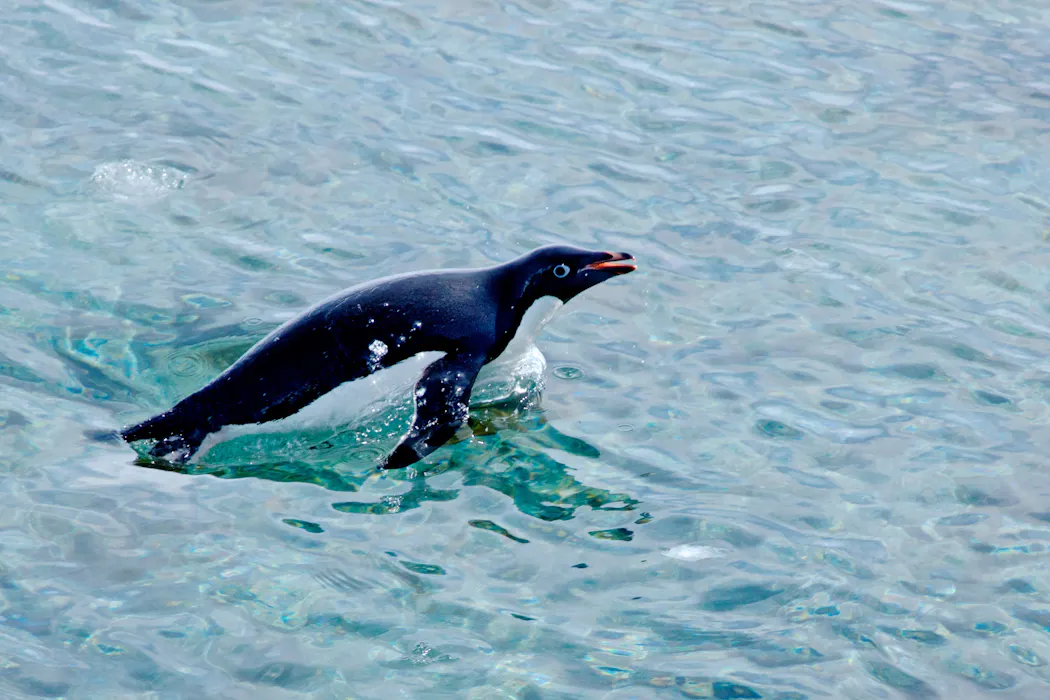
Adélie penguins are one of the most abundant predators in the Southern Ocean. They rely on food sources in the ocean, but nest on rocky outcrops all around the Antarctic continent.
Penguin colonies often have hundreds of thousands of nesting birds, which generate a lot of guano – so much so that it can be readily identified from space, using NASA’s Landsat satellites.
A multidisciplinary group of scholars that I led has used thousands of satellite images dating as far back as the 1980s to examine these patches of penguin guano, to reveal what these birds are eating and how changes in the environment are affecting their diets – which also affect their survival.
In particular, we found that when there is an abundance of sea ice at a colony, Adélie penguins there tend to rely more on small fish. When there is less sea ice, they depend more on krill, which are small shrimplike crustaceans.

NASA Earth Observatory/Michala Garrison
The color of food
Krill have a pink exoskeleton that penguins don’t fully digest, which contributes a rosy shade of pink to their guano. It is the color of guano that we can use to determine what penguins are eating.
This approach relies on a quantitative approach we developed that examines guano color and links that to the share of a penguin’s diet that is krill.
To develop the linkage, we collected penguin guano at several locations. With a spectrometer, we determined the color of each sample as a satellite would see it. This was done in a small makeshift lab on a ship in the Antarctic, which likely smells of penguin guano to this day. We analyzed what was in this guano, using tools from environmental chemistry, to determine the diet that had generated that color of guano.

Casey Youngflesh, CC BY
That information, along with some statistical modeling, allowed us to determine what penguins are eating based on the color of their guano as observed from satellites. More broadly, it provides a window into what is happening in the larger Antarctic marine food web – information typically hidden under the surface of the Southern Ocean. To our knowledge, this is the first effort to directly monitor what animals are eating from space.

Thomas Sayre-McCord/WHOI/MIT, CC BY
Using information from around 4,000 satellite images, we looked at how penguins’ diets varied over both time and space. We found that penguins do eat different things across the Antarctic continent, and that what they eat varies both across the year as well as from one year to the next.
Links between sea ice, food webs and penguin populations
Our data reveals how climate change is shifting penguins’ diets and how the Antarctic food web as a whole is changing.
Since the 2010s, sea ice has declined precipitously around the continent, with several years setting new historical sea ice minimums. Less sea ice means fewer fish, which is bad news for penguins: Adélie penguin chicks are typically heavier when fed fish as opposed to krill, and heavier chicks are more likely to survive into adulthood.
Our findings indicate that in locations where penguins eat less fish, the number of penguins has declined over the past few decades across the species’ entire range. By contrast, penguin colonies that eat more fish are more likely to be stable or increasing.

Michael Polito, University of California Santa Cruz, CC BY
Unfortunately, large-scale declines in sea ice are projected to continue into the future. Adélie penguins are also now facing increased competition for fish and krill from other marine life and from humans.
For example, in the Antarctic Peninsula region, the area directly below South America, baleen whale populations, which feed largely on krill, have rebounded substantially since the end of commercial whaling decades ago. Gentoo penguins are shifting their range from the sub-Antarctic southward to the Antarctic as the climate warms, adding to the numbers of predators hunting in those waters.
Fishing trawlers are also now harvesting large quantities of krill to be used in fish feed and human dietary supplements, which may put additional pressures on Adélie penguins in these regions.

Michael Polito, University of California Santa Cruz, CC BY
The power of big data
Only by using thousands of satellite images could our research team understand how Adélie penguins’ diets vary across the range of the species, how it shifts over the seasons, and how it is responding to a changing environment over the past several decades.
Information from satellites is particularly valuable for remote and hard-to-reach areas like Antarctica’s penguin colonies, as other methods of collecting this data would take massive amounts of personnel, planning and travel and survival logistics.
As satellite technologies continue to improve, with increasing resolution, shorter intervals between images and new sensors for collecting information, there are opportunities to fundamentally change how we monitor some wildlife, providing critical information about how the world is changing and how humanity might respond to these changes.

Casey Youngflesh receives funding from NASA.
Original source: https://analysis1.mil-osi.com/2026/09/03/satellite-images-show-how-penguins-diets-are-changing-in-response-to-antarctic-climate-change/