

Source: The Conversation – Canada
A seismic shift in American geopolitics explains the breakdown in United States-Canada trade relations. Understanding U.S. security policy is critical as Canada faces stark choices.
The Donald Trump administration’s 2025 National Security Strategy (NSS) appears to mark a sharp break in U.S. foreign policy. It explicitly rejects the U.S.-enforced, rules-based international order and liberalized trade regime that has guided American foreign policy since 1945.
Read more:
Venezuela attack, Greenland threats and Gaza assault mark the collapse of international legal order
It resurrects, instead, longstanding and deeply rooted isolationist and protectionist ideologies that have shaped much of the history of American foreign policy. But, it also asserts the “Trump Corollary” to the Monroe Doctrine.
The legacy of the Monroe Doctrine
Since its creation by President James Monroe in 1823, the Monroe Doctrine has been a mainstay of American foreign policy. It asserts the exclusive right of the U.S. to expel any perceived foreign threats from the Western Hemisphere. But it also claims the right to intervene in any hemispheric country whose domestic affairs present a threat to American security interests.
The 2026 capture of Venezuelan leader Nicolás Maduro is ostensibly the most recent example, as far as the Trump administration is concerned. But the list is long.
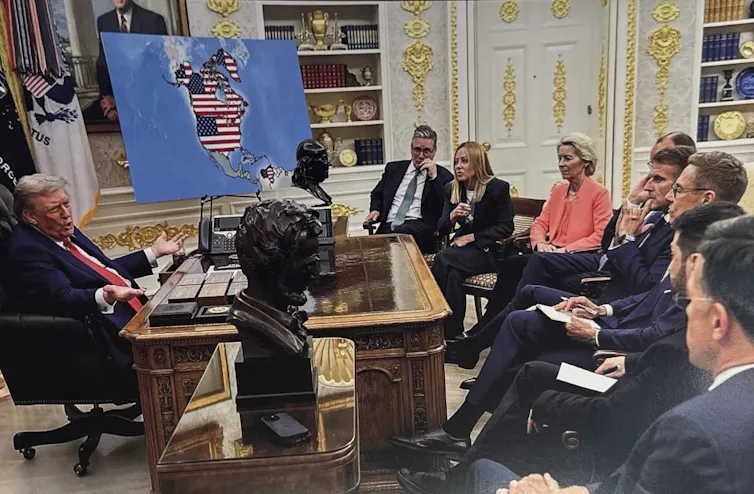
(Donald J. Trump via Truth Social)
In its application of the Monroe Doctrine, the U.S. has always looked south; now, it’s looking north too. This is a seismic shift.
American international relations over the past 80 years were hardly perfect. The U.S. often violated its own rules of the game. There was, however, strong political and economic co-operation among OECD and NATO countries.
For Canada and the U.S., this was a period of deepening integration through NORAD (1957), the 1965 Auto Pact, the 1972 Great Lakes Water Quality Agreement, the 1988 Canada-U.S. Free Trade, and the 1991 Canada-U.S. Air Quality Agreement, known as the acid rain treaty. This era is vanishing rapidly.
The world is now entering an era in which hegemonic nations strive to assert domination in their respective spheres of influence. As the 2025 NSS argues:
“The outsized influence of larger, richer, and stronger nations is a timeless truth of international relations.”
The U.S. has made clear it no longer plans to conduct its affairs with allies as first-among-equals. Instead, might makes right.
History of expansionism
The Trump Corollary should concern Canada given the importance of energy and mineral resources. The 2025 NSS expressly references the need for “expanding American access to critical minerals and materials.”
The Trump administration also sees hemispheric resources as geopolitical assets for the U.S. to own and control: “Strengthening critical supply chains in this hemisphere will reduce dependencies and increase American economic resilience.”
The recent agreement that gives the U.S. controlling ownership of billions of barrels of Venezuelan oil production is a case in point.
Read more:
American revolution 2.0: how Trump has changed the US, and why it was powerless to stop him
It’s important to remember that the territorial expansion of the U.S. is the history of land purchases and conquest. The Louisiana Purchase and the Alaska Purchase are famous. So, too, is the Mexican Cession, the relinquishment of more than half of Mexico’s territory to the U.S. in 1848.
The U.S. continued to acquire more territory in the 20th century, including the 1917 purchase of the Virgin Islands from Denmark. The American effort to purchase Greenland from Denmark in 2026 is consistent with historical U.S. expansionism.
Economic warfare
Canada and Greenland are both integral parts of the Western Hemisphere. Both have significant energy and mineral resources the U.S. needs and wants. The constant references to Canada as the 51st state and to the Canada-U.S. border as “artificial” are not bluster. Canada and Greenland are both in the Trump administration’s crosshairs.
Read more:
Trump’s Lake Ontario bluster: Why treating his sovereignty threats as a joke is dangerous
The U.S. is fully aware, however, that these ambitions aren’t possible to achieve immediately. Therefore, it’s weaponized tariffs against Canada for the purpose of breaking the country economically in the short term. Canada as the 51st state is the desired option; Canada as a “Venezuela North” is the acceptable second choice. Economic warfare, therefore, is the continuation of American geopolitics by other means.
Concluding a fair trade deal with Canada was never on offer from the U.S. While the 2025 NSS speaks to “fair, reciprocal trade deals,” it makes clear that “our priorities must and will be our own workers, our own industries, and our own national security.”
The goal to “re-shore industrial production” is a national security imperative, not an economic preference.
This is why Trump is weaponizing tariffs. It’s the tactic of choice to kill the auto industry and wound other key sectors in the Canadian economy. The geopolitical goal is clear.
Those who place hope in the November mid-term elections or a future Democratic presidency will be disappointed. Let’s not forget the Joe Biden administration actually doubled the Trump tariff rate for Canadian softwood lumber.
How Canada must fight back
Canada is now on war footing, so it’s taking steps to buttress the economy against a potentially long economic war.
Geopolitics has implications beyond trade. Interdependence in trade with the U.S. has placed Canada in an extremely precarious position; military co-operation is no less fraught. In February 2026, the U.S. paused participation in the U.S.–Canada Permanent Joint Board on Defence, which had operated uninterrupted since 1940. Even NORAD looks increasingly untenable.
Realistically, fighter aircraft, submarines, naval vessels and armaments need to be produced in Canada or purchased from — or jointly produced with — Nordic, European and Korean allies and reliable partners.
Norway and Finland have learned to live beside Russia. Canada will now have to live “with clear eyes” beside a hegemonic United States.

Greg Poelzer was a Liberal candidate in the 2025 federal election in the riding of Saskatoon University.
Original source: https://analysis1.mil-osi.com/2026/08/31/trumps-geopolitical-aims-not-economics-are-behind-his-trade-hostility-towards-canada/