

Source: The Conversation (Au and NZ)
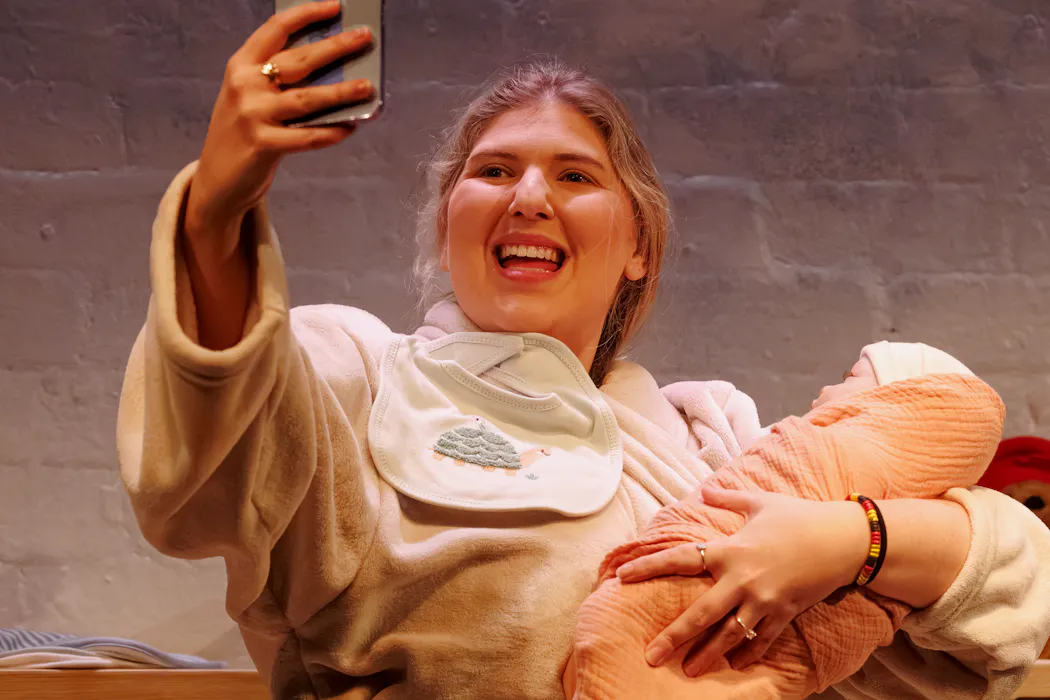
Mum Club is a much-needed narrative for our stages.
Contemporary motherhood is at once hyperconnected (so many WhatsApp groups!) and isolating. This is all the more keenly felt by our lovable protagonist, Sadie (Stephanie Somerville), a young Martu mum from Boorloo/Perth recently moved to Sydney’s Inner West.
Her partner is travelling (a lot) more than she anticipated, her family lives far away, and she is alone navigating the potent – and often contradictory – cocktail of emotions that accompany new motherhood. There is the overwhelming love for her baby Yaala, stress, sleep deprivation, loneliness, sex dreams, and the unbelievable pain of blocked breast ducts.
She joins a mum club to find community and connection. The journey is not straightforward.
The mums in the group are white, and they seem to be handling things much better than her. Eventually their performative facade that “everything is fine” comes thrillingly – and hilariously – undone.
Racism and sexism in Australia
Written by Jorjia Gillis and directed by Ian Michael, Mum Club begins post-Yaala’s birth, with Sadie lying with her legs in stirrups on a gurney while medical staff in scrubs examine her.
We witness a medical system that is hostile and judgemental towards an Aboriginal woman’s birth experience, demonstrated by the overzealous and entitled ignorance of the midwife (Alex Malone) and complete apathy of her trainee (Zarif).
The tone is satirical and comedic, but an unnerving combination of fear-based communication and racism underpins the medical staff’s interaction with Sadie. This sets the stage for a production that faces confronting truths about racism and sexism in Australia and the way they intersect for Aboriginal women.
The active-wear-clad white women at the mum club are insufferable.
One mum (Alex Malone) boasts of being from Bondi and moving to the Inner West “for love”, and that her baby sleeps eight hours a night.
Another (Ruby Teys) makes jaw-droppingly racist comments, packaged in the obsequious falsity of “inclusion”. She constantly draws attention to Sadie’s Aboriginality, othering her. She wants to have a special edition of mum club focused on Sadie for NAIDOC week – one of many violences enacted by the white women in the group, wrapped in purportedly good intentions.
Sadie makes a more genuine connection with the one (gay) dad in the group (Zarif), but her attraction to him confuses her.
A visceral production
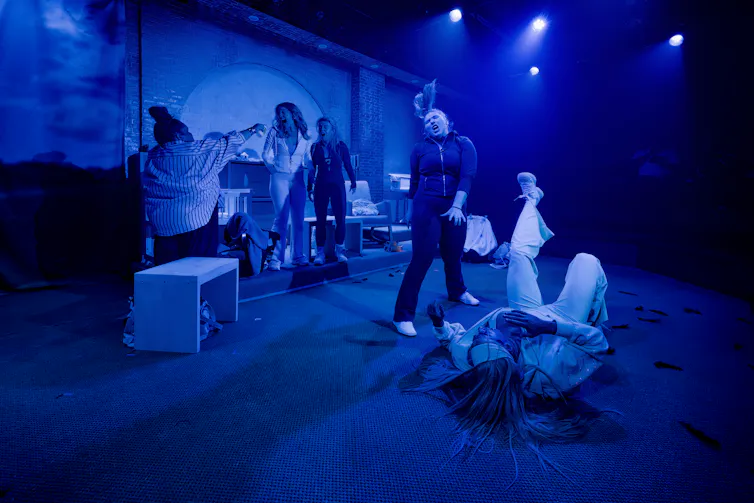
Cris Baldwin’s set demonstrates a deft imagination in Downstairs Belvoir’s intimate space, shifting between Sadie’s home, the park where the mum club gathers and the Aboriginal Health centre in Redfern.
A carpeted platform upstage demarcates Sadie’s home. Here, she navigates many sleepless nights, makes desperate FaceTime calls to faraway family for support, and has the occasional erotic dream. Sadie winces every time she sits in her nursing chair.
As a mum myself, I felt it viscerally in my own body.
The play does not shy away from taking us into a world where the experience of motherhood carries multitudes; an experience that is too often made invisible, flattened out, sanitised, de-eroticised and whitewashed.
The friendship that emerges between Sadie and the receptionist (a captivating Megan Wilding) of the Aboriginal Medical Service demonstrates the power of Blak sisterhood.
Wilding is an actor in complete command of her craft. She manoeuvres between expertly delivered comic timing and assertive political resistance in her everyday interactions. Her and Sadie’s relationship, and the chemistry between the actors, contrasts with the superficial and competitive ways the white women in the mum club relate to each other.
Zarif’s stark transition between characters – gay dad, hyper-hetero delivery guy, eroticised romantasy “crow man”, buxom Mosman mum – shows their powerful adaptability as a performer.
Lighting designer Verity Hampson punctuates scene transitions with abrupt blackouts, coupled with sudden, loud, pulsing sound design by Brendon Boney.
Phil Erbacher/Griffin
A necessarily confronting play
White women in Australia benefit from white race privilege. Aileen Moreton-Robinson’s 2000 book Talkin’ Up to the White Woman makes abundantly clear that, in white feminism, “whiteness remains invisible, natural, normal and unmarked”.
Gillis’ Mum Club is a nuanced, hilarious and necessarily confronting play that makes this invisibility powerfully visible, highlighting pervasive, unchecked whiteness’ harmful impact on Aboriginal mums.
The play shows both the damaging legacies of white feminism, and the beauty of community and connection shared between Aboriginal mothers.
At times the performances by the white women leaned into caricature, whereby the subtle nuance of the dialogue was played for laughs rather than allowing for the politics of racist microaggression to resound and hit harder.
In this propulsively paced production, more spaciousness in the scenes may have highlighted the warped sense of time experienced by new mothers, allowing the tedium to be part of the texture of the performance providing greater contrast to the fast-paced comic delivery throughout.
Mum Club is a lively, enthralling production that stages a much-needed story for our times about Blak motherhood. It addresses the enduring and damaging legacies of colonisation and white feminism, and the power and necessity of cultural connection for Blak mums in an increasingly disconnected world.
Mum Club is at Belvoir Downstairs, Sydney, for Griffin Theatre until September 20.

Charlotte Farrell’s research is funded in part by the Australian Research Council Discovery Program (project number DP260102365) funded by the Australian Government.
Original source: https://analysis1.mil-osi.com/2026/08/31/mum-club-is-a-necessarily-confronting-play-and-a-tribute-to-blak-motherhood/