

Source: The Conversation – Canada
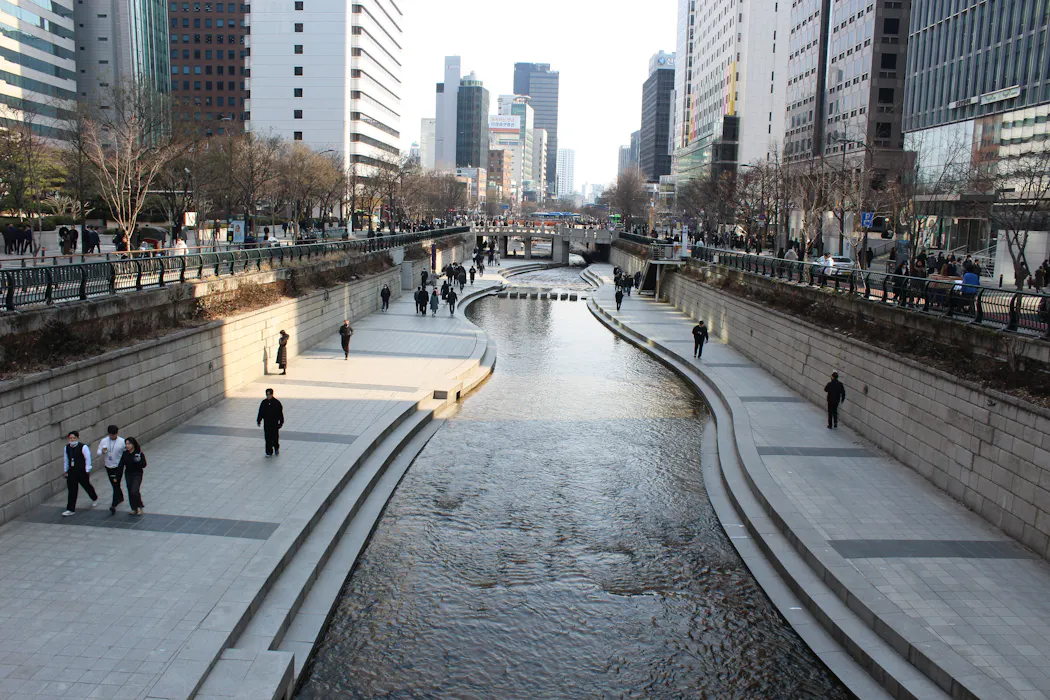
As many cities developed, streams that once flowed on the surface were buried underground to make way for growing infrastructure. However, as heavier rainfall, extreme weather and aging infrastructure place growing pressure on cities, these buried streams could become part of the solution.
Restoring streams to the surface — a practice known as stream daylighting — can help manage storm water, restore habitats and create greener, more walkable public spaces. But recognizing these benefits is easier than delivering a successful project.
Municipalities must find feasible sites, co-ordinate across departments, secure funding and plan for long-term maintenance. But they must also ensure that environmental improvements benefit existing residents rather than contribute to displacement.
My research on stream daylighting compares two contrasting approaches in Seoul, South Korea, and Zürich, Switzerland. The findings suggest that municipalities don’t need to choose between a single large project and many small interventions. They need flexible programs that can identify the right approach for each site and apply lessons from one project to the next.
Two cities, two approaches
Between 2003 and 2005, Seoul restored the Cheonggyecheon stream through a rapid, centralized and costly project along one major downtown corridor. The city removed an elevated motorway and integrated the restored stream with public transit, cycling infrastructure, pedestrian bridges, walkways and public spaces.
The example shows what stream daylighting can accomplish when political leadership, infrastructure renewal and major public investment align. It also exposes the risks associated with large flagship projects. The project required substantial capital investment and continues to incur maintenance costs.
Critics have questioned its ecological integrity because pumps supply water to the channel. Redevelopment around the corridor also increased land values and displaced some smaller businesses.
Zürich’s Bachkonzept, or stream concept, took a different approach. The city began with pilot projects in the 1980s and restored numerous smaller stream segments over several decades.
Zürich linked the projects to sewer management, infrastructure renewal, ecological restoration and neighbourhood planning. Daylighted streams now pass through residential areas, parks and public spaces. Paths, small bridges, seating, playgrounds and recreational areas accompany many of them.
No single project in Zürich has the public profile of Seoul’s Cheonggyecheon. Together, however, the projects form a distributed network that improves watershed function, connects habitats and gives neighbourhoods greater access to water.
This incremental approach may be more practical for many smaller municipalities. Cities can begin with manageable sites, monitor their performance and pursue new projects as infrastructure renewal or redevelopment creates opportunities.
Find opportunities before they disappear
The first step is not construction. It is mapping.
Municipalities can combine culvert inventories and historical watercourse maps with data on flood and heat risks, social vulnerability, public land, parks, planned infrastructure projects and major redevelopment sites.
Mapping does not imply that every buried stream should return to the surface. It gives municipalities a consistent way to identify sites that deserve technical study before other land-use and infrastructure decisions make daylighting difficult or impossible.
Toronto illustrates this challenge. The city recognizes historical watercourses and supports their restoration where feasible. But that support fails to identify what sites should receive priority, who should assess them or how a project would be funded and maintained.
Research on flood risks in Toronto identifies Black Creek and Flemingdon Park among the neighbourhoods where flood exposure intersects with social vulnerability and limited capacity to adapt. Combining this evidence with lost-stream mapping, public land ownership and capital plans could help the city identify equitable pilot opportunities.
Choose the right delivery pathway
Stream daylighting generally enters municipal practice through one of two routes.
The first is public capital works. Culvert replacement, sewer separation, road reconstruction, park renewal, ravine restoration and flood-control projects give municipalities opportunities to examine whether a stream should remain underground. This pathway is especially promising on public land, where a municipality has greater control over design, public access and maintenance.
The second route is private redevelopment. Large industrial, commercial, brownfield or transit-area sites may provide enough space to restore a stream channel, accommodate floodwater and establish vegetation.
Timing matters. Once buildings, roads and development densities are set in place, restoring a waterway becomes much more difficult. Municipalities should screen large sites early and make decisions about land dedication, development rights, public access, construction costs and maintenance transparent.

(Flying Penguin), CC BY-SA
Vancouver’s Still Creek shows how municipal investment, redevelopment opportunities, watershed planning and community stewardship can support gradual restoration rather than one defining project.
Over more than two decades, the city and its partners have delivered site-specific projects involving habitat restoration, rainwater management and public access, including a developer-funded daylighting project completed in 2009.
Updated plans now connect future restoration to redevelopment and flood management, while community organizations contribute through stewardship and salmon monitoring.
Build a program that learns
A daylighting project doesn’t end when construction finishes. Vegetation becomes established, water conditions change and communities use new public spaces in unexpected ways. Municipalities should therefore follow an adaptive cycle: map, assess, co-design, implement, monitor, learn, adjust and scale.
Monitoring should cover flood performance, water quality, habitat, public use, accessibility, maintenance costs and equity. Municipalities should then use the findings to manage completed sites and improve the selection and design of future projects.
Equity also requires sustained attention. Attractive public spaces can increase neighbourhood desirability and development pressure. Affordable housing measures, community benefits and ongoing monitoring can help ensure that existing residents share in the gains.
Scaling a daylighting program does not necessarily mean constructing a larger project. It can mean building a connected portfolio of smaller interventions that gradually restores watershed function.
Stream daylighting will not be feasible everywhere. Without a clear program, however, municipalities may never identify where it could work.
The central lesson from Seoul and Zürich is that cities should treat buried streams not simply as forgotten natural features. They are ecological systems, climate infrastructure and, if developed with care, public spaces all residents can enjoy.

Luna Khirfan has received funding from the Social Sciences and Humanities Research Council of Canada.
Original source: https://analysis1.mil-osi.com/2026/08/27/many-cities-buried-urban-streams-heres-how-to-bring-them-back/