

Source: Asia Pacific Report
COMMENTARY: By Kalinga Seneviratne
In the past year there has been a scramble by the big powers to secure the continuing supply of “rare minerals” that are used in batteries driving electric cars and wind power turbines. There is a looming catastrophe awaiting the Pacific Ocean if countries in the region are not alert to the environmental threats facing the region.
Decades ago, greedy industrialists were polluting the air, and their governments refused to listen to scientific warnings of a looming climatic disaster, and now the island nations of the South Pacific are facing the brunt of climate change disasters.
If the current trends of digging out rare minerals from wherever you can find them continues, we will be left with oceans — especially the Pacific — where we cannot swim or fish, further threatening the livelihoods of many small Oceania nations.
- READ MORE: Pacific protesters against deep sea mining challenge US exploration ship
- Other Pacific deep sea mining reports
With the scramble for rare minerals extending to the deep seabed, a new geopolitical battle is hotting up in the South Pacific, where corruption and divisions among Pacific Island countries could be fermented by global powers battling to control the supply chain, with countries like Cook Islands, Kiribati and Nauru on the frontline.
Eliki Drugunalevu, a member of the research team that compiled the Pacific Ocean Climate Crisis Assessment (POCCA) to the COP 29 meeting in Azerbaijan in 2024, warned in an interview with In-Depth News that inaction by the United Nations to pause the march towards deep sea mining for precious metals would result in a “catastrophic impact” on the Pacific for the long term.
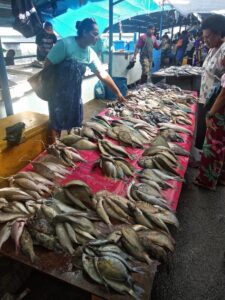
“People on the Pacific islands rely on the ocean not only for their sustenance but also for their economic survival,” he said.
“If the fish are not going to come in, they will have to fish in another community’s fishing grounds, that will have a butterfly effect and create conflict.”
‘Protected’ by ISA
The deep blue oceans are expected to be protected by an autonomous international organisation, the International Seabed Authority (ISA) as the “common heritage of mankind” under the UN Convention on the Law of the Sea (UNCLOS), which was adopted by the United Nations in 1982 and signed and ratified by 168 UN member states.
But the US has refused to sign the convention, objecting to articles restricting seabed mining.
Now the Trump administration seems keen to provide licences to American companies to mine the seabed in the Pacific, while the ISA which on July 31 concluded its latest two-week council and assembly meetings in Jamaica, is deadlocked in framing commercial exploitation guidelines — known as a Mining Code– for the seabed.
At the meeting, 45 countries called for a moratorium or precautionary pause on seabed mining, with Vanuatu in the Pacific proposing that such a pause be in operation until the risks are fully understood and the necessary scientific knowledge is available for a transparent process.
“Deep-sea mining is fraught with immense scientific uncertainty, [so] caution and common sense prevailed at this session, with member states rejecting a rushed adoption of the mining code,” noted Simon Candon, international media manager of Lisbon-based Oceano Azul Foundation in an interview with IDN.
With the US trying to undermine the UNCLOS and ISA, he added that “many countries used the assembly to unite against unilateral mining, agreeing that bypassing the ISA for commercial operations threatens ocean governance and the common heritage of humankind.
“But consensus could not be yet found on Vanuatu’s proposal.”
Onus on miners
Profesor David Schoeman, of the Ocean Futures Research Centre at Queensland’s University of the Sunshine State, argues that the onus should be on prospective seabed miners to provide empirical evidence that their activities will not cause harm to the ocean ecosystem.
“In terms of the type of evidence that could be provided, the gold standard would be a before–after, control–impact (BACI) study of simulated [small-scale] mining operations at select locations, with appropriate sampling of biotic and abiotic elements of the ecosystem over periods covering the anticipated recovery time of the system”.
Clarion Clipperton Zone (CCZ) — a high seas area stretching over 4500 km between Hawai’i and Kiribati across to Mexico — is poised to become the first commercial seabed mining operation in the world if the US subsidiary of the Canada-based The Metals Company (TMC) succeed in getting an US National Oceanic and Atmospheric Administration, licence to mine, in contravention of the UNCLOS.
Their application is currently under review.
Dr Felix Mallin, senior researcher of the Italian National Research Council told IDN that a test done in CCZ a few years ago with one machine alerted the scientific community to the damage to marine life in the deep oceans.
“While any commercial operation would be orders of magnitude bigger. Even if the scars left by modern technology were smaller, we would be looking at a much bigger aggregate damage across vast tracts of ocean floor,” he warns.
“For the Pacific, the fisheries link and the impact it might have on economic life is the one that should worry people most. Some modelling has projected tuna biomass in CCZ rising in coming decades, by up to about a third for skipjack, as global warming pushes stocks east, right into the zone where mining might take place.
‘Industrialising the water’
“So, if we are unlucky, we could be industrialising the water exactly where the region’s most valuable renewable resource is heading.”
While the ISA Mining Code negotiations drag on, Dr Mallin argues that what is needed is an environmental harm independent baseline study in the Pacific, “which no one wants to fund”.
He notes that the prospective seabed mining companies have plugged enormous financial resources into developing technology and lobbying, and if commercial returns are not forthcoming quickly, the investors could flee.
Thus, they are exercising enormous pressure on small Pacific Island states.
Nauru, a nation of 12,00 people, which was exploited by phosphate miners in the 1990s resulting in an environmental disaster to the land, is now been targeted by the seabed miners.
In 2021, Nauru said it would grant a commercial-scale seabed mining approval in their Exclusive Economic Zone (EEZ) — granted under the UNCLOS — to a subsidiary of TMC, which rang alarm bells at ISA, and triggered an urgency to come up with a Mining Code.
The ISA called for a pause while the code is been negotiated, another arm of the UN has come up with another treaty, the Boundaries Beyond National Jurisdiction (BBNJ) agreement which came into effect in January 2026.
Agreement ‘plugging gaps’
This agreement is designed to plug gaps in the UNCLOS, to safeguard seabeds outside a nation’s EEZ.
A controversy is currently brewing in the Cook Islands over US corporate designs to mine the seabed that belongs to the Pacific Islanders.
While Cook Islands has 240 sq km of land, it owns just under 2 million sq km of sea. Under UNCLOS it exercises full sovereign rights to explore, exploit, and manage the natural resources of the seabed and subsoil within its expansive EEZ.
Another Pacific nation, Kiribati’s EEZ covers over 3 million sq km via its far-flung islands, making it one of the largest oceanic territories in the world. They generate significant economic revenue through fishing access agreements with foreign nations to this zone.
It is believed that China is wooing Kiribati to gain future access to seabed mining in their EEZ.
It will be lucrative for such island nations to sell mining rights to the ocean seabed under their EEZ’s, but the problem is, no one knows what would be the long-term impacts of such mining on marine resources like fisheries, and the ocean environment in general.
“My fear is that places like Kiribati and the Cook Islands (with their small populations) will simply be bought off by US miners,” warns Michael Field, Auckland-based editor of South Pacific Tides.
“Pacific states will get just licensing money out of mining [as they do with fishing] but undersea minerals will not provide much in the way of jobs or revenue.
“Minerals, for example, extracted in the Cook Islands, will have to be refined, probably in Asia. The profits will come elsewhere but the environmental risks will be the exclusive property of Pacific people”.
Kalinga Seneviratne is a Sri Lankan-Australian journalist and international communication scholar. He is author of GeoPolitics and the Media in Asia and the Pacific: Pulling in Different Directions. This article was first published by IDN and is republished with permission.
Original source: https://analysis1.mil-osi.com/2026/08/26/pacific-catastrophe-awaits-if-nations-not-alert-to-deep-sea-eco-threat/