

Source: Asia Pacific Report
COMMENTARY: By David Robie, editor of Asia Pacific Report
Some years ago when I headed the Pacific Media Centre that I founded at Auckland University of Technology, we ran a postgraduate internship programme at the China Daily in Beijing.
It was part of a professional development exposure platform that also included Jakarta in Indonesia and the Philippines, along with several media and university journalism campus outlets in the Pacific, including the University of the South Pacific.
There was nothing else comparable at other journalism programmes in New Zealand, and now there are no opportunities of this kind after the closure of the PMC in 2021.
- READ MORE: China’s growing grip on the Solomon Islands’ fragile media sector
- New Zealanders’ Perceptions of Asia 2026
- Other reports on China and media in the Pacific
But there was some eyebrow raising about our collaboration over China Daily’s soft diplomacy role at the heart of Chinese media as part of its growing outreach into the Pacific along with the global Belt and Road development policy.
Linked to our Asia Pacific journalism studies course with support by the Asia NZ Foundation, these three-month internships provided a good insight into how Chinese media operated for New Zealand journalists graduating with an eye on an Asia-Pacific media future.
“Advanced studies in comparative journalism and media globalisation” and the “political economy” of the countries studied were important parts of our course.
A glimpse of how some media operate outside of the Western bubble.
‘Polishers’ of reports
The journalistic role that the students faced while they were at the China Daily were initially of a subeditorial or copy-editing nature — they were called “polishers” of English-language reports. But as time when on, the opportunities grew, including reporting assignments, feature writing, and broadcasting.
On exchange, we also hosted professional journalists from the China Daily on our journalism papers. Overall the collaborative experience was positive. But the stakes are much higher now.
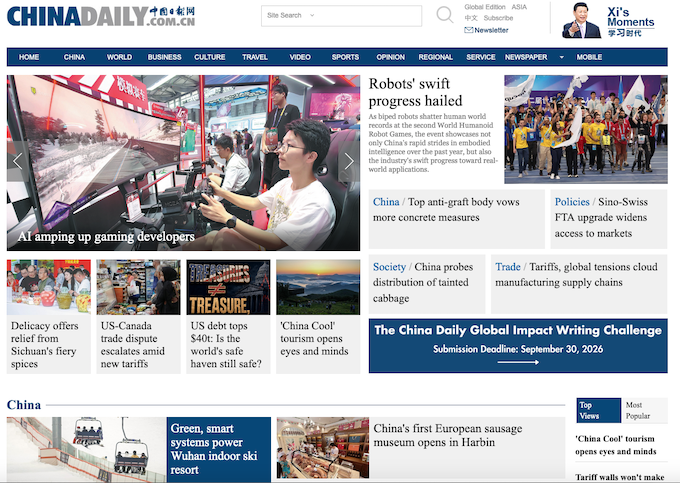
The China Daily was founded as an English daily in 1981 and although it is owned and published by the Chinese Communist Party’s Publicity Department — the “Propaganda Department” — it is not an “official mouthpiece” of the CCP establishment.
In 2011, it celebrated 30 years of publishing during our collaboration.
China Daily has usually enjoyed a more “liberal” face than most other Chinese state media.
For example, coverage of the 1989 Tiananmen Square massacre was generally sympathetic to the student protests and at least one account claims that some of its journalists joined in the demonstrations. Also, the paper’s coverage of the Severe Acute Respiratory Syndrome (SARS) outbreak of 2002-2004 was more fact-driven and balanced than the “official” state media.
China Daily has also published sponsored inserts in such global newspapers as The New York Times and Wall Street Journal in the US and Le Figaro in France.
Massive operation
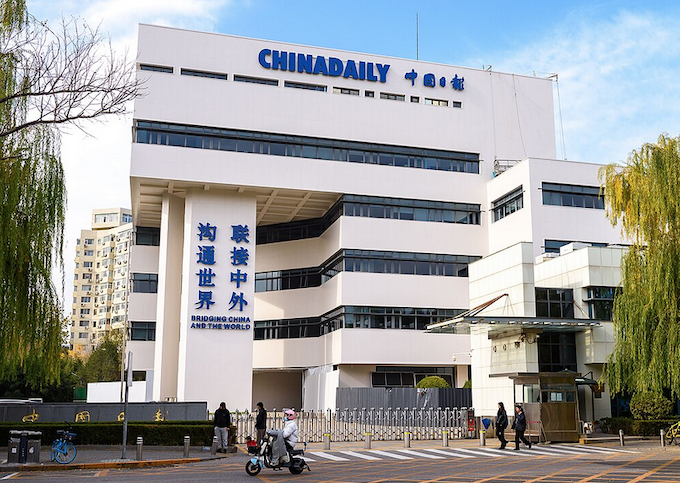
Published out of a large headquarters in Chaoyang district, it is a massive operation by New Zealand standards, publishing the best part of a million copies daily, two-thirds of the copies via special editions reaching at least 150 countries.
But the most visible face of the newspaper in New Zealand and the Pacific these days is online at the China Daily website.
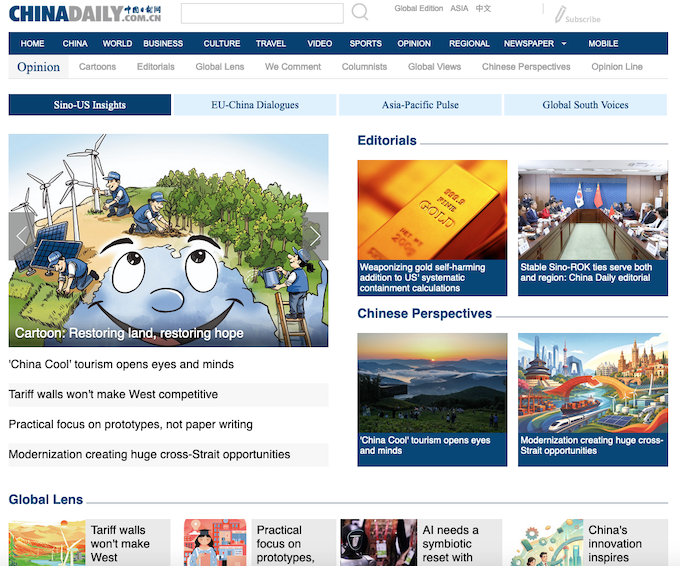
China Daily has often framed its Pacific outreach through official editorials, youth forums and diplomatic rebuttals. It publicises green energy ties, criticises “foreign alarmism regarding regional expansion”, and argues that organisations such as the Pacific Islands Forum must back the one-China policy.
As the Chinese media outreach into the Pacific has been growing in recent years, the rivalry between Beijing, Washington and Canberra has been ratcheted up with accusations of “editorial interference and influence” in some countries, such as Kiribati and Solomon Islands, at least until the change of government in Honiara in May when Matthew Wale ousted the pro-China leadership in a general election.
In an in-depth report just two months before the election, the Paris-based media freedom watchdog Reporters Without Borders warned that since Honiara had established diplomatic relations with China in 2019 the Pacific country had become a “strategic arena for Beijing’s influence”.
“By capitalising on the economic fragility of the local media sector, China has stepped up conditional funding, editorial partnerships and influence programmes to disseminate its narratives, RSF said, calling on the Solomon Islands’ government to make the viability and independence of the media sector a priority.
Outreach invitation
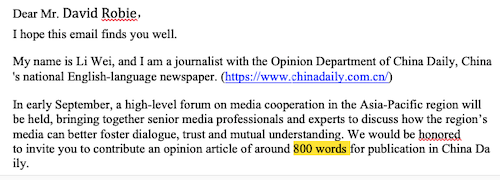
The China Daily has stepped up its outreach initiatives in the Pacific lately as evidenced by an email to me four days ago inviting me to write an op-ed for the publication’s Opinion section. And the deadline is tomorrow.
Signed by an editor of the newspaper’s Opinion Department, the invitation said: “In early September, a high-level forum on media cooperation in the Asia-Pacific region will be held, bringing together senior media professionals and experts to discuss how the region’s media can better foster dialogue, trust and mutual understanding.
“We would be honoured to invite you to contribute an opinion article of around 800 words for publication in China Daily.”
The invitation continued:
“As a reference, we have outlined several possible directions:
1. In the age of AI, how can Asia-Pacific media rebuild public trust?
2. From ‘reporting Asia’ to ‘telling Asia’s stories’: Can Asia-Pacific media move beyond Western narrative frameworks?
3. From “information competition” to media cooperation: How can Asia-Pacific media promote greater mutual understanding across the region?
These topics are only suggestions. We would be delighted if you chose to write on another angle that better reflects your current research or interests.
“Rather than opening with abstract concepts or institutional frameworks, we encourage authors to begin with something timely and tangible: a recent news event, a real-world development, or an everyday experience that readers immediately recognise.
‘Drawing in’ readers
“Once readers are drawn in, the article can naturally expand to explain the broader policy, economic, technological or geopolitical forces behind it. In our experience, this narrative structure makes complex issues far more engaging for a broad international audience.
“The strongest pieces usually build around one central argument, moving from the concrete to the conceptual, from the familiar to the unfamiliar, and from today’s headline to its longer-term implications.
“We particularly value articles that combine the immediacy of current events with original analysis, clear storytelling and practical insights, rather than offering a comprehensive survey of every aspect of the topic.
“In addition to the written article, we would also be delighted if you could record a short video commentary of around one minute.
“A simple self-recorded video using a mobile phone would be perfectly fine. A vertical format with a clean and quiet background would be ideal; there is no need for professional filming or editing, as our team will handle the post-production.”
The invitation continued in the same vein.
Concluding, the email said: “As our production schedule is quite tight, we would greatly appreciate it if you could send us both the article and the video by August 25, 2026.”
My reply? You are reading it right here on Asia Pacific Report.
Original source: https://analysis1.mil-osi.com/2026/08/24/china-daily-collaborations-media-education-and-pacific-outreach/