

Source: The Conversation – Africa
In many South African classrooms, learners continue to experience the subject of history through the language, concepts and perspectives inherited from colonial traditions. Changes have been made to what children are taught. But the curriculum changes might not be enough to change what children learn in history classrooms.
The reason for this is that English continues to dominate as the language of learning and teaching in most secondary schools. This is despite the fact that South Africa officially recognises 12 languages.
As education researchers with an interest in the languages used in the classroom, we wanted to examine the relationship between language choice and the teaching of history.
We did this through a study of Grade 8 history classrooms in the Northern Cape province of South Africa. Focusing on a local historical event, learners were encouraged to examine whose perspectives become visible or invisible through different language choices.
We found that this allowed them to think critically about how history is recorded, challenge the standard versions of the event, and create more of a connection between their own lives and the bigger historical picture.
Our research suggests that if learners are to engage critically with history, they must also be empowered to question the language through which the subject is taught.
The Kimberley diamond rush
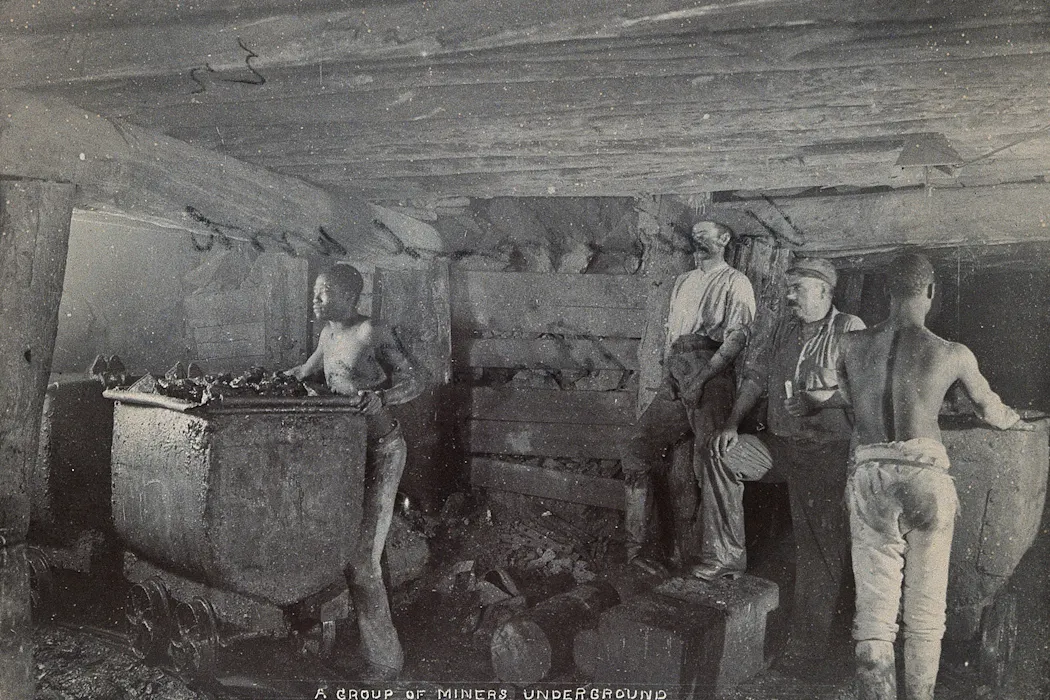
Our research focused on the Kimberley diamond rush. The development of Kimberley can be traced back to the discovery of diamonds around 1870 on a farm in what was then known as Griqualand West, now part of South Africa’s Northern Cape province. News of the discovery spread quickly and attracted thousands of prospectors, fortune seekers and labourers from across the region and beyond. As people flocked to the area in search of wealth and employment, a small settlement rapidly grew into the bustling town of Kimberley. The diamond rush played a significant role in shaping South Africa’s economic and social history, establishing Kimberley as one of the country’s most important mining centres.
This is a topic taught in South African schools in Grade 8 (for learners in the age group 14-16 years).
Traditionally, learners encounter this history through narratives centred on economic development, industrialisation and influential figures such as Cecil John Rhodes. All these texts are written in English. While these accounts are important, they leave little room for the experiences, languages and perspectives of African communities affected by mining, land dispossession and labour exploitation.
Our study followed an approach known as decolonial language awareness. The approach positions indigenous languages as legitimate sources of knowledge.
The study took place in two public secondary schools in the Northern Cape. Participants were two Grade 8 History teachers and learners in linguistically diverse classrooms. The schools served multilingual communities where isiXhosa, Setswana, Afrikaans and English were commonly used, although English remained the primary language of learning and teaching.
The intervention began with what looked like a simple question posed by teachers:
Why is the story of Kimberley diamonds always taught in English?
The discussion that followed revealed a level of critical awareness often underestimated in young learners. Students quickly linked English to political power, pointing out that many historical records were written by colonial administrators, mine owners and government officials. They recognised that the voices preserved in textbooks were often those of people who held power rather than those who experienced the consequences of that power.
Read more:
History teaching in South Africa could be vastly improved – if language skills were added to the mix
What happened next was perhaps the most significant aspect of the project.
Teachers and learners in this study worked together to develop a historical glossary in English and isiXhosa. This was more than a simple translation exercise. Instead, learners explored whether familiar historical terms accurately represented the experiences of African communities. They drew on family histories, community memories, oral narratives, cultural knowledge, and contemporary experiences of language, identity and inequality to make sense of events that had occurred generations earlier.
Take the term “compound system”. In many history textbooks, it is presented as a labour arrangement that housed African mine workers in employer-provided accommodation to facilitate the management and control of the workforce. Yet when learners explored isiXhosa alternatives such as inkampu yabakhonziswa (“a camp of those compelled to labour”), they began to question the neutrality of the textbook term. Their discussions shifted attention from labour organisation to the lived realities of confinement, coercion and restricted freedom.
In this way, language became a tool for uncovering different interpretations of the same historical phenomenon and for foregrounding perspectives often absent from dominant historical accounts.
A similar process unfolded around the concept of “dispossession”. When discussions shifted towards isiXhosa expressions such as ukuncothulwa emhlabeni (“being uprooted from the land”), the historical event acquired a more human and emotional dimension. Learners connected the concept not only to the loss of land but also to disrupted ties of belonging, community, identity and ancestry. What had previously appeared as an abstract textbook term was reinterpreted as a lived experience with profound social and cultural consequences.
Read more:
History with a human face and voice: how museum theatre gets kids to care about the past
These discussions transformed the dynamics of the classroom. Learners who were often quiet during conventional history lessons became active participants. Some brought stories, expressions and insights from parents and grandparents into classroom debates. Others challenged textbook terminology and proposed alternative ways of understanding historical events. Home language was no longer treated as something left at the classroom door. It became a valuable academic resource.
Perhaps most importantly, learners began to recognise that history was not a single story.
When presented with a British mine manager’s report describing workers as “industrious but sullen”, learners asked how those same workers might have described the manager. Whose perspective was represented? What experiences were omitted? How would the story change if told from another viewpoint? These questions demonstrate a level of historical thinking that goes far beyond memorising facts and dates.
Beyond curriculum change
Critics may argue that such approaches make history too political. Yet history has always been political. Decisions about which events are recorded, whose voices are preserved and which languages are regarded as authoritative are never neutral. By making these processes visible, learners are being equipped to think critically about knowledge itself.
Read more:
South Africa’s history uncovered: the 1,000-year gap they don’t teach in school
The broader implications extend beyond history classrooms. Three decades after the end of apartheid, South Africa continues to grapple with questions of transformation, equity and inclusion. If educational success remains tied to English, many learners will continue to experience a disconnect between their lived realities and what schools recognise as knowledge.
Decolonising education is not about replacing one version of history with another. It is about giving learners the agency to ask difficult questions, evaluate competing perspectives and participate in the ongoing construction of historical knowledge.

The authors do not work for, consult, own shares in or receive funding from any company or organisation that would benefit from this article, and have disclosed no relevant affiliations beyond their academic appointment.
Original source: https://analysis1.mil-osi.com/2026/08/20/changing-the-history-curriculum-is-not-enough-if-english-always-dominates-the-classroom-south-african-study/