

Source: The Conversation – USA (2)
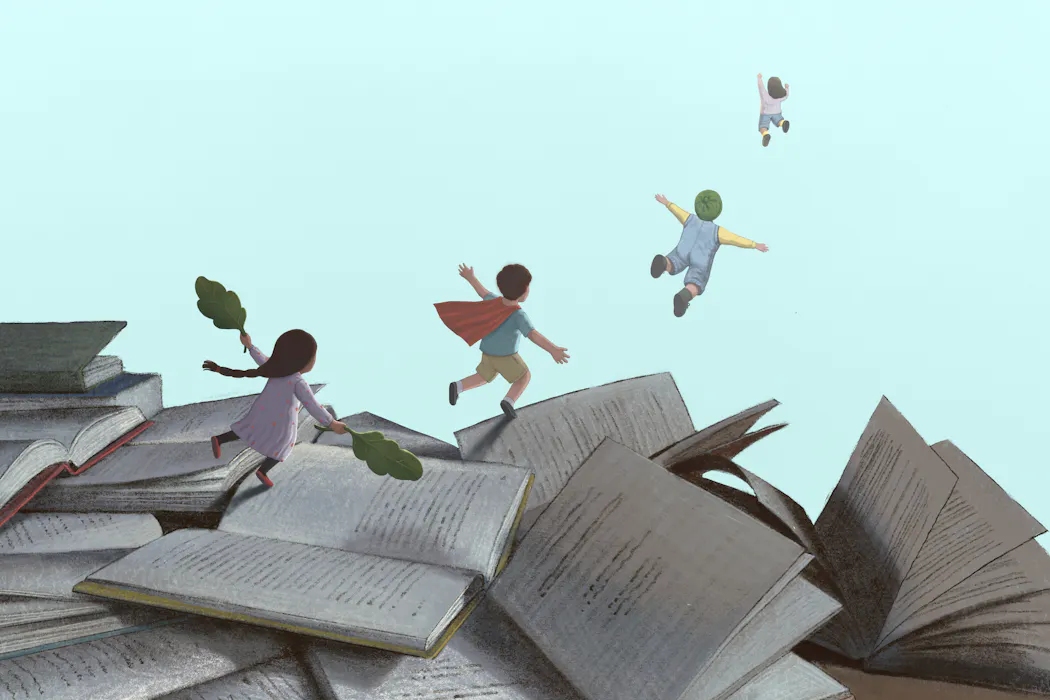
What does a child need to prepare themselves for kindergarten? I’m not talking about a new water bottle and a backpack, though certainly those come in handy.
I mean what it takes to try to make new friends, be brave, resilient, inventive and hopeful – no small tasks for anyone.
I am a children’s book writer and have been a professor of children’s literature and creative writing for more than 40 years. So you can guess that my answer to this question about school readiness involves books.
Reading lets children test out challenging, or frightening, situations in their imaginations.
It offers a path out of anxiety and into joy and adventure.
C. S. Lewis, author of the 1950 children’s book “The Lion, the Witch and the Wardrobe,” reminds people that a reader “does not despise real woods because he has read of enchanted woods: the reading makes all real woods a little enchanted.”
Kindergarten is often an enchanted place, one which many children vividly remember all their lives. But it can seem scary to some children, simply because it is so new.
Here are a few important ideas that can fortify children who are entering this unknown land – as told through five engaging books that may help new students prepare for their journey ahead.

Harper Collins Publishers
1. Hope and persistence pay off
Some of the happiest children are those who maintain a sense of hopefulness and possibility.
Children see these traits at play in Ruth Krauss’ 1945 classic picture book, “The Carrot Seed.” In it, an unnamed little boy plants, weeds, waters and then patiently watches over his carrot seed for a very, very long time. Doubters surround him.
His mother said,
‘I’m afraid it won’t come up.’
And his big brother says,
‘It won’t come up.’
What happens in the end will astonish and delight all readers – though it doesn’t faze the boy who always believed.
2. A new adventure is exciting
If you don’t think heading off to school for the first time is a wild adventure, you’re forgetting something.
The vivid 1963 children’s book “Where the Wild Things Are,” written by Maurice Sendak, brings readers into an unruly night where young Max puts on his wolf suit “and makes mischief of one kind and another” until his exhausted mother orders him to bed without his dinner.
Max imagines a world of tangled forests, a choppy sea and a “private boat for Max.” He sails off through “days and weeks and in and out of years” before he reaches a tropical island where the wild things live.
There, Max discovers his own power to command the wild things, and a “wild rumpus,” or a party with his new friends, begins. The book offers the tempting possibility that children have wonderful, exciting things in store for them in unknown experiences.
The wild things – fictional monsters Sendak has said were based on his own family members – roll their terrible eyes, gnash their teeth and show their terrible claws. But Max stands his ground and becomes king of them all. At the story’s end, Max makes it home just in time to discover that his dinner is still warm, and waiting for him in his room.
The book also offers comfort both for young children and parents who might be anxious about those first few morning drop-offs. At the end of the school day, our children do return, happy to be where someone loves them “best of all.”

James Keyser/Getty Images
3. School might be tough, but so are you
After raising a son and a daughter 14 years apart, I realized that every child is uniquely themselves. I raised one “wild thing” who play-acted and roared his way through obstacles. And one “Brave Irene,” who quietly and calmly got the job done.
Author and illustrator William Steig’s 1986 book brings us into the humble cottage of Irene and her seamstress mother, who has finally finished a hand-sewn ballgown for a duchess to wear at an upcoming ball. But Irene’s mom suddenly becomes sick and can’t deliver the dress herself.
Irene doesn’t let a raging snowstorm stop her from bringing the duchess her new gown.
She trudges sideways, backward, into deep snowdrifts and a howling wind that rips the box open.
The ball gown flounced out and went waltzing through the powdered air with tissue-paper attendants.
Brave Irene wrestles the dress and rides the box downhill like a sled in order to reach the duchess, who is anxiously waiting for her gown.
Irene can do the hard things and get through whatever tribulations get thrown her way. She also offers young readers a reminder that true bravery is trying your best to help people you love when they need it.
4. Try to listen; have empathy for others
All children deal with anger. A favorite toy breaks – or worse yet, gets broken by somebody else. And since those moments are inevitable, most people learn how to cope as they grow.
In Cori Doerrfeld’s 2018 children’s book “The Rabbit Listened,” a bird knocks down the building-block masterpiece that the young protagonist Taylor created.
Taylor is furious and sad.
Well-meaning friends stop by and try to help. A bear suggests that Taylor get angry and shout about the destroyed blocks. An ostrich recommends that Taylor hide and pretend nothing happened.
Finally, a rabbit comes along, sits and simply listens. It’s just what Taylor needs – to be heard. And children, no matter how small, are not too young to be good listeners and good friends.

Penguin Random House
5. You can’t go wrong with being yourself
Abby Hanlon’s “Dory Fantasmagory” series, the first book published in 2014, brings readers into the otherworldly imagination of young Dory.
Dory, who is often called Rascal by her family and friends, is a new-age “Ramona the Pest,” the classic chapter-book kindergarten heroine. The Dory series is about surviving the ups and downs of childhood, on steroids. Dory, who is the baby of her three-kid family, invents friends, villains and a bearded fairy godmother for company.
Hanlon’s whimsical illustrations are drawn as a brilliant child might create them. Many of Hanlon’s best jokes are visual, providing hilarious reading for lap-sitters and early readers.
In 2015’s “Dory Fantasmagory: The Real True Friend,” our heroine sets off for school, her backpack stuffed with Dad’s dirty laundry, “extra salami” and lemon juice. Her siblings block the door. Her big sister warns, “You. Won’t. Have. Any. Friends.”
“The most important thing for you to remember is, DON’T BE YOURSELF. Can you do that?”
Of course not. Nor should anyone ever have to.
Dory blends her very imaginary and very real worlds together, and emerges with the true friendships she deserves – both with children at school and with characters in her own mind. Young readers rooting for Dory, and laughing alongside her, will see that it’s OK to have full conversations with an imaginary witch named Mrs. Gobble Gracker, or bark like a dog, if the moment moves you. In fact, other children may well want to play along.
It’s sometimes fun to be imaginative, silly and uniquely yourself – and children can be true to themselves, including at school.

Liz Rosenberg does not work for, consult, own shares in or receive funding from any company or organization that would benefit from this article, and has disclosed no relevant affiliations beyond their academic appointment.
Original source: https://analysis1.mil-osi.com/2026/08/14/staying-hopeful-and-true-to-oneself-is-a-lesson-these-5-kids-books-offer-to-kindergartners-and-other-children/