

Source: The Conversation – UK
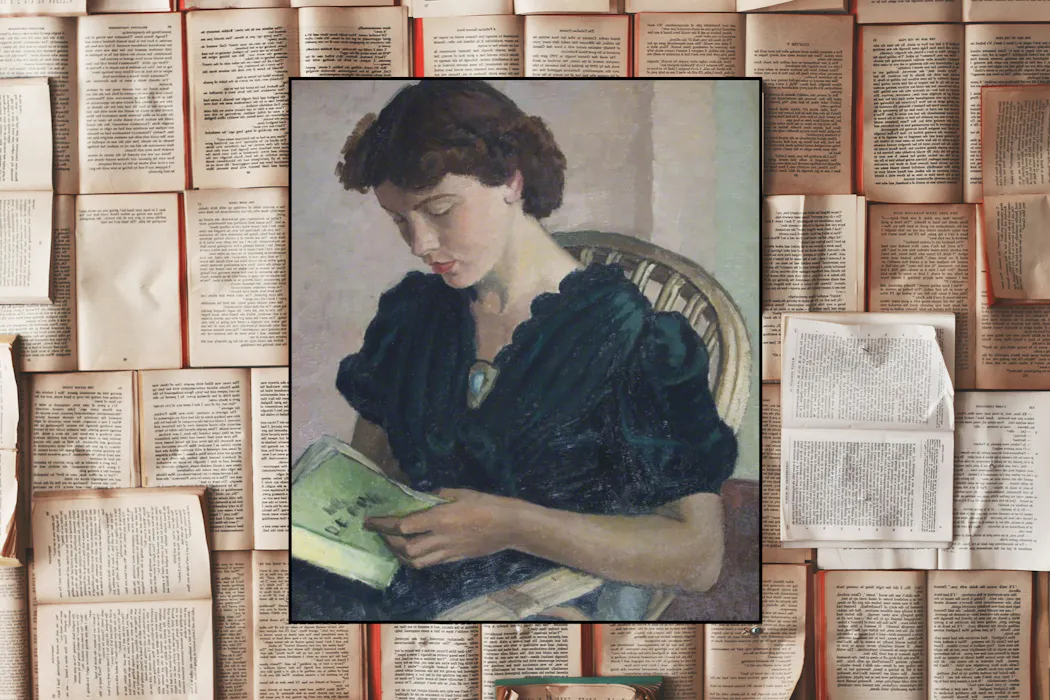
In 1906, the journalist W.T. Stead warned in A Plea for the Revival of Reading that Britain faced a reading crisis. People, he complained, no longer read books. Instead, they skimmed newspapers on trains, forgot what they had read by lunchtime and increasingly preferred distraction to sustained attention. His proposed solution? A national revival of reading.
One hundred and twenty years later, 2026 is the UK’s National Year of Reading. After years of concern about declining rates of reading for pleasure, the headlines are dramatic. The Times recently warned: “If humans stop reading, barbarians will live among us again”. Screens, smartphones and short-form video social media platforms like TikTok are regularly presented as the culprits.
So, reading Stead’s pamphlet (1906) today is an uncanny experience. While researching Stead’s journalism for my book The Americanisation of W.T. Stead (2026), I found that many of the arguments we assume belong to the digital age were already being made in Victorian Britain.
Stead begins with a distinction that still lies at the heart of debates about reading: “Millions have never yet found out that books were interesting,” he writes. “They can read, but they do not care for reading”.
This observation chimes with our contemporary moment. The problem is not literacy alone, but reading identity. Someone may possess the technical ability to read without ever coming to think of themselves as a reader. Current reading research makes a similar distinction. There is now broad agreement that developing a love of reading depends not simply on decoding words but on motivation, confidence and finding books that feel relevant.
Stead also rejected the idea that this love of reading could simply be imposed: “The love for the reading of books is an acquired taste,” he argued. Children might have to be compelled to learn to read, but learning to love reading required something quite different, “instead of coercion there is needed a good deal of coaxing”.
Again, this sounds very familiar today. Modern initiatives promoting shared reading, reading for pleasure and child-led book choice all rest on the principle: readers are made through encouragement rather than compulsion.
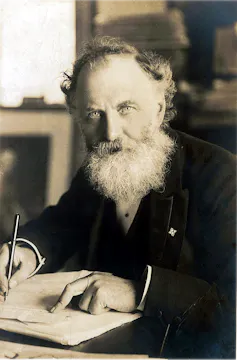
Wikimedia
Stead’s advice began with children. He believed that one of the most effective ways of creating readers was simply reading aloud. Good oral reading, he claimed, was “the surest, simplest, and speediest way of awakening a love of reading”.
More than a century later, spoken language is once again moving up the educational agenda. The government’s proposed oracy framework, expected to be introduced by 2028, reflects a renewed recognition that speaking, listening and reading are closely connected – even if the framework’s primary focus extends beyond literacy alone.
It is in Stead’s discussion of attention, however, that the similarities with today’s debates become most apparent.
The attention debate
Stead worried that newspapers had fundamentally altered reading habits. Circulation libraries, newspapers and magazines encouraged “a habit of skimming rather than reading”. Newspapers, he complained, had become “mere rag bags of shreds and patches”. Readers looked through them “as we look into kaleidoscopes”, producing only “an evanescent effect upon our minds”.
Replace “newspapers” with “social media feeds” and the argument would sound entirely contemporary.
“Memory, judgement, the critical faculty are unexercised”, Stead lamented. It is difficult not to hear echoes of today’s debates about social media and, increasingly, concerns about generative-AI technologies. Critics now ask whether the use of AI assistants to process information and endless scrolling on screens fragments attention, weakens memory and encourages rapid emotional reactions rather than sustained reflection. While the technologies are radically different, the underlying concern is remarkably familiar: the way we consume information shapes how we think.
Where Stead relied on cultural observation, researchers today investigate these questions empirically. There is growing evidence that sustained, immersive reading supports concentration, reflection and aspects of mental wellbeing, while regular reading has also been associated with lower stress levels and, over the longer term, healthier cognitive ageing.
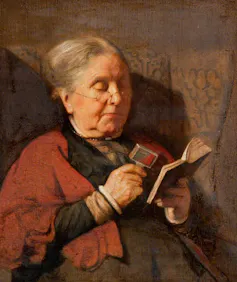
McLean Museum and Art Gallery – Inverclyde Council, CC BY-NC-ND
At the same time, experts caution against simplistic comparisons between books and screens. Different media support different kinds of reading, and much depends on what people are reading and how they engage with it.
Stead quotes the Liberal MP and editor John Morley, who argued that people needed to make time in each day – half an hour ideally, but even a quarter of an hour, if pushed – for what he called “good and disinterested reading”. The value of this practice, he suggested, lay not simply in acquiring knowledge but in cultivating “happiness, fortitude, wisdom and calm”. To translate those words into modern terms, we might say reading supports our mental health, emotional resilience and everyday wellbeing. The language has changed, but the aspiration is the same.
Although Stead worried that newspapers encouraged superficial reading, he also recognised that books would have to adapt. “Books”, he wrote, “must struggle for existence by the use of the same weapons as those which have secured the ascendency of the newspaper”.
This is perhaps the most surprising insight in the pamphlet. Rather than defending books against modern media, Stead argued that they should borrow modern media’s strengths. Books should become cheaper, shorter, regularly issued and more accessible. Far from resisting new communication technologies, he believed reading could flourish by adapting to them. Today’s equivalent might be publishers embracing audiobooks, podcasts, readings apps and BookTok. The principle is the same: meet readers where they already are.
Of course, Stead did not get everything right. Like many of his contemporaries and forebears, he worried about the dangers of “habitual novel reading”. He discussed proposals from America that would have restricted children’s access to popular fiction in a similar way to how tobacco sales were regulated. Today, those fears seem excessive. Yet they offer a useful reminder that every generation identifies certain forms of reading as uniquely dangerous.
The recent resurgence of book challenges and bans reminds us that debates about reading have always been as much about what people read as whether they read at all. Whether such restrictions are justified or not, history suggests these debates often reveal broader anxieties about childhood, attention and morality as much as the medium itself. Each generation, it seems, has its preferred media villain.
That is not to say current concerns should be dismissed. Reading for pleasure has genuinely declined among children, and many adults struggle to sustain the time and concentration that long-form reading demands. These are important educational and cultural questions, but they are best understood as part of a much longer story. Every major communications revolution has prompted fears that serious reading was disappearing. Yet reading has repeatedly adapted rather than vanished.
Stead understood something that remains true today. The challenge is not merely persuading people that books matter. It is, as he put it in 1906, helping people who “can read” become people who “care for reading”.

Helena Goodwyn does not work for, consult, own shares in or receive funding from any company or organisation that would benefit from this article, and has disclosed no relevant affiliations beyond their academic appointment.
Original source: https://analysis1.mil-osi.com/2026/08/12/why-an-120-year-old-warning-about-reading-feels-uncomfortably-familiar/