

Source: The Conversation – USA
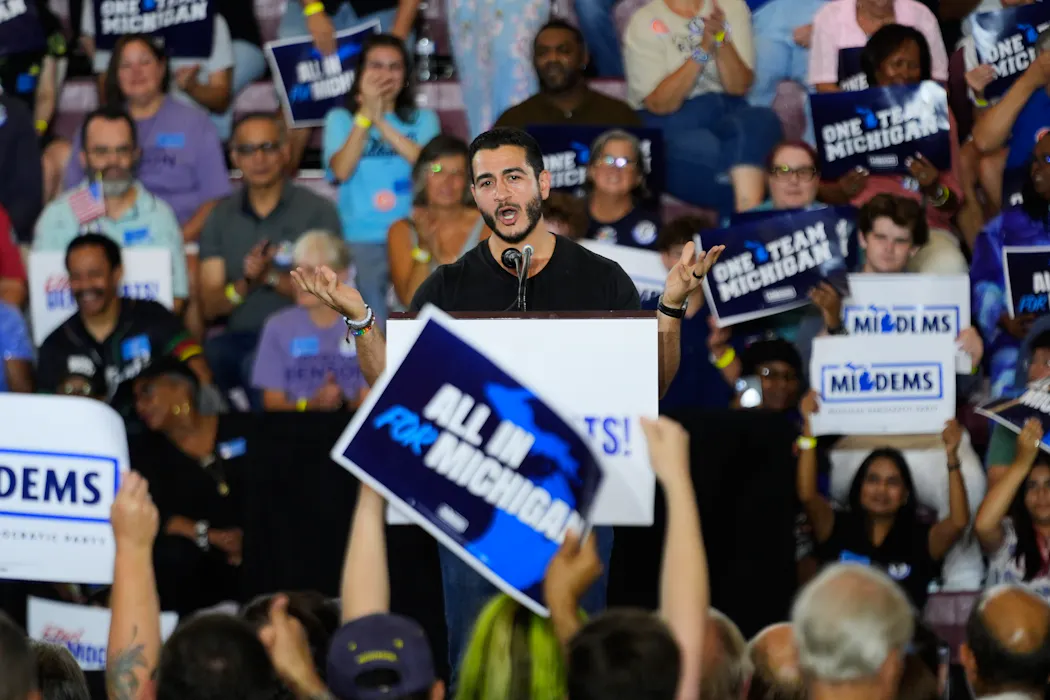
Abdul El-Sayed won a hard fight in Michigan’s Democratic primary race for U.S. Senate against Rep. Haley Stevens. He eked out a win by 15,000 votes, or about 1% of the almost 1.5 million votes cast during the election on Aug. 4, 2026.
El-Sayed had a consistent populist message during the primary campaign. He told The New York Times, “I can walk into almost any room, and I can say: ‘Money out of?’ and everybody’s like: ‘Politics.’ ‘Money in your?’ ‘Pocket.’ ‘Medicare for?’ ‘All.’ People know what we’re about.”
Now El-Sayed, the former director of the Department of Health, Human and Veterans Services of Wayne County, has to shift his effort and messaging to a general election campaign against Republican Mike Rogers.
I am a political scientist who studies campaigns and elections, both nationally and in the key swing state of Michigan where I live and teach.
El-Sayed ran a prototypical primary campaign, positioning himself as a progressive outsider against a moderate insider. Like Stevens, he appealed to specific segments of the Democratic electorate in an attempt to assemble a winning coalition.
But a run against a Republican with prior campaign and governing experience and the support of President Donald Trump is a different challenge – especially with the control of the U.S. Senate at stake. Republicans currently holds a three-seat advantage in that chamber; the Democrats are hoping to pick up four seats to gain control.
Historically expensive campaign
This election was the third-most expensive on record and the second-most expensive this year, following the Texas Senate primary. Based on end-of-July ad bookings, almost US$81 million was spent in the Michigan Senate Democratic primary race, but it was not close to evenly divided.
A total of $63.9 million was spent in support of Stevens, most coming from sources from outside Michigan, while $7.3 million was spent in support of El-Sayed. That’s a ratio of 9 to 1 in Stevens’ favor.
About 97% of Stevens’ ad placements came from groups supported by the American Israel Public Affairs Committee, or AIPAC, a powerful lobbying group that supports pro-Israel policies. This became a significant point of attack for El-Sayed’s campaign. He said he was not taking any funds from corporate political action committees, while at the same time portraying Stevens as a Washington insider beholden to special interests. Most of the ads paid for by AIPAC did not have anything to do with U.S.-Israel affairs or El-Sayed’s position on ending aid to Israel.
El-Sayed overcame funding disadvantage
The stark contrasts in candidate funding led to differences in advertising strategies and appeals to different groups of voters.
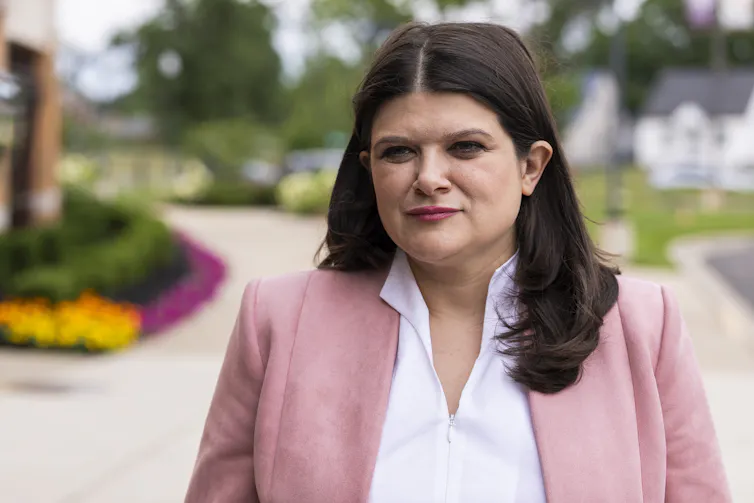
Stevens made implicit appeals to Black voters, concentrated in the Detroit metropolitan area, by including news clips of Barack Obama during his presidency touting her support for an auto bailout, although the former president never explicitly endorsed her. Other negative ads suggested El-Sayed had made disparaging comments about Michelle Obama.
Finn Gomez/Getty Images
AIPAC ads in support of Stevens suggested that El-Sayed is misogynistic and said he disrespects women, although independent fact checks concluded that his prior comments cited in the attack ads were taken out of context.
Because he had less money, El-Sayed produced a lot of social media content, much of it designed to get the attention of younger voters at a lower cost than TV ad rates. Some of his ads were produced by the Fight Agency, which also worked for Mayor Zohran Mamdani’s campaign in New York City.
Some of El-Sayed’s content looked like music videos. Other content contained traditional pleas to small-dollar donors.
Support from different wings of the party
Both candidates assembled an impressive array of political elites backing their candidacy, but the groups were quite different.
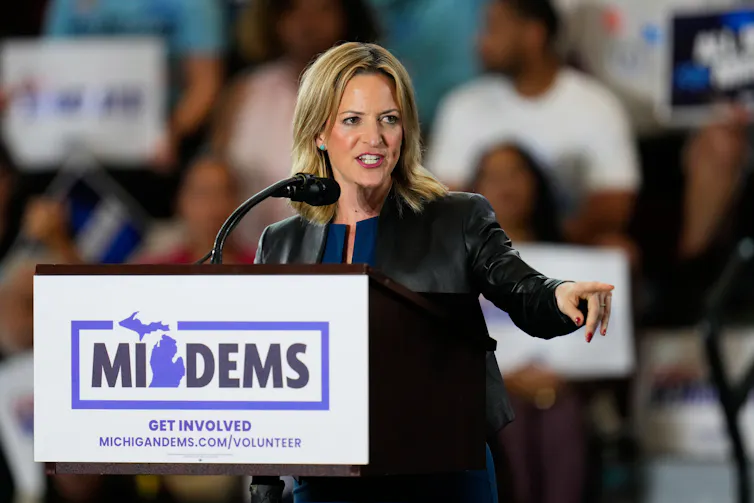
Stevens was endorsed by the Michigan Democratic establishment, including Gov. Gretchen Whitmer, former Gov. Jennifer Granholm, current U.S. Sen. Gary Peters and former U.S. Sen. Debbie Stabenow, as well as many Democratic elected officials from Michigan. She was also endorsed by U.S. Senate Minority Leader Chuck Schumer of New York and Speaker Emerita Nancy Pelosi of California.
Paul Sancya/AP Photo
Most visible among El-Sayed’s endorsements were Sen. Bernie Sanders of Vermont, Sen. Elizabeth Warren of Massachusetts and U.S. Rep. Alexandria Ocasio-Cortez of New York. They all campaigned alongside El-Sayed at various Michigan rallies to demonstrate his progressive bona fides. Each visit produced extensive local media coverage for his campaign.
Divides across religion, race and education
There were no exit polls conducted during the primary, but analyses of aggregate vote returns suggest important differences in patterns of voting behavior.
El-Sayed won more than 70% of the vote in the main Arab-American areas of southeastern Michigan: Dearborn, Dearborn Heights and Hamtramck. At the same time, Stevens carried Black voters in Detroit and other parts of Wayne County – although her 58% of the vote was not as much as Biden’s 78% of the vote in the 2024 presidential primary.
El-Sayed did better among young voters, as he won every one of the college towns in the state, including Ann Arbor and East Lansing.
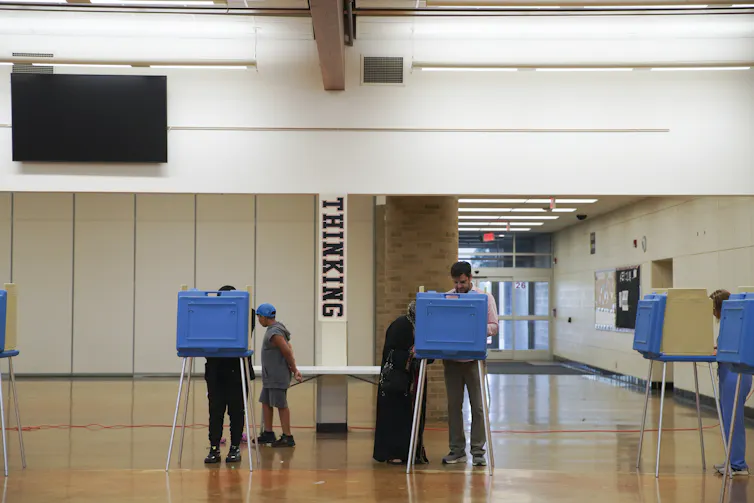
And there seemed to be distinct differences in their supporters’ methods of voting. El-Sayed performed better among voters who cast their ballot on Election Day, which is typically favored by young adults. Early voting, whether in person or by mail, were methods typically favored by older Michigan voters who chose Stevens.
Katie McTiernan/Anadolu via Getty Images
Looking to November
El-Sayed now has to turn to the general election campaign, where early post-primary polls suggest the race is a dead heat.
Michigan was considered a toss-up race before the primary, and it remains that way with El-Sayed’s victory.
His first task is to unite the Democratic Party behind him. Prominent Michigan Democrats pledged their support during a rally held in Detroit on Aug. 7. Former Transportation Secretary Pete Buttigieg, a possible 2028 presidential candidate, expressed support for El-Sayed at the rally, as did Whitmer, who had endorsed Stevens before the primary.
One notable absence, however, was Dana Nessel, the state’s attorney general. She associates El-Sayed’s concern about arming Israel as an expression of antisemitism and claims that she won’t feel safe at the state’s nominating convention because she is Jewish.
The Democratic candidate understands the affordability issue and is comfortable campaigning on it.
Since June, Trump has been calling Democratic candidates “Communists” – even those, like El-Sayed, who do not label themselves as “democratic socialists.”
Jeff Kowalsky/AFP via Getty Images
El-Sayed will also likely face Islamophobic attacks. After the primary, the Republican candidate Rogers said El-Sayed is someone who “believes America deserved 9/11” and “pledged his support to the Muslim Brotherhood.” In recent Senate testimony, Sen. Ted Cruz focused on El-Sayed’s alleged family connections to organizations associated with the Muslim Brotherhood. These claims are not true but may still influence voters who are just beginning to pay attention to the campaign.
Rogers is a skillful campaigner who might continue to capitalize on this strategy. It is too early to tell whether El-Sayed can inoculate himself against this characterization.
For his part, El-Sayed will likely try to link Rogers as closely to Trump as possible because of the president’s low approval ratings. Rogers will have to weigh carefully whether to invite Trump to Michigan to campaign with him.
One thing is certain. Michigan voters can expect a long, negative campaign between now and November.
Read more of our stories about Michigan and Detroit.

Michael Traugott receives funding from the National Science Foundation.