

Source: The Conversation (Au and NZ)
On the first day of winter, southwest Western Australia was pummelled by a damaging storm. The Bureau of Meteorology (BoM) described it as the most intense weather system to hit the region in almost 50 years. Although severe storms can be devastating, they’re also important for delivering rain in a part of Australia that is drying out.
As the planet continues to warm, climate patterns that were stable for decades are beginning to shift. This changes the extreme weather events we experience from day to day.
Long-term historical records help us make sense of recent trends. They give us a rare chance to see how weather extremes have changed since pre-industrial times.
In meteorology, atmospheric pressure measures the weight of the air around us, with sudden drops indicating stormy conditions. Our new study, published in Climate Dynamics, has reconstructed the longest record of pressure readings taken multiple times a day in the Southern Hemisphere, tracking severe storms in Perth from 1830.
Historically, data from this region has been sparse. Our results are a vital contribution to the World Meteorological Organization’s global network of long-term monitoring stations.
By consolidating nearly 200 years of daily pressure, temperature and rainfall observations from Perth, our research reveals new details about the behaviour of severe storms, and broader weather trends across Australia.
Reconstructing weather extremes from Australia’s past
How did Australia’s climate fluctuate before the large-scale burning of fossil fuels? To find out, we needed to look at historical weather observations recorded during the pre-industrial period.
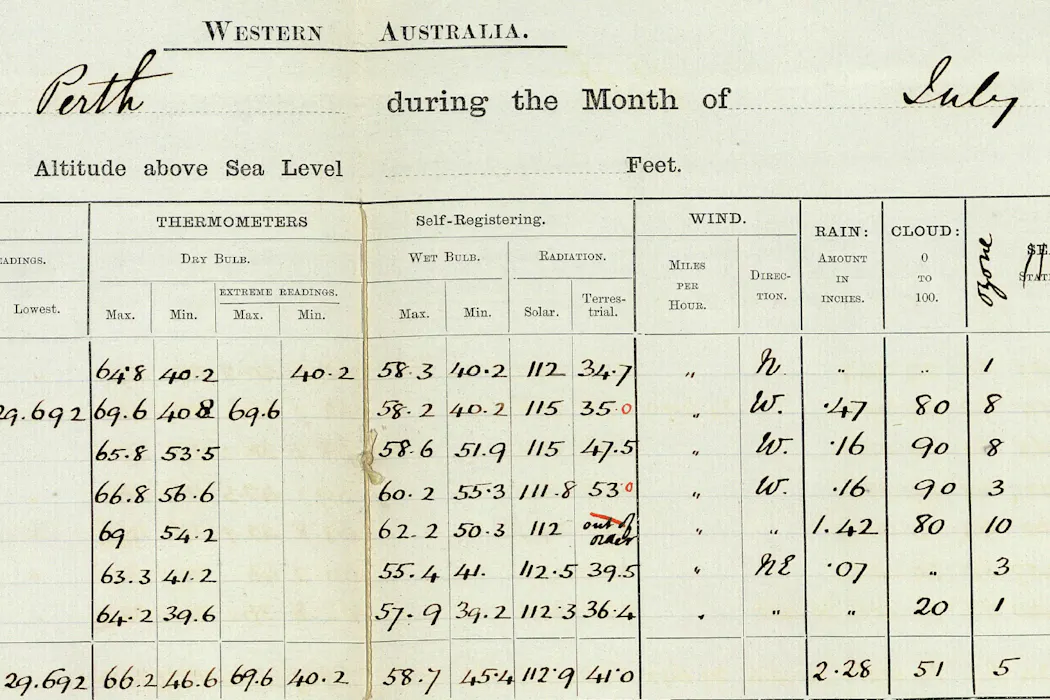
Data used by the BoM to study long-term weather and climate typically begin in the early 1900s. But older weather records do exist in state and national archives – we just need to “rescue” them. This means digitising fragile journals and transcribing historical observations for weather and climate research.
There have been past weather data rescue efforts in Australia, but these mostly focused on temperature and rainfall. Pre-1955 barometer readings – measurements of atmospheric pressure – for most Australian capital cities are only available in the BoM’s original handwritten meteorological registers.
By recovering these historical observations, we mapped the large-scale atmospheric circulation patterns that drive extreme weather – from low-pressure storm systems to high-pressure heatwaves. This allowed us to reconstruct past weather maps, day by day, all the way back to 1830.

BOM SARO Weather Folios, Australian Meteorological Association, Adelaide, CC BY
We focused on the data rescue of multiple daily pressure readings from Perth. This work provides the “missing link” between the BoM’s pressure observations available for the city from 1942, and our team’s previous data rescue efforts, including a citizen science project to transcribe 19th century materials.
What did the records show?
We consolidated 196 years of weather data from four historical sites:
- Swan River (1830–1875)
- Perth Gardens (1876–1900)
- Perth Observatory (1897–1908).
- Perth Regional Office (1907–1944).
This work builds on our previous analysis of daily temperature extremes in Adelaide, allowing us to evaluate long-term changes in severe storms in another important area of southern Australia.
We identified 141 severe storms that impacted Perth between 1830 and 2024. We cross-checked these against historical material, including newspaper articles.
For example, on June 17 1927, a “terrific wind and rain storm” impacted Perth with a record wind speed of 128km per hour, causing extensive damage to buildings and infrastructure. It was reported as a storm of “cyclonic strength”, which wasn’t just media exaggeration – such high wind speeds are classified as a category 2 tropical cyclone today.

National Library of Australia, CC BY
Why are winter storms declining?
The decline in Perth’s winter storms since 1970 is linked to changes to the Hadley cell – a major atmospheric circulation pattern that influences the Earth’s climate.
This large-scale pattern is responsible for moving heat from the equator toward the poles, creating wet rainforests at the equator and dry desert zones in the subtropics.
As increasing greenhouse gases and ozone depletion heat the atmosphere, the Hadley cell is expanding. In Australia, this is pushing the subtropical high-pressure desert belt poleward. In turn, this weakens the rain-bearing westerly winds and the storm fronts that usually travel across our southern coastline, reducing rainfall across the southern mainland.
Since the 1970s, this process has triggered the drying of subtropical regions around the world, including southern Australia, southern Africa, and the Mediterranean.
Southwestern Australia is recognised as a global climate change hotspot, having experienced a dramatic 20% decrease in winter rainfall since 1970.
Until now, studies tracking the pathway of past storms were confined to the mid-20th century onward, when modern datasets begin. Most studies have also focused on the Northern Hemisphere where long-term pressure records are more common.
Looking back to look forward
Our extended analysis shows the modern decline in storms hitting Perth is unusually persistent. The decade from 2010 to 2019 had fewer storms than any other decade since 1830.

CC BY
Our analysis also identified a long dry period between 1830 and 1846 that was actually drier than our current rainfall deficit.
While the modern decline is more relentless, this historical dry spell suggests that modern weather observations don’t capture the full range of natural variability and extremes.
This means future climate risk is likely being underestimated in Perth, and across Australia in general.
Historical observations are our best way of filling crucial gaps in Australia’s climate records, allowing us to sharpen our forecasts of future weather extremes in a warmer world.

Joëlle Gergis has received funding from the Australian Research Council in the past. She is a former Councillor and current Fellow of the Climate Council.
Jarrad Rowe has received an Australian Research Council Centre of Excellence for Climate Extremes funded scholarship in the past.
Linden Ashcroft has received funding from the Australian Research Council (ARC) and is affiliated with the ARC Centre of Excellence for 21st Century Weather. Linden is a Fellow of the Climate Council.
Original source: https://analysis1.mil-osi.com/2026/07/28/what-two-centuries-of-perth-storm-records-tell-us-about-future-climate-risk/