

Source: The Conversation (Au and NZ)

The spidery wattle (Acacia araneosa) is a national treasure.
This plant is named for its spidery, leaf-like phyllodes and shares the same iconic golden flowers as Australia’s floral emblem, the golden wattle (Acacia pycnantha).
The spidery wattle is extremely rare, found only in a tiny area of South Australia’s Arkaroola Wilderness Sanctuary and Vulkathunha-Gammon Ranges National Park. This, alongside its unusual appearance, makes it a distinctive and beloved part of the landscape.
But this local icon is under threat. In the late 1830s, the first pastoral leases – which allowed livestock grazing on government land – were granted in South Australia. This significantly reshaped the state’s landscapes and ecosystems.
Our new study shows since that period, the spidery wattle population has drastically shrunk by about 98%. If this trend continues, the future of this unique species looks grim.
Thankfully, we can do something about it.

Emily McAllan
A perplexing plant
The spidery wattle has long puzzled scientists.
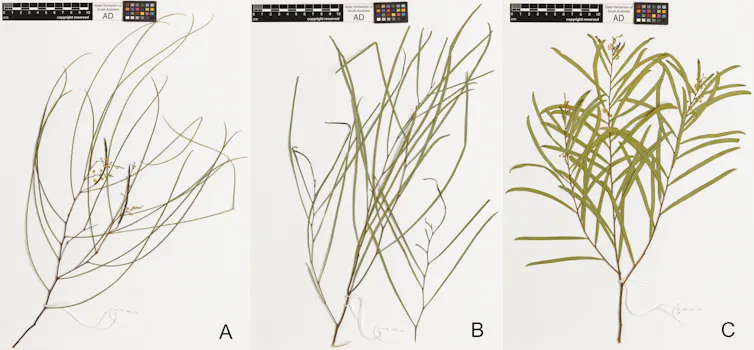
For years, researchers studying this unassuming plant noticed seed from the spidery wattle would sometimes “revert” to the form of another common wattle species, the silver wattle (Acacia rivalis). The silver wattle is a more widespread species than the spidery wattle, but grows in the same area.
This phenomenon could be explained by phenotypic plasticity — the ability of an organism to modify its physical traits or behaviour in response to environmental changes. This is fairly common in the plant world, with one example being Hydrangea flowers that change colour depending on soil pH levels.
These observations raised a crucial question: are spidery wattles just silver wattles that have changed form to suit local conditions?
It can be difficult to get funding for conservation efforts, so if we are to protect a plant or animal, it better be a “real” species!
Our latest research reveals, for the first time, the spidery wattle and silver wattle are indeed two distinct species. But we found these plants can hybridise in the wild, meaning the “reverted” seeds scientists observed were very likely hybrid seeds.
Why genes matter
We know of only two small spidery wattle populations, growing very close together on the hills of the Arkaroola Wilderness Sanctuary. Data from the mid-1990s suggests there were about 1,000 individual plants in total. This figure has almost certainly decreased since.
Despite being within shouting distance of each other, these two populations are genetically distinct. This is concerning because when populations shrink, they can rapidly lose genetic diversity. This is due to a process known as “genetic drift”, where the number of different genes in a small population randomly fluctuates.
Brittany Hogben
It’s also more likely that individual plants with similar genes will interbreed. This means two small populations of 50 individuals are more vulnerable to pests, disease and environmental change, compared to a single population of 100.
This was the case with the Florida panther, a species once found across the south-eastern United States. In the 1980s, this panther population rapidly shrank, leading to inbreeding and the birth of many unhealthy kittens.
Worryingly, our research suggests the two remaining spidery wattle populations are already showing signs of being less genetically diverse.
A species under threat
Local observations suggest adult spidery wattles cope reasonably well in hot and dry conditions. However, their tiny seedlings are extremely vulnerable to drought and introduced herbivores such as rabbits, goats and sheep.
Over the past few millenia, Australia’s weather has become more dry and unpredictable. Our research shows these climatic changes have had a marked impact on the spidery wattle. This is because seedlings struggle to reach maturity in drought conditions, affecting the overall health of the spidery wattle population.
We found the species started declining roughly 3,300 years ago. Other research shows the now-extinct Tasmanian tiger disappeared from mainland Australia at this time, due to the same climatic changes.
However, the spidery wattle population started declining much faster once humans settled in South Australia and started farming from 1836 onwards. In the intervening years, the spidery wattle population has shrunk by roughly 98%.
So, what can we do?
Together, these factors mean the spidery wattle is now on the brink of extinction. However, work is already underway to ensure this unique species survives.
A passionate group of South Australian conservationists are spearheading efforts to set up exclusion fences, which stop herbivores from grazing spidery wattle seedlings. Through restoration planting, they have also grown and planted seedlings to boost the size of existing populations.
Importantly, about 2,000 spidery wattle seeds are being preserved in South Australia’s Botanic Gardens and the United Kingdom’s Millennium Seed Bank.
But there is still more we can do.

Emily McAllan
Currently, the spidery wattle is listed as a “Vulnerable” species federally, and “Endangered” at a state level. Given the two remaining populations are still at risk, it’s time we recognise it as a “Critically Endangered” species in Australia.
The spidery wattle should also be added to the International Union for Conservation of Nature’s Red List. These listings would support conservationists and policymakers to secure the funding needed to protect this iconic species.
We dedicate this work to the memory of Martin O‘Leary of the South Australian Herbarium, whose contribution to this study was crucial. A leading plant taxonomist in South Australia, Martin brought warmth and enthusiasm to his work, with a particular kindness to students. We are grateful for the privilege of working with him.

Brittany Hogben receives funding from the Australian Research Council. She is affiliated with Adelaide University, as well as other not-for-profit and professional associations including the Biology Society of South Australia and Society for Wildlife Forensic Science.
Andrew Lowe receives funding from the Australian Research Council and other Australian government sources. This work was supported by a grant from the Threatened Species Initiative of BioPlatforms Australia. He is a board member of Landscape South Australia – Hills and Fleurieu.
During this work, Colette Blyth was affiliated with Adelaide University and the University of Natural Resources and Life Sciences, Vienna. Funding for this project is from the Threatened Species Initiative via Bioplatforms Australia.
James B. Dorey is affiliated with the University of Wollongong and Flinders University. He is also affiliated with other professional associations including the Australian Native Bee Association, Australian Entomological Society and Australian Ecological Society.
Original source: https://analysis1.mil-osi.com/2026/07/16/this-rare-australian-wattle-is-on-the-brink-of-extinction-new-research/