

Source: The Conversation – USA
Most people probably aren’t thinking about the complexity of nature when they get stung by a bee or prick their thumb on a rose. They are probably just thinking, “Ouch, that hurts!”
Even at this level of interaction, however, it is obvious not all things in nature that poke you are created equal. The rose prickle may draw blood, while the bee sting can leave an itchy rash.
The act of puncture – stabbing something with a sharp tool – is incredibly widespread in the natural world. Examples of puncture tools can be found everywhere: in mammals, snakes, birds, fish, insects, snails, jellyfish, plants, fungi, bacteria and even viruses. Their proliferation leads to a contradiction: If all of these puncture tools do essentially the same thing – stab – why do they look, and sometimes behave, so differently?
It is this contradiction that has captured my curiosity as a scientist who studies biomechanics, a field that uses physics to understand biological diversity. For the past 10 years, my lab members and I have examined the physics of puncture in an attempt to understand the wide diversity of puncture tools that appear in the natural world.
In a recent paper, we examined 143 species and found a wonderfully complex relationship between the shape of a puncture tool and what it is being used for.
The right tool for the job
Puncture tools are used for a variety of different jobs, and those jobs often dictate how the puncture tool evolves.
For example, vipers use their fangs to inject venom into their target. This injection occurs during a strike, where the snake needs to puncture, inject and then remove their tooth and head afterward. Not surprisingly, the fangs evolved to be smooth, so they can be removed from prey easily after puncture and injection.

Usman Ahmad/Flickr, CC BY-SA
Not all puncture tools want to be removed.
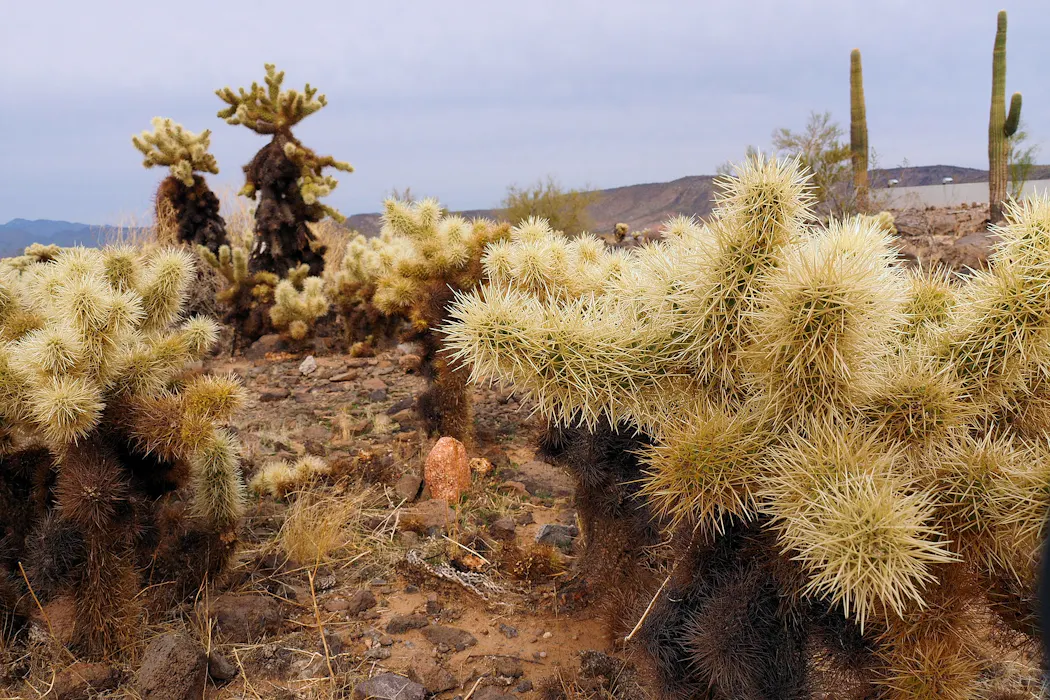
The jumping cholla is a cactus that reproduces via the spread of clones. When animals brush against the cactus, part of the cactus gets stuck to them, tears away from the main plant and hitches a ride. Eventually, the stowaway cactus drops off and becomes a new individual. The reason the cholla can ride along so well is that its spines are covered in backward-facing barbs that ensure they get stuck in the skin of their ride.

Corey Taratuta/Flickr, CC BY
Even within a seemingly related group of animals, there can be major differences.
In a behavior straight from a horror film, parasitoid wasps inject their eggs into other animals, where they hatch and consume the host. However, the various hosts of these parasites can live in a variety of places, such as in figs, leaves or even deep in rotten wood. As a result, different parasitoid wasps have evolved a wide variety of stinger shapes and sizes to deal with this variety of targets.
For example, wasps that target hosts that hide deep in materials such as fruit or rotted wood have particularly long stingers. These long stingers can actually be steered through the material to find the hiding host.

Boris Hrasovec, Faculty of Forestry, Bugwood.org., CC BY-NC-ND
Strange bedfellows
If evolution pushes puncture tools toward certain shapes to deal with specific jobs, what happens if tools from both an animal and plant have essentially the same job? In these cases, evolution can lead to striking similarities.
Take the jumping cholla cactus mentioned above. Its backward-facing barbs resemble overlapping tiles on a roof. This same pattern of barbs has been found on porcupine quills.
Even though these tools are made from very different materials, and one is a plant while the other is an animal, they have converged on a similar shape because both need to get stuck in whatever they are puncturing.
As another example, here’s a riddle: When is a snail like a shark? When it uses its love dart.

Joris M. Koene and Hinrich Schulenburg/BMC Evolutionary Biology, 2005, CC BY
Many land snails have both male and female genitalia. When these snails exchange sperm during mating they repeatedly stab each other with a structure called a love dart. These darts are covered with a substance that is thought to make their partner more likely to accept the sperm.
While scientists are still working out the details, it seems that some of these darts have a flat and triangular shape, potentially to allow for the dart to puncture deeper and create wider openings for the substance to infiltrate. These darts are shaped a lot like a shark tooth, another puncture tool used to create deep and wide openings when biting into prey.

Jon Zander (Digon3)/Wikimedia Commons
Nature is complex
These examples are just the tip of the iceberg when it comes to puncture tool shape and diversity.
Yet across this vast diversity, all it takes to find commonalities is an understanding of the underlying physics of how these tools are used. This is the power of interdisciplinary fields, such as biomechanics, which allow scientists to find the connections and patterns between seemingly disparate things.
So the next time you get bitten by a mosquito or step on a sea urchin, take a moment to marvel at the complexity of nature’s puncture tools … right after you cuss out whatever stabbed you.

Philip Anderson receives funding from the National science Foundation.
Original source: https://analysis1.mil-osi.com/2026/07/08/cacti-spines-snake-fangs-snail-love-darts-oh-my-how-function-drives-the-evolution-of-natures-puncture-tools/