

Source: Asia Pacific Report
A recent United Nations report has detailed serious allegations of Israel deliberately targeting Palestinian children during the conflict since October 2023.
The report by the UN Independent International Commission of Inquiry on the Occupied Palestinian Territory, including East Jerusalem and Israel, which has been rejected by the Israeli government, documents harrowing child deaths. It describes the scale of the deaths as “unprecedented”.
Legally, the report itself does not prosecute anyone, but it can have major consequences by adding to a growing record of international law evidence.
READ MORE: Israel continues to commit genocide and other atrocity crimes by deliberately targeting Palestinian children
Israel’s deliberate targeting of Gaza children part of genocide: UN inquiry
The Gaza doctrine – Israeli ‘journacide’ and the muted NZ media response
Other Gaza genocide reports
An independent investigation
The commission is a standing investigative body created by the UN Human Rights Council in May 2021 after the escalation in Gaza and East Jerusalem that year.
Its mandate is unusually broad and ongoing. It is tasked with investigating all alleged violations of international humanitarian and human rights law in Israel and the Occupied Palestinian Territory, identifying root causes and preserving evidence for accountability.
Since Hamas attacked Israel on 7 October 2023, the commission has published several reports on the conflict, including on the deaths of Israeli children.
This latest report is significant because it focuses specifically on children, examining the impact of Israeli military operations on Palestinian children between October 2023 and March 2026.
The report notes that the commission sent requests for information to the State of Palestine, the Ministry of Health in the Gaza Strip and the Israeli government. The first two responded, but the latter did not.
Four major findings
The commission’s report makes four highly significant findings.
1. The scale of child deaths is unprecedented
The report finds more than 20,000 Palestinian children have been killed and more than 44,000 injured since October 2023.
The commission says the “overwhelming scale and rate of children killed and injured in Gaza have been unparalleled across modern conflicts globally”.
UNICEF describes the Gaza Strip as “the most dangerous place in the world to be a child”.
2. Evidence of deliberate targeting
This is the report’s most legally explosive finding. It documents repeated incidents of children being killed by single sniper or drone shots, often in the head or upper torso, suggesting deliberate targeting rather than incidental harm.
Cases such as Hind Rajab and other children shot while evacuating or sheltering are central examples.
Doctors on medical missions in Gaza reported to the commission that it appeared Israeli Defense Force (IDF) soldiers were engaged in a “game” of target practice with “different body parts being targeted on different days”.
The commission concluded that based on forensic evidence and military analysis, there are reasonable grounds to believe some children were deliberately targeted.
3. Systematic attacks on child-essential infrastructure
The report documents attacks on hospitals, schools and orphanages, which enjoy special protection under international law. The commission found these attacks have directly contributed to preventable child deaths, long-term disability and educational collapse.
The commission’s findings raise serious questions about whether those special legal protections were respected, especially where attacks disrupted paediatric care, neonatal treatment and emergency surgery.
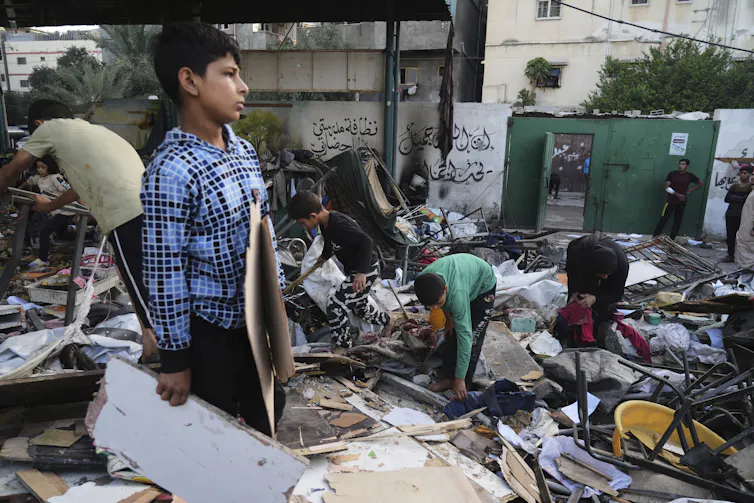
4. Arbitrary detention, torture and sexual violence
The report documents patterns of child detention, ill-treatment and abuse in custody.
The commission noted that dehumanising rhetoric by political leaders, soldiers and public figures has normalised violence against Palestinian children and contributed to an environment where such harm becomes acceptable.
How do these findings fit with international law?
This report is important because it reframes the war not only through the lens of civilian casualties, but through special legal obligations owed to children.
International humanitarian law and international human rights law apply concurrently in the Occupied Palestinian Territory. This is because Israel retains effective control over its borders, airspace and territorial waters, and has re-established military control on the ground.
As an occupying power, Israel has specific obligations under the Fourth Geneva Convention. These include ensuring food, medical care and the protection of civilians, especially children.
Under the Convention on the Rights of the Child, Israel must protect children’s rights to life, survival and development. It must prohibit arbitrary detention, torture and deprivation of life. It must also ensure the best interests of the child remain a primary consideration in all actions affecting them.
The commission’s conclusions are stark: children have not simply been caught in the crossfire of war. Many appear to have been deliberately targeted, denied essential care, detained, tortured, displaced and subjected to conditions that threaten their survival.
It reframes the suffering of Palestinian children not as collateral damage alone, but as a possible site of serious international crimes.
Serious legal questions
Many of the acts documented in the report amount to war crimes and crimes against humanity.
If children were deliberately targeted, this would constitute a grave breach of the international humanitarian law principle to distinguish combatants from civilians.
The sheer scale of child deaths raises serious concerns about whether Israeli forces have been adhering to the proportionality analysis: if civilian harm is excessive compared with the concrete military advantage anticipated, the attack is unlawful.
Parties must take all feasible precautions to minimise civilian harm. The report argues Israel’s use of heavy explosive weapons in densely populated civilian areas indicates repeated failures of precaution.
Israel at the UN: “This council has heard the same accusations against us again & again.. that Israel intentionally targets doctors, aid workers & journalists”
Yes, because you’ve murdered hundreds of doctors, aid workers & journalists. pic.twitter.com/9gMhanyYBa
— Saul Staniforth (@SaulStaniforth) June 30, 2026
Adding to the evidence record
In international law, accountability is often slow, but reports like this help build the legal architecture for future prosecutions.
The findings may feed directly into ongoing investigations by the International Criminal Court (ICC) into alleged crimes in Palestine. The commission explicitly recommends further scrutiny by the court.
States could rely on this evidence in domestic prosecutions under universal jurisdiction. This allows domestic courts to hear cases alleging international crimes, regardless of where the crimes occurred, or the nationality of the victims or perpetrators.
States may also impose targeted sanctions or arms embargoes based on credible findings in UN reports documenting serious violations of international humanitarian law, even without a court ruling.
The findings could shape arguments in existing and future proceedings before the International Court of Justice, particularly around genocide and occupation.
Under international law, children are supposed to be the most protected people in war. The children of Gaza have not just suffered in the war, they have become one of its defining legal fault lines.
Shannon Bosch is associate professor (law) at Edith Cowan University. Republished from The Conversation under Creative Commons.
Original source: https://analysis1.mil-osi.com/2026/06/30/a-un-report-details-the-overwhelming-scale-of-children-killed-in-gaza-it-raises-grave-legal-questions-2/