

Source: Asia Pacific Report
COMMENTARY: By Lim Tean
In 1904, a British geographer named Halford Mackinder stood before the Royal Geographical Society in London and delivered what would become the most prophetic warning in the history of geopolitics:
“Who rules the Heartland commands the World Island. Who rules the World Island commands the World.”
Mackinder’s insight was deceptively simple. The world’s greatest landmass — Eurasia and Africa combined, what he called the World Island — contained resources, populations and industrial potential that dwarfed anything that maritime powers could master.
READ MORE: China built the railway Iran needed — America’s strategy is obsolete
How the US naval blockade has bled Iran of nearly $6bn in oil revenues — but rail may change this
Other war on Iran/ceasefire reports
The only thing preventing a land-based power from dominating was geography. The Heartland — that vast Central Asian interior was inaccessible to navies. No fleet could project power into the steppe.
But railways could unlock it.
Mackinder was watching Tsarist Russia’s railways push southward through Central Asia and issuing a warning to Britain: if any single power ever consolidated the Heartland by rail, British naval supremacy would become irrelevant.
The world’s oceans, which made Britain great, would become a moat around a fortress someone else owned.
Britain took the warning seriously.
Keeping Eurasia divided
America, inheriting Britain’s role as the guardian of the maritime order, built its entire grand strategy around preventing exactly this — keeping Eurasia divided — contested, and dependent on American-controlled sea lanes.
For 70 years, it worked.
Xian. The ancient capital of China. The city where the original Silk Road began 2000 years ago, where camel caravans loaded with silk, spices, and porcelain departed westward into the vast Central Asian steppe, threading through kingdoms and deserts toward Isfahan in Persia.
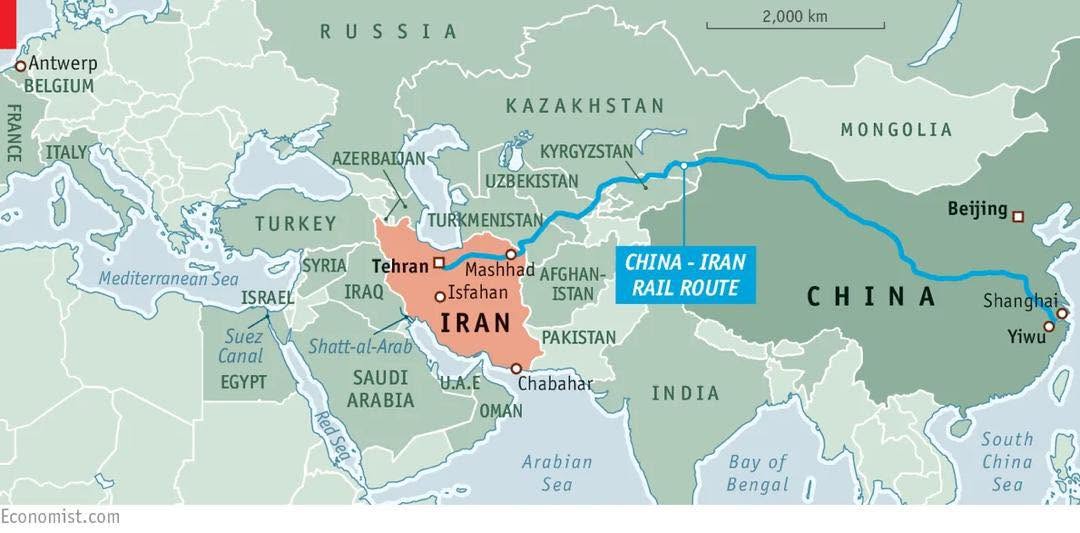
Today, freight trains depart from Xian’s modern logistics terminals heading in the same direction. Not on camels. Not in weeks. In 14 days — 10,400 km threading through Kazakhstan, Uzbekistan, Kyrgyzstan, and Turkmenistan before arriving in Tehran.
History doesn’t repeat. But it rhymes with astonishing precision.
Since the outbreak of the US-Israel war on Iran, something remarkable has happened on that Xian-Tehran rail corridor.
Train schedules have increased by 300 percent weekly.
Bypassing the US and its Strait if Hormuz blockade Video: BeyondTheBuild
China is simply ‘going around’
Think about what that means. America’s naval assets — the most powerful maritime force in human history — are positioned around the Strait of Hormuz, squeezing Iran’s maritime trade. The blockade is real. The pressure is real.
And China is simply going around it.
Not through diplomatic protest. Not through UN resolutions. Through railways threading through the Heartland — through exactly the geography that Mackinder identified as impervious to naval power 120 years ago.
Every freight train that departs Xian is a Mackinderian argument made in steel and diesel. American carrier groups cannot follow it. American sanctions cannot easily interdict it.
American naval supremacy, the foundation of the post-war international order, is geographically irrelevant to a train crossing Kazakhstan.
This isn’t improvisation. China didn’t build this corridor in response to the current crisis. It built it years in advance — patiently, methodically, as part of the Belt and Road initiative — precisely because Chinese strategists understood that America’s ultimate weapon was control of sea lanes.
The answer to sea lane control is to not need the sea lanes.
Belt and Road strategy
The Xian-Tehran railway passes through four Central Asian republics — all former Soviet states that Russia once controlled, that America tried to court after 1991, and that China has now quietly bound into its infrastructure network through investment, loans and railway agreements.
The April 2024 four-party tariff agreement between China, Iran, Kazakhstan, and Turkmenistan established unified tariffs and guaranteed transit times. The corridor was operationalised before the crisis that would make it indispensable.
That is strategic foresight of a very high order.
What China has done with Belt and Road is achieve what Mackinder feared most — Heartland consolidation — not through military conquest but through commerce.
The Central Asian republics are now threaded into China’s logistics networks. Iran is bound to China through a 25 year comprehensive cooperation agreement.
Russia, weakened by Ukraine, watches Chinese influence expand into its former backyard with limited ability to resist. The Heartland — from Xian to Tehran, from the Caspian to the Pamirs, is quietly reorganising around Chinese economic gravity.
Shift in world power balance
Mackinder warned that this moment, if it ever came, would represent a fundamental shift in the balance of world power. He wasn’t wrong about much.
America’s blockade of Hormuz operates on a 20th century assumption — that controlling the maritime chokepoint controls the relationship. That assumption holds when there is no alternative. It weakens precisely as alternatives are built.
Iran’s trade with China — its economic lifeline — is increasingly flowing overland. The railway that cannot be blockaded is running at 300 percent of its pre-war schedule. China and Iran are simultaneously accelerating the electrification of Iranian rail infrastructure, deepening the corridor’s capacity further.
Russia completed its first freight run to Tehran through Kazakhstan and Turkmenistan in November 2025. The overland architecture is not just surviving the blockade — it is being reinforced by it.
This is what strategic infrastructure looks long when it was designed with exactly this contingency in mind.
Mackinder died in 1947, just as America was assuming Britain’s mantle as the world’s pre-eminent maritime power. He spent his final years anxious that the lesson of the Heartland had not been properly absorbed.
Standing in Xian today, watching freight trains loaded with Chinese goods depart for Tehran through four Central Asian republics, along a route that American naval power cannot touch — one suspects that he would feel a complicated mixture of vindication and dread.
The railway is 10,400 km long.
It is also in a very real sense, the distance between the world America built and the world that is coming.
Lim Tean is a Singaporean lawyer, politician and commentator. He is the founder of the political party People’s Voice and a co-founder of the political alliance People’s Alliance for Reform.
Original source: https://analysis1.mil-osi.com/2026/06/09/the-train-the-changes-everything-the-silk-road-railway-beats-blockade/