
Source: The Conversation (Au and NZ) – By Imogen Wegman, Lecturer in Humanities, University of Tasmania
On November 18 1909, greengrocer Claude Nam Shing was woken up by shouts of “fire”. He found his store, on the corner of Elizabeth and Melville Streets in central Hobart, ablaze.
He escaped quickly. The fire brigade arrived and the fire was doused. Nam Shing’s stock suffered little damage, unlike his neighbour’s paint shop. Hobart’s newspapers cheered, as such damage to these old buildings would surely hasten their replacement. Today on this corner stand several buildings dating back to 1914.
It’s stories like Nam Shing’s that we’ve been chronicling as part of our research project, called Everyday Heritage. We’ve been investigating the lives of Chinese migrants and their descendants in Tasmania in the late 19th and early 20th centuries.
After mapping 105 “Chinese” addresses across the centre of Hobart, we found these businesses were scattered across the whole city. So while Tasmania’s capital has never had a Chinatown like Melbourne or Sydney, the footprint of Chinese migration remains all over the city to this day.
White-washing the past
Claude Nam Shing was an immigrant from China who arrived in Australia in the mid-1890s, making Tasmania his home for more than 40 years. In the 1911 census, he was one of 353 men in Tasmania who reported China as their birthplace – a reduction of more than 30% from the state’s peak in 1891.
After federation, the Australian government introduced the White Australia Policy, a series of discriminatory laws and policies designed to limit non-white immigration and restrict the rights of non-white residents.
Some immigrants of colour and their families chose to leave Australia, while others sought new opportunities by joining larger communities in cities like Melbourne and Sydney.
This internal migration coincided with urban renewal that saw accidental fires tear through ramshackle wooden storefronts and investment in modernised streetscapes.
In places that never had the population density for a Chinatown, early Chinese communities might seem to leave little tangible trace. But such an absence does not necessarily mean the absence of a Chinese history.
Unearthing Hobart’s history
Our growing dataset comes from diverse historical sources including birth and marriage records, naturalisation records, newspapers and gravestones. We are extracting as many names, addresses, and dates as possible, so we can restore individuals and families of Chinese heritage to Tasmania’s history.
Most of the Chinese immigrants who came to Australia before the 1950s trace their heritage to the Pearl River Delta in southern Guangdong province.
In towns and cities across Australia, Chinese migrants built communities that were often based on networks of family and kinship, hometown origins and common dialects.
Those who came to Tasmania mostly came from one of two counties: Sunwui and Toishan (today known as Xinhui and Taishan in Mandarin), where the local dialects differ from the standard Cantonese spoken in Guangzhou and Hong Kong.
By mapping shops and businesses we found in Tasmania’s Post Office Directories, we could see those networks in action as businesses changed hands over the years, but stayed within the Chinese community.
From fruiterers to fancy goods
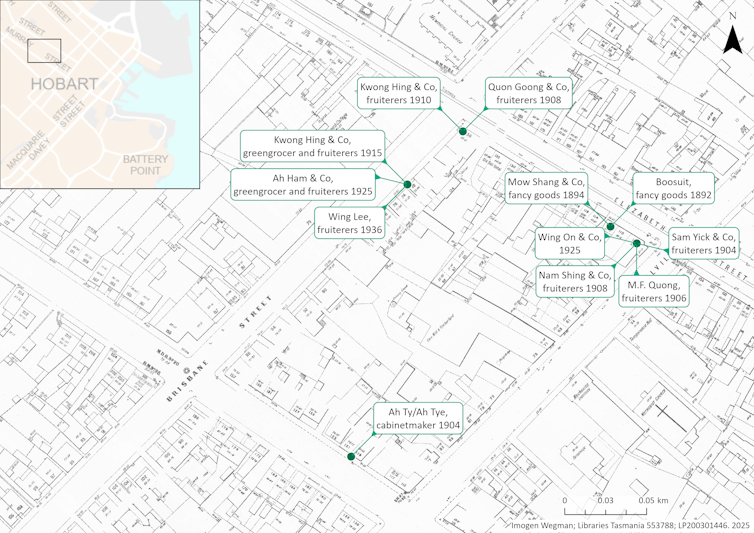
On one street corner, Alfred Wood’s “fruiterer” business was sold to Peter Quon Goong in 1907, then to Kwong Hing two years later. Within three years, this shop was known as the “Chinese fruiterers”, distinguishing it from at least four other fruiterers within a few doors.
Near another corner of this block, we found one of several Chinese cabinetmakers, Ah Tye. He may have chosen this property because it placed him conveniently close to the F&E Crisp timber yards.
The block could have been dominated by these yards. They filled half of it, and it’s had such longevity that the new university building we work in is called The Forest.
Instead, we see an array of industries – bootmakers, blacksmiths and boarding houses – and retailers including those run by Chinese migrants.
Along with greengrocers and fruiterers, Chinese Tasmanians operated confectionery and gift shops, and what were known as “fancy goods” stores. These sold “exotic” imports, and personal and household items.
In the 1890s on this block was the store of Vong (or John) Boosuit, who started as a hawker of fancy goods before becoming successful enough to start a bricks-and-mortar business.
Boosuit married Selina Findon, the daughter of an English convict, and today their descendants include actor Patrick Brammall.

The only time we found Chinese businesses clustered together in Hobart was when they required specific infrastructure. There were a few small groups of laundries tucked around the city, in locations we assume had a reliable water supply and enough space for drying washing.
Driving community spirit
Tasmania’s newspapers tell of the generosity of Chinese migrants towards their new home. Their shops not only served Hobart’s residents, they were also community hubs.
For nearly half a century, the fruiterers at Ah Ham & Co organised an annual fundraising drive for the main Hobart hospital, despite rarely using the hospital themselves.
Migrants and their children in a small city were comfortable moving between two of its most active cultures – British and Chinese.

Between 2011 and 2021, the population of central Hobart that speaks a language other than English at home nearly doubled, from 12.5% to 24%.
Rather than viewing this as a radical change for Australia’s island capital, it reads more as a rekindling of a history that was interrupted for more than 70 years by the White Australia Policy.
As we walk through the multicultural bustle of our inner-city university campus, we are following streets that were home to successful laundries, fancy good stores, tobacconists, fruiterers, grocers and restaurants run by immigrants well into the 20th century.
The descendants of Australia’s earliest Chinese migrants, many of whom still live in our rural and regional areas, should be proud of the central role their ancestors played in creating the towns and cities we have today. The built heritage may have gone or be hidden, but their stories linger waiting to be found in the written record.
– ref. Why doesn’t Hobart have a Chinatown? – https://theconversation.com/why-doesnt-hobart-have-a-chinatown-272260