
Source: The Conversation (Au and NZ) – By Hugh White, Emeritus Professor of Strategic Studies at the Strategic and Defence Studies Centre, Australian National University
In a dangerous and uncertain world, what should US allies do? Draw closer to America, or pull away?
When the United States under President Donald Trump is itself among the biggest drivers of danger and uncertainty, the answer seems obvious.
Canada’s prime minster, Mark Carney, spelled it out with brutal clarity in his attention-grabbing speech at Davos in January and again speaking to the Australian parliament last week.
Middle powers like Canada and Australia must stop depending on Washington and start working more closely together to navigate a world in which the idea of a US-led rules-based order is a fiction.
Prime Minister Anthony Albanese says he agrees with Carney. But there is a problem.
At a time when diplomatic realities, strategic imperatives and political expedience all suggest we should gently but firmly distance ourselves from Trump’s America, AUKUS ties us tighter than ever.
The need to step back from our US entanglements is clearer than ever as Washington plunges headlong into major war with Iran without any coherent strategic purpose. The way AUKUS deepens those entanglements is neatly symbolised by the presence of three Australian AUKUS trainees on the US fast-attack submarine that sunk an Iranian warship last week.
The world order has “ruptured”, Canadian Prime Minister Mark Carney has warned – so it’s time for countries like Australia and New Zealand to forge a new, less US-reliant future. In this new series, we’ve asked top experts to explain what that future could look like – and the challenges that lie ahead.
‘Full steam ahead’?
The Albanese government has embraced AUKUS as the central pillar of its defence policy and a fundamental reframing of our entire strategic posture. But the future of AUKUS hangs on the whim of the most mercurial and mendacious figure in world politics.
Canberra breathed a huge sigh of relief when Trump declared AUKUS as “full steam ahead” in his meeting with Albanese in October. He seemed to brush aside the doubts and questions that have dogged AUKUS ever since Labor announced it would require the US to sell Australia at least three Virginia-class submarines.
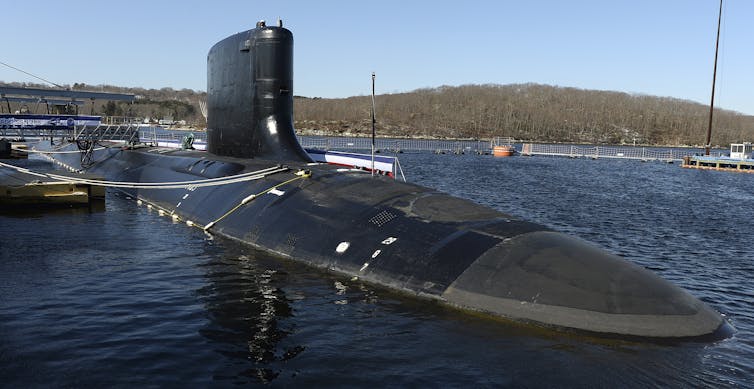
But those doubts remain. They were apparently spelled out in the Pentagon’s review of AUKUS completed just before Albanese’s visit.
Neither Washington nor Canberra has been willing to say what it concluded, beyond admitting it raised concerns about how to “do AUKUS better”. But it’s pretty clear what the concerns are.
Here are three pressing questions that remain unresolved:
Is the US prepared to give us subs?
First, there is the problem that America has no Virginia-class subs to spare.
Ever since the plan was announced, US Navy and Defence officials, as well as members of Congress, have warned the US could not spare subs for Australia unless its shipyards can double the rate of production. Confidence in AUKUS has always depended on blind faith this will happen.
But it is not happening. The US Government Accountability Office last year reported to Congress that between 2019 and 2023, the US shipyards were forecast to build 11 Virginia-class submarines. They delivered just four.
In December, a senior Pentagon official described the situation as “borderline frightening” and a major challenge to AUKUS.
Is Australia prepared to spend more on defence?
Second, there is the problem of defence spending. There is a lot of concern in Australian defence circles that the reported pricetag of up to A$365 billion over the next 30 years will distort the defence budget by pulling funds away from other vital defence capability investments. These worries are shared in Washington.
The idea that Australia is seriously expecting to build and operate a fleet of nuclear-powered subs while also maintaining and upgrading a wide range of other expensive capabilities on a defence budget that is planned to grow to only 2.3% of GDP by the mid-2030s is seen by US policymakers as delusional. Which it is.
This worries US defence planners. They don’t want AUKUS to starve the rest of the Australian Defence Force (ADF), because they expect Australia, as a close ally, to be able to offer a wide range of forces to US-led coalitions, not just submarines.
And they understand that even if the AUKUS plan goes like clockwork, Australia will not have a viable independent nuclear sub force until the mid-2040s at the very earliest. So, AUKUS will not work for America unless Australia starts spending a lot more on defence right now.
Would Australia go to war with China?
The leads to the most serious concern of all, given the events of the last week in the Middle East: the question of how confident Washington can be that Canberra would wholeheartedly support the US in a war with China.
That includes whether Australia would allow our bases to be used by US forces to attack China, and whether we would send out forces to fight alongside America’s. These are absolutely critical issues for US policymakers.
Unless they can be very confident about Australia’s commitment, it simply makes no strategic sense for them to base their forces here or sell us submarines that could otherwise strengthen their own submarine force.
And they are not satisfied by whatever nods and winks they may getting from the Albanese government.
This was made very clear just last month by Ely Ratner, the Pentagon’s highly-respected policy lead on the Indo-Pacific under the Biden Administration. Speaking in Canberra he said, there was a “need for very serious and deep alliance conversations about our expectations around roles and missions” if a war with China were to break out.
He plainly implied these conversations had not happened yet. And the Albanese government continues to insist that no such understandings or undertakings will be entered into.
Australia needs to think about an alternative
The deeper reality is that even if these problems can be addressed, AUKUS will do nothing help the US regain its maritime supremacy in the western Pacific, which it has lost as China’s capabilities have grown.
Fundamentally, that is because the US lacks the resolve to do what would be necessary to remain the region’s primary power.
In fact, AUKUS is a perfect symbol of this: historians will see it as an attempt by America to get Australia to pay to bolster US military power against China.
But Australia is not yet prepared to do the alternative, which is to start seriously taking responsibility for our own security in a region no longer dominated and made safe for us by our powerful friends.
We will not take that step until we stop pretending to ourselves and to Washington that AUKUS somehow makes that unnecessary.
– ref. AUKUS is binding Australia to a dangerous, unpredictable leader. We need a Plan B now – https://theconversation.com/aukus-is-binding-australia-to-a-dangerous-unpredictable-leader-we-need-a-plan-b-now-276364