
Source: The Conversation (Au and NZ) – By Eva Anagnostou-Laoutides, Associate Professor in Ancient History, Australian Research Council Future Fellow, Macquarie University
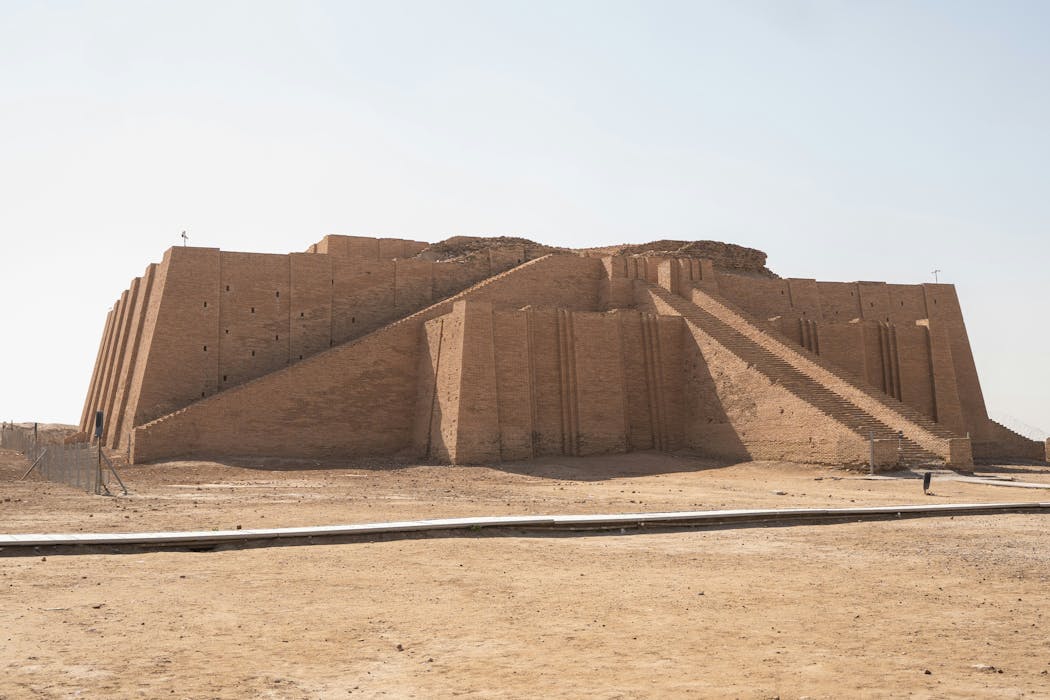
A ziggurat (also spelled ziqqurat) was a raised platform with four sloping sides that looked like a tiered pyramid.
Ziggurats were common in ancient Mesopotamia (roughly modern Iraq) from around 4,000 to 500 BCE.
Unlike the Egyptian pyramids, they were not places of royal burials, but temples dedicated to the patron deity of a city.
How were they made?
Stone was relatively rare in Mesopotamia, so ziggurats were mainly made of sun-dried mudbricks coated with limestone and bitumen (a sticky, tar-like substance).
Their sides were decorated with grooved stripes and were often plastered with lime mortar or gypsum and glazed in various colours.
Unlike the pyramids, they had no internal chambers. The actual shrine was at the top of the structure where the god resided. It was accessible by steps and was believed to be a meeting point between heaven and earth.
Ziggurats towered over the centre of ancient Mesopotamian cities; as archaeological evidence indicates, they were typically built next to the palace or the temple of a city’s patron god to stress the role of the god in supporting the king.
How the Anu ziggurat became the White Temple
The Anu ziggurat, the oldest known, was built at Uruk (modern-day Warka, about 250 kilometres south of Baghdad) by the Sumerians around 4,000 BCE. (The Sumerians were an ancient people, among the first known to have established cities, who lived roughly in the area of modern Iraq, between the Tigris and Euphrates rivers.)
This ziggurat was dedicated to Anu, their sky god. Sometime between 3,500 and 3,000 BCE, the so-called White Temple was built on top of it.
The White Temple, approximately 12 metres high, was so named because it was entirely whitewashed inside and out. It must have shone dazzlingly in the sun.
The Sumerian culture was eventually taken over by the Akkadian Empire, followed by the Babylonian and Assyrian Empires. Throughout the rise and fall of empires, ziggurats continued to be built in the Ancient Near East.
In fact, the word ziggurat comes from the Akkadian verb zaqâru, meaning “to build high”.
Other famous ziggurats
Assyrian kings built an impressive ziggurat in their capital, Nimrud (about 30 kilometres south of Mosul). This ziggurat was dedicated to Ninurta, a Sumerian and Akkadian god of war and victory.
Ninurta’s father, the god Enlil, was worshipped at the ziggurat of the sacred city Nippur, in modern-day Iraq.
The Babylonian king Nebuchadnezzar II dedicated the ziggurat Etemenanki to the Babylonian king of gods, Marduk. The name Etemenanki means the Temple of the Foundation of Heaven and Earth.
Etemenanki was located north of a different temple called the Esagil, which was Marduk’s main temple in Babylon.
Etemenanki likely inspired the story of the Tower of Babel in the Old Testament. Genesis 11 refers to a “tower” built of mud bricks instead of stone, which was intended to reach the heavens.
The building, perceived as an act of human pride, angered God, who caused the people to speak different languages and scattered them across the Earth.
According to the Greek historian Herodotus, Marduk often chose a woman to spend the night with him in the top-most shrine of his ziggurat.
The text has been often understood to refer to a “sacred marriage” rite involving the sexual union of a woman with the god.
However, it seems more likely to have been an incubation rite, when the god’s will is revealed to someone sleeping in a sacred place.
Constant preservation
Because of the relative lack of durability of mud bricks, ziggurats required constant preservation.
Etemenanki in Babylon had to be rebuilt several times until Alexander the Great ordered his soldiers to destroy it in 323 BCE so as to rebuild it from scratch.
However, Alexander’s premature death (historians continue to debate what he died of) meant the task had to be completed by his successors. But whether the rebuilding task was ever completed is uncertain.
Better preserved ziggurats include the Ziggurat of Ur (in the region of modern-day Tell el-Muqayyar in Iraq). The powerful king, Ur-Nammu, dedicated this ziggurat to the moon god, Nanna or Sîn, around 2100 BCE.
Another example is the ziggurat of Chogha Zanbil in modern Iran, which was built around 1250 BCE. It now stands only 24.5 metres tall, instead of the original estimated 53 metres.

Sam Moghadam Khamseh/Unsplash
A lasting influence on architecture
Ziggurats influenced architecture long after their demise, including the new tiered “skyscrapers” of the art deco era in the 20th century.
Modern ziggurats ended up dotting the New York skyline.

Kit Suman/Unsplash
And, if you look closely, you’ll see that there’s a fair amount of ziggurat about the Empire State Building.
These modern examples serve as a fascinating reminder of a design and construction language that goes back to the Middle East over six millennia ago.

Eva Anagnostou-Laoutides receives funding from the Gerda Henkel Foundation.
Michael B. Charles does not work for, consult, own shares in or receive funding from any company or organisation that would benefit from this article, and has disclosed no relevant affiliations beyond their academic appointment.
– ref. In ancient Mesopotamia, what was a ziggurat? – https://theconversation.com/in-ancient-mesopotamia-what-was-a-ziggurat-268658