
Source: The Conversation (Au and NZ) – By Robyn J. Whitaker, Associate Professor, New Testament, & Inaugural Director of The Wesley Centre for Theology, Ethics, and Public Policy
But little Lord Jesus, no crying he makes is a line from one of my least favourite Christmas carols. Apart from being generally saccharine, Away in a Manger depicts baby Jesus as something truly exceptional – a baby that does not cry.
Most of us know the basics of the story of Jesus’ birth. According to the ancient sources, he was born in Bethlehem to Mary and Joseph, Jews living in Israel in the first century CE. Traditional scenes depict him surrounded by animals, angels, shepherds and “magi” – possibly astrologers – from the east, who visited during the first year or two of his life. Then, most of these ancient sources go quiet, and Jesus does not appear again until he is an adult with a message and a ministry.
But what about his childhood? Do we know anything about Jesus as a child? Yes. And, no.
In the whole Bible there are only a handful of verses that speak about Jesus as a child. Matthew’s gospel includes one story about Jesus’ childhood. Matthew says that Jesus’ family fled to Egypt to escape a decree of King Herod to kill all Jewish baby boys under aged two. Joan Taylor, author of Boy Jesus: Growing up Judean in Turbulent Times, argues this is historically plausible, given the political upheaval of Jesus’ time.
Similarly, historian Robert Myles told me:
There is quite a lot we can say about the social and economic forces in Galilee during Jesus’ childhood, even though the Gospels are mostly silent on these details. In 4 BCE the Romans destroyed the nearby city of Sepphoris, close to Nazareth, and enslaved its inhabitants to suppress an uprising. If Jesus was born by then, he would have been a toddler, but stories about freedom fighters and the trauma of Roman retaliation would have circulated in Galilee for years afterward.
The impacts of such events created economic pressures, as well as displacement, for many.
Childhood in antiquity depended greatly on one’s social status, much like today. Mortality rates were high. Boys were generally prized much more highly than girls, who usually stayed in the domestic sphere and could be married as young as 12 or 13. Poor and enslaved children were extremely vulnerable to exploitation.
As a Jewish child, Jesus was likely educated in his home and the local synagogue. It would have been normal for a child in Galilee to live in a multi-generational home, and eat a diet that consisted mostly of legumes, bread, and vegetables.
For ancient authors, this would have been so banal as to not be worth mentioning.
Only in Luke’s gospel do we get a story about Jesus’ as a child. Luke describes that “the child grew and became strong, filled with wisdom” (Luke 2:40) and tells one story to illustrate the point.
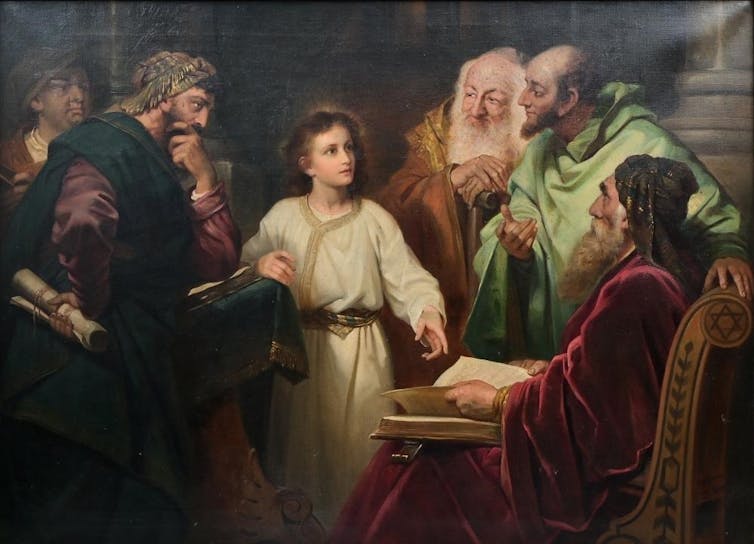
Twelve-year-old Jesus has been on an annual visit to the Jewish Temple in Jerusalem with his parents. When they leave, presumably travelling with a group, they don’t initially notice he has stayed behind and a search ensues. They eventually find him in the temple talking with the Jewish teachers who are “amazed” at his understanding. Despite Jesus displaying a lack of concern for his parent’s anxiety in this story, Luke explicitly states that he returned home with his parents and was “obedient”. That is the extent of insight into his childhood in the Bible: Jesus was both exceptional and obedient.
This lack of information about his childhood in the Bible did not, however, stop early Christians speculating about Jesus’ early life.
Wikicommons
The Infancy Gospel of Thomas, dating to the second century CE, is a speculative story about Jesus’ life as a five to 12-year-old. In this text the child Jesus is, quite frankly, a brat. He uses his powers to make living sparrows out of clay, he rearranges water with his words, and he curses other children and adults to death. A lot of them. (Most are miraculously saved later.) When the parents complain to his father Joseph about these things, Jesus curses them and they go blind.
Jesus is simultaneously depicted as unteachable and astonishingly wise, eventually taking on his teacher and amazing him with his innate and perfect knowledge of letters and the law. He does heal people and raise others from the dead, but overall the depiction is not particularly flattering – at least by modern standards. In The Infancy Gospel of Thomas, Jesus is like a tiny monster with endless power and no emotional regulation.
Such stories about Jesus’ childhood should not be considered history in any modern sense. They are a type of legend, told in the manner of ancient biography (bios), where a story about the childhood of a noteworthy adult might be narrated to point out the natural genius of the person.
Ancient biographies tended to be episodic and designed to highlight exceptional character or ability, although they did not often focus on childhood.
The intriguing question is why would early Christians think this is a good way to depict Jesus? It is quite a distance from the later “little Lord Jesus” who does not cry when he “lays down his sweet head”.
But like that hymn, The Infancy Gospel of Thomas makes a claim for Jesus’ exceptionalism. In its case, Jesus is depicted as having complete power over life and death and already knowing all things.
The Christian claim that Jesus was sinless has often been conflated with the idea of Jesus as perfect and possessing all knowledge. But what makes a perfect child? One who never cries? Who never has to learn anything? Such assumptions need to be interrogated.
In my view, remembering Jesus was a human child in the ancient world whose own family fled violence and oppression, reminds us that he has more in common with contemporary vulnerable children who are likewise born in unstable housing, grow up in occupied territory, or are threatened by violence.
Later Christian creeds – a kind of summary of core beliefs – such as the Nicene Creed, combat notions of superhero Jesus by emphasising his full humanity. While we might be curious about the kind of childhood Jesus had or the kind of child he was, it is Jesus as a fully human prophet, healer, teacher, and martyr who Christians consider the full revelation of God in the flesh.

Robyn J. Whitaker does not work for, consult, own shares in or receive funding from any company or organisation that would benefit from this article, and has disclosed no relevant affiliations beyond their academic appointment.
– ref. We know about Jesus as a baby, and as a man. But what kind of child was he? – https://theconversation.com/we-know-about-jesus-as-a-baby-and-as-a-man-but-what-kind-of-child-was-he-269183