

Source: The Conversation (Au and NZ)
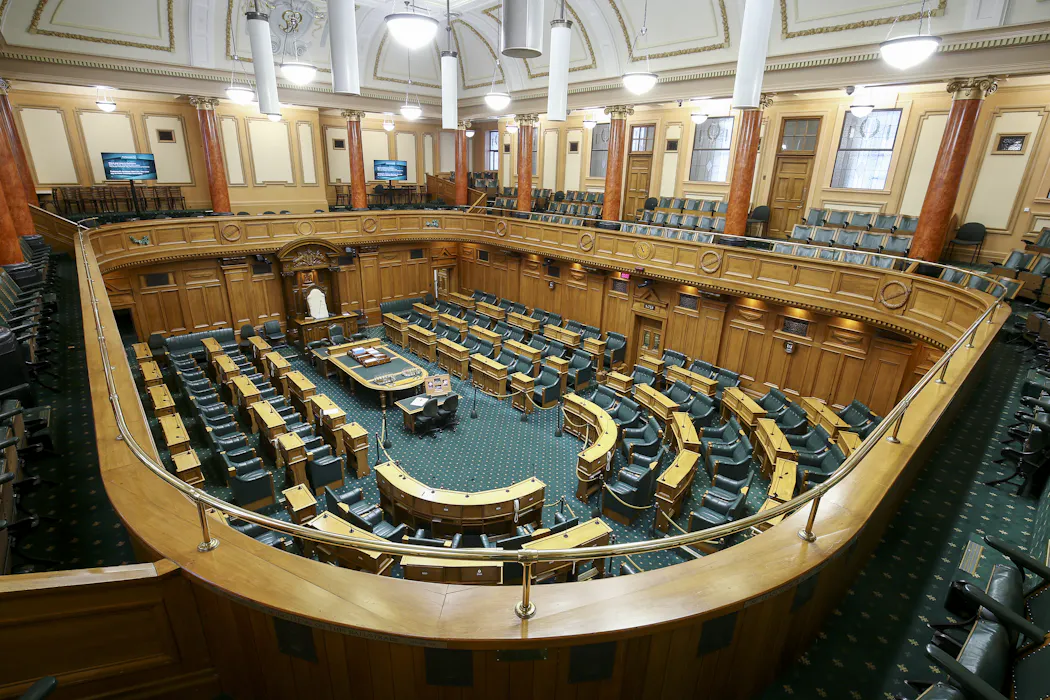
In all the debate about the problems with the MMP system thrown up by an unprecedented election result, there has been remarkably little discussion of the main factor threatening the proportionality of parliament.
That is the historically and comparatively small size of New Zealand’s parliament. In fact, historical statistics show parliament is now the smallest it has ever been relative to the total population.
Combined with other factors – strategic vote splitting and mismatched numbers of electorate and party-list seats – this has created the conditions for an unusually large overhang of parliamentary seats and a disproportionate outcome.
With final election results due on Friday, attention will inevitably focus on which parties might be able to form a coalition government.
But the overhang question will not go away, and any subsequent review of MMP must look at the logic of increasing the size of parliament.
Why is parliament so small?
When the first Labour government was elected in 1935, there were 80 MPs for a population of 1.56 million, a ratio of one MP per 19,527 people.
Parliament had 80 MPs until 1966, by which time the population had increased to 2.7 million, a ratio of one MP per 33,461 people.
The 1965 Electoral Amendment Act allowed the size of parliament to increase relative to North Island population growth. The number of MPs increased from 84 in 1969 to 99 in 1993.
Parliament increased to 120 MPs with the first MMP election in 1996 when the population was 3.6 million: one MP per 30,153 people.
Since then, parliamentary seats have remained fixed at 120 while the population has increased to 5,372,400 – an historically high ratio of one MP per 44,770 people.
The problem becomes even clearer when we compare the New Zealand parliament to those of other small countries with market economies, liberal democracies and broadly similar population sizes.
For example, Finland (population 5.7 million) has 200 MPs. Ireland (5.5 million) has a lower house consisting of 174 members. Norway (5.7 million) has 169 MPs, and Denmark (6.03 million) 179 MPs.
One factor contributing to the size of the current parliamentary overhang is that, since 1996, the number of electorate MPs has been adjusted upwards to match a rising population while the overall size of parliament has not.
Parliament ignored the 1986 Royal Commission on the Electoral System recommendation of maintaining a balance of 60 electorate seats and 60 list seats.
Instead, it set the number of electorate seats at 65 for the 1996 election, or 54% of the total seats at that time. This has since increased to 71 seats, in turn increasing the percentage of electorate seats in parliament.
Once the final result of the 2026 election is determined, electorate seats are likely to make up around 62% of a parliament enlarged by between nine and 11 overhang seats.
Larger parliaments are here to stay
MMP cannot ensure the proportionality of party representation with such a high ratio of electorate seats to list seats.
One solution would be to reduce the number of electorate seats. But this is unlikely to be supported by Te Pāti Māori or the centre-right parties, for whom electorate seats have become crucial.
A simpler solution would be to adjust the overall size of parliament. For example, an increase to 171 seats would generate a ratio of one MP to 31,418 people, only slightly higher than in 1996.
Assuming there were no overhangs, this would reduce the electorate seats to 41.5% of the total seats in parliament.
Improving the proportionality of party representation would also enhance the legitimacy of the electoral system, diminish the current dominance of the executive branch of government, and enhance the gender and ethnic representativeness of parliament.
In any case, the days of a 120-seat parliament are over. If no formal changes are made to the MMP system, future parliaments will continue to be substantially larger.
Parties will logically adapt to the new reality. For example, Labour and the Greens might respond to National’s hold over the electorate seats by reaching an agreement with Te Pāti Māori to split party and electorate votes.
This vote splitting strategy would likely create at least a six-seat overhang on the left. That could be augmented by Labour and the Greens adopting a shared strategy of encouraging voters to split their electorate and party votes in marginal electorates.
It’s the size, not the system
There are other aspects of the MMP system that could be changed, too. New Zealand could follow the German example and simply eliminate overhang seats. The 5% threshold for party representation could be reduced, and electorate seats set at less than 50%.
In the past, New Zealanders have displayed a preference for a smaller parliament. The citizens initiated referendum in 1999, which asked whether the House of Representatives should be reduced from 120 members to 99, saw 81.5% in favour of reducing the size of parliament.
But the outcome was largely due to widespread distrust of politicians resulting from the rapid implementation of unpopular neoliberal policies from 1984 to 1999. There would likely be more support for increasing the size of parliament now the disadvantages of a small one are becoming clearer.
Overall, political parties on the right tend to favour limiting or reducing the size of parliament, in keeping with their preference for smaller government. Parties on the left have (so far) displayed little appetite for increasing its size.
Ultimately, however, the issue will have to be addressed.
The problem of disproportionality caused by a large number of overhang seats – itself the result of strategic vote splitting and population increase over time – is largely due to the small size of parliament, not the electoral system itself.

Brian S. Roper is affiliated with the International Socialist Organization (ISO).
Original source: https://analysis1.mil-osi.com/2026/11/25/a-bigger-parliament-would-fix-the-overhang-problem-the-case-for-more-mps/