

Source: The Conversation – Canada
(Pixabay)
As adults, we may take for granted what we know about numbers and how we arrived at this knowledge — for example, when comparing item prices to get the best deals, or to get to appointments on time.
But the number system is composed of abstract symbols. To advance in math skills, young children need to learn what they mean. How would any of us know that the abstract numeral “5” represents the quantity of exactly five objects unless we had been taught?
Foundational numeracy skills like counting, recognizing numbers and understanding quantity are related to future success in school, university and careers.
The Assessment and Instruction for Mathematics (AIM) Collective is a network of researchers and educators committed to promoting the development of foundational numeracy skills across Canada. Researchers are familiar with evidence-based ways to assess children’s thinking and identify what skills are important for later success, and classroom educators are the experts at designing instructional activities to put this research into action.
Here, as members of AIM, we explore some key foundational numeracy skills and offer practical examples of how adults can foster them to support children’s numeracy development.
Counting and quantities
During a child’s early years, they should have opportunities to practise counting, beginning with smaller ranges (for example, up to five or 10) and gradually progressing higher. Counting songs, like “Five Little Ducks,” and books like The Very Hungry Caterpillar are great ways to practise the count sequence.
Practising the count sequence is important, but not sufficient, to support children’s developing numeracy. Young children can often recite the count sequence to five, 10 or even 20 before they really understand what the number words refer to.
If you ask a three-year-old who can recite numbers up to five to give you five goldfish crackers from a bowl, a child who has not yet linked the words to the quantities they represent may grab a handful of crackers. They have not yet learned how to use counting to find out how many objects are in a set, or to create a set of an exact number.
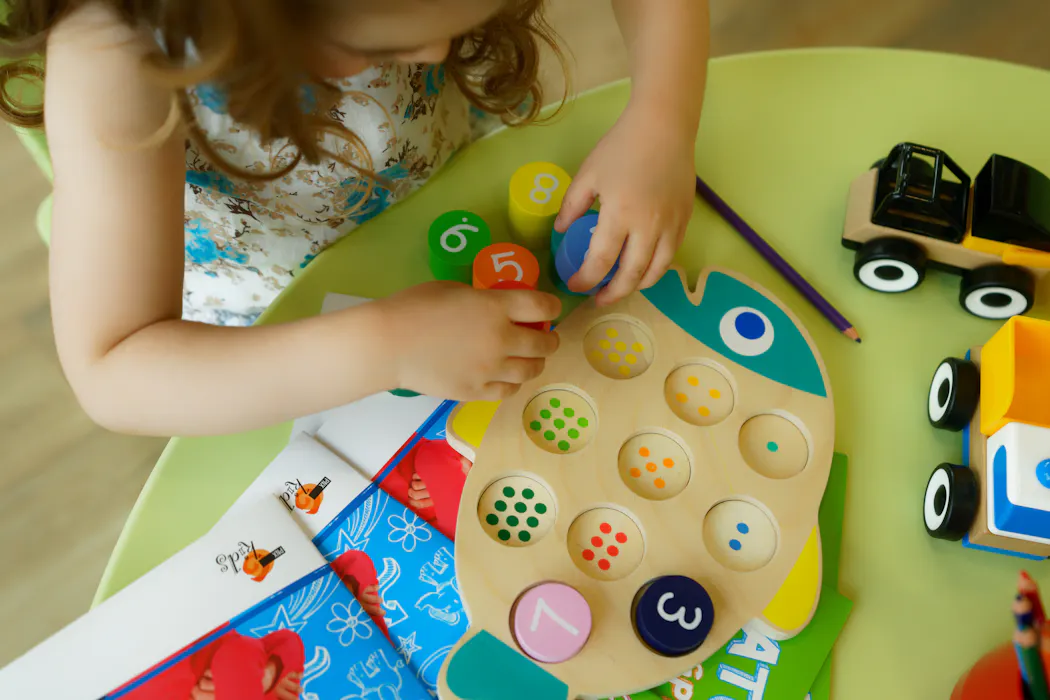
To help children learn to link the numbers to the quantities they represent, children should also have opportunities to practise counting objects, and matching different representations of number.
For example, playing a game like “Tiny Polka Dots” requires matching cards with numerals: like a “3” matched with images of three polka dots arranged in varied ways.
Patterning and ordering
Being able to use numbers with ease requires knowing not just the quantities numbers represent, but also the relations between the number symbols themselves.
Once children have mastered the count sequence, they should then move on to practise skip counting (for example, by twos or fives).
Researchers found that kindergarteners were much quicker at recognizing that the numerals 1, 2, 3 were in order than they were at recognizing that 2, 4, 6 were in order.
Many children said 2, 4, 6 were not in order because they aren’t next to each other in the count sequence. Activities putting different sequences in order along a number line can help children better understand relations between numbers.
Order applies to more than just numbers, and children can also practise putting things in order from smallest to biggest, or putting sequences of events in order.
Calendar routines in early years classrooms are another great way to show children how to use numbers to represent the passing of time, and to show sequences larger than 10.
Place value
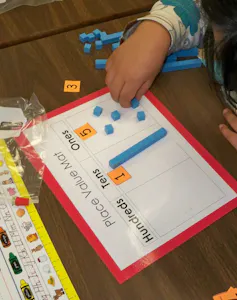
In the base-10 number system, a numeral’s position determines its value. For example, in the number 356, the numeral “3” represents 300 (three hundreds), the numeral “5” represents 50 (five tens), and the numeral “6” represents six (six ones).
(Chrissy Johnson1/Flickr), CC BY
Understanding this positional principle is essential for building children’s understanding of multi-digit numbers. Although children may intuitively recognize that larger numbers are generally longer than shorter ones, a solid understanding of place value enables them to develop a deeper and more accurate understanding of how multi-digit numbers are structured and represented.
To reinforce the notion of place value, children can be encouraged to represent multi-digit numbers with concrete materials, like base-10 blocks and objects bundled into groups of 10 (for example: popsicle sticks, straws), as well as visual tools, such as place value charts and as 10 frames.
Activities that focus on combining and breaking apart numbers by place value, like number bonds, can also strengthen children’s knowledge of multi-digit numbers.
Importantly, mathematics learning is hierarchical, and more advanced skills build on foundational ones. By supporting young children’s emerging understanding of number, we can help them develop strong foundations to support their later mathematics learning.

Rebecca Merkley receives funding from the Social Sciences and Humanities Research Council of Canada and Mitacs.
Alexandra (Sandy) Youmans receives funding from the Social Sciences and Humanities Research Council of Canada.
Original source: https://analysis1.mil-osi.com/2026/11/16/building-childrens-numeracy-foundations-involves-more-than-1-2-3/