

Source: The Conversation – UK
The behaviour of every atom, and so all of biology and chemistry as we know them, depends on the mass of the electron.
Electrons are one of the fundamental particles (the very smallest building blocks of nature) that make up the atom. They orbit the atom’s central nucleus, which is made up of proton and neutron particles. The mass of the electron is very small, contributing little to the mass of the atom, but it is vital for determining an atom’s size.
If the mass of the electron was made significantly lighter or heavier, it would affect not only the size of the atom, but also the way that chemistry works throughout the universe – potentially making biology impossible.
Physicists have never confirmed how the electron acquires its mass. But a proposed collider at Cern, in Geneva, could finally put that to the test.
The masses of fundamental particles span an enormous range. The current best theory to explain fundamental physics, known as the Standard Model, offers no explanation for this. So testing the origin of particle masses offers a crucial check on this theory. It could also point researchers towards new discoveries in physics.
In 1964, the Edinburgh-based physicist Peter Higgs and fellow researchers proposed that fundamental particles obtain their mass by interacting with a new field. In physics, a field is a physical quantity that has a value assigned to each point in space and time, like the temperatures dotted across a weather map. An object interacting with a field is influenced by the field’s value at its location.
The stronger the interaction between a fundamental particle and this field, the heavier the particle will be. This idea became the heart of the Standard Model. It took nearly 50 years, and the construction of the largest machine ever built – the Large Hadron Collider at Cern, the European laboratory for particle physics – to confirm the existence of the Higgs boson.
The discovery of this particle confirmed that nature uses the mass-generating mechanism proposed by Peter Higgs and others back in the 60s. This momentous achievement led to Higgs and fellow pioneering physicist François Englert sharing the 2013 Nobel Prize in Physics.
Fundamental particles, like the electron, cannot be broken down into smaller parts. But they can combine to form composite particles, such as the proton and neutron that form the nucleus of an atom. The Standard Model describes twelve fundamental matter particles.

Cush / MissMJ, CC BY
Six are called quarks and include the “up” and “down” quarks that make up protons and neutrons. The other six are called leptons, one of which is the electron.
The masses of these fundamental particles have a puzzling hierarchy. For example, the heaviest, the top quark, has a mass 300,000 times larger than the electron, and 40 times larger than the next heaviest quark.
While the Standard Model can explain how particles obtain mass, it offers no explanation for why these masses span such an enormous range. This is one of several reasons why particle physicists believe that there must be physics beyond the Standard Model that has not yet been explored.
Challenging measurement
New theories could modify our picture of how fundamental particles obtain mass, making it important to use experiments to test the mechanism proposed by Higgs and others. At the Large Hadron Collider, we have verified it for the heaviest particles, and we are close to doing so for the muon, a heavier cousin of the electron.
However, the electron interacts incredibly weakly with the Higgs field, making it too difficult to measure at current colliders. This leaves open the question of whether the Higgs mechanism is responsible for its mass.
To close this gap in our knowledge, physicists have proposed using FCC-ee, the first stage of a planned $19 billion physics machine called the Future Circular Collider, which could follow the Large Hadron Collider in the 2040s.
FCC Study@Cern
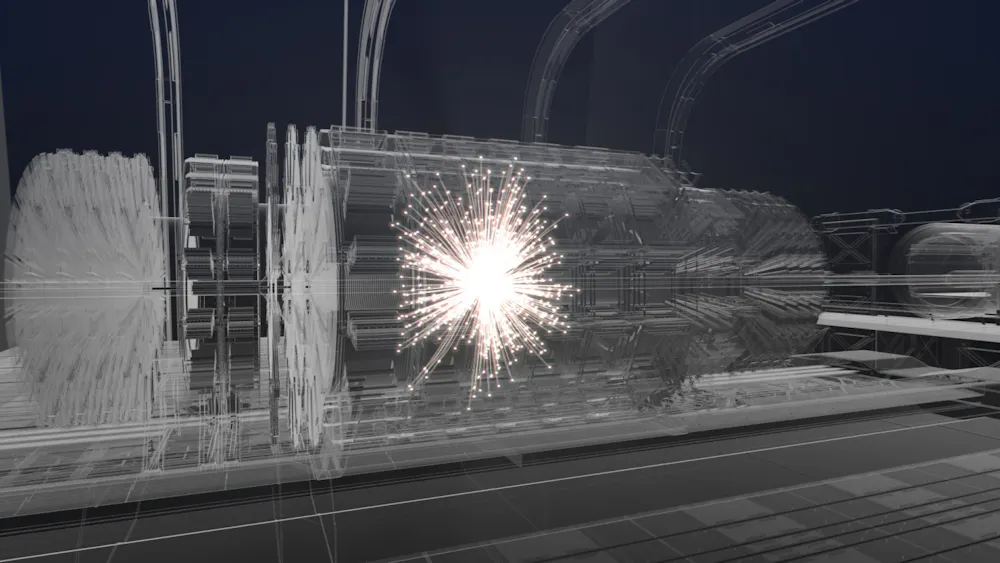
Most fundamental particles have a corresponding antiparticle – another sub-atomic particle that has the same mass but a different electric charge. FCC-ee would accelerate electrons and their corresponding antiparticles (known as positrons) around a 91km-long ring underneath the French-Swiss border, before colliding the two beams of particles inside detectors. These detectors are specialised experiments that can track and measure the particles produced when the beams crash into one another.
FCC-ee has a key advantage over proton-proton colliders such as the Large Hadron Collider: smashing together electrons and positrons can directly produce a Higgs boson. By looking for this process, we can probe the strength of the electron-Higgs interaction.
Detecting new particles
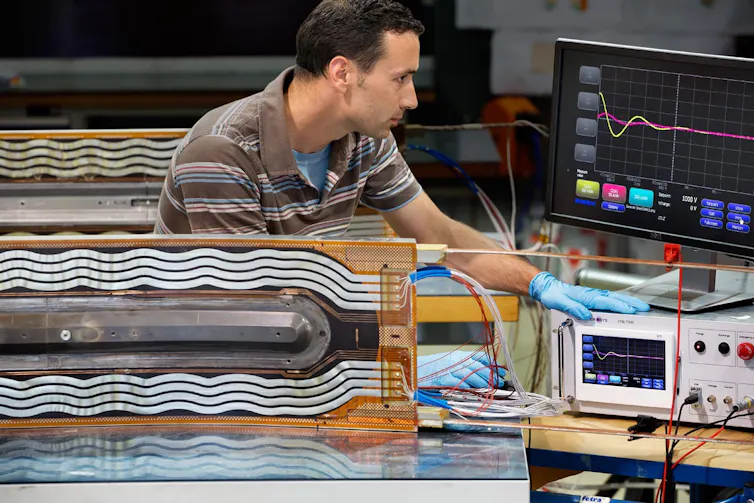
In principle, the measurement is simple: collide electrons with positrons and count the Higgs bosons produced. In practice, it is very challenging. To produce enough Higgs bosons, the collider would need to run for a few years at an energy extremely close to the mass of the Higgs boson particle.
However, that’s a long time to run this machine in such a specialised way. The measurement also relies on us knowing the Higgs mass much more precisely than we do today. Detecting the Higgs bosons is another challenge, because many unrelated processes can mimic the desired signal.
FCC Study@Cern
In a recent preprint (which has not yet been published in a peer-reviewed journal) on this topic, a team of physicists assumed that the Higgs bosons decay (or transform) into W bosons, another fundamental particle with a lower mass. They used a machine learning algorithm to distinguish the desired signal from other processes. In simulations, they found that this approach could improve sensitivity to the electron-Higgs interaction by nearly a factor of 200 compared with current limits at the Large Hadron Collider.
However, new theories could modify interactions between the electron and the Higgs field, including through the action of previously undiscovered particles. But these theories would also need to fit with the known, previously measured properties of the electron. This is what my collaborators and I studied in a recent paper, where we examined how new particles can change the way the electron interacts with the Higgs field.

Cern
Our findings suggest that many candidates for such hypothetical particles, such as new, heavy versions of the electron, can be indirectly searched for in planned measurements of the magnetic properties of the electron. These tests will be carried out by several different physics experiments around the world.
However, one potential new particle is a different form of the Higgs boson that interacts mainly with electrons. If this exists, the Future Circular Collider will be in a unique position to test its properties and how it affects the electron.
This story captures the interplay between theory and experiment when planning new colliders. Theorists map out the new physics a measurement could detect, so experimentalists know when a result would be decisive.
This proposed run of the FCC-ee isn’t yet confirmed and many of the new physics models it could test can be probed in other ways. But a new, electron-loving form of Higgs boson would first show up here. Either way, this measurement would tell us something we’ve never known: how the electron, one of the most studied particles in nature, truly gets its mass.

Benjamin Smith is supported by a Lord Kelvin Adam Smith scholarship from the University of Glasgow.
Original source: https://analysis1.mil-osi.com/2026/11/12/new-physics-machine-at-cern-could-unlock-the-secrets-of-the-electron/