

Source: The Conversation (Au and NZ)
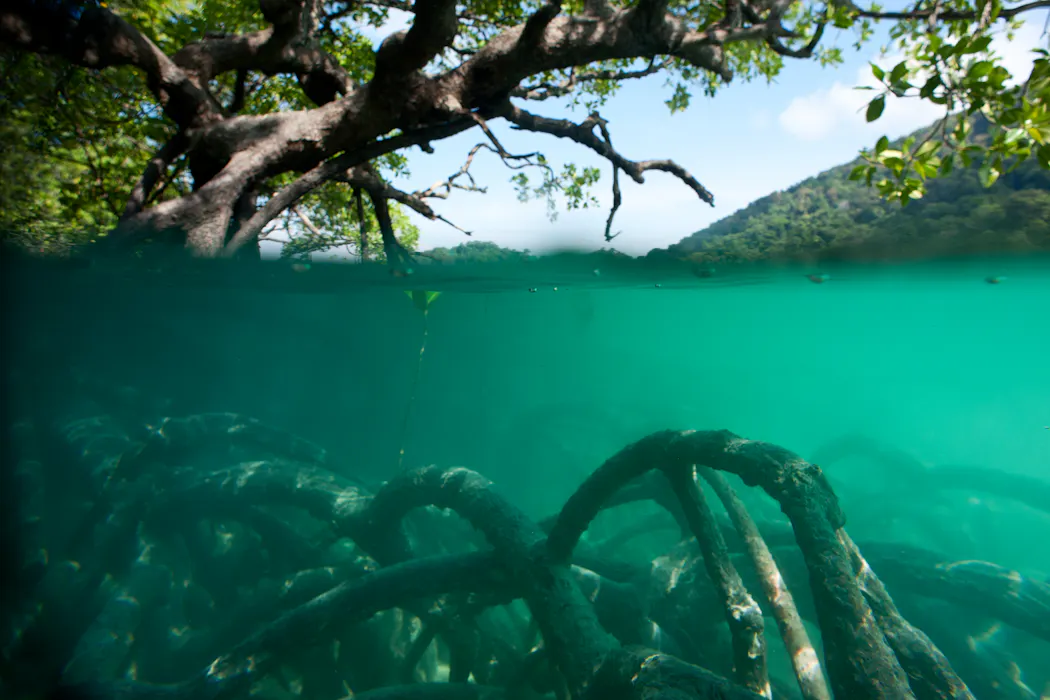
What’s the best way to protect ourselves against climate change? The default is to reach for concrete and steel to build seawalls, dykes, dams and drainage systems. These can work. But they are expensive and inflexible.
There’s another, much cheaper option which gets vastly less attention. Mangroves, forests and urban trees can help protect humans and their homes, farms and cities from floods, droughts, rising seas and heat.
As our recent research shows, these methods aren’t fig leaves – they’re high-performance critical infrastructure.
Unlike grey infrastructure of steel and concrete, these living systems can adapt as the climate shifts. Mangrove forests can shift as the sea rises, for example.
Green infrastructure has proven itself cost-effective and functional in nations from Brazil to Kenya to Indonesia. But adoption could be much broader – if authorities properly considered nature as an infrastructure option.
The limits of concrete and steel
Many engineered assets were designed for a stable climate that no longer exists.
Coastal defences designed to repel mid-20th century level storm surges are being breached with growing regularity.
As rainfall patterns shift, a rise in extreme rainfall can overwhelm drainage systems built for the last century. In 2022, severe summer downpours caused the failure of water infrastructure in Jackson, Mississippi. This year, intense cloudbursts turned streets into raging rivers in Saitama, Japan.
Once built, concrete and steel do their job until they fail. But living systems can respond by adjusting to new patterns of temperature, rainfall and sediment deposition rather than simply failing.
The idea isn’t new. In the 1990s, New York City authorities spent roughly A$2.1 billion protecting forests and plants in the city’s watershed. As a result, they avoided the need to build a conventional filtration plant, which would have cost an estimated $8.6-11 billion.
Many other nations have embraced cheaper, more flexible green infrastructure.
Mangroves protect coastlines
Tropical nations face the worst risk from sea level rise, as they are home to more than 60% of the world’s low-lying coastlines.
Even if greenhouse emissions are drastically reduced, by 2100 seas will rise about 0.6 metres above 2000 levels. If emissions don’t fall sharply, sea level rise will be more like 2.2m.
Without efforts to adapt, encroaching seas could do more than $27 trillion in damage globally.
Governments often build seawalls and dykes to protect coasts. These can work, but they cost a great deal and can fail catastrophically under extreme conditions.
By contrast, fast-growing mangroves naturally dampen storm surges and inundation. Protection from the world’s existing mangrove forests is worth an estimated A$1.2 trillion over 100 years.
Planting mangroves typically cost less than 50% of the cost of concrete and steel equivalents for the same protection, while the value of avoided property damage can be 10 to 100 times greater than planting costs.
In the Mekong Delta, authorities are combining grey and green infrastructure, planting mangrove belts to give built embankments a longer lifespan and cut maintenance costs.
Forests are water infrastructure
It makes good financial sense to replant forests in city watersheds, as they naturally filter rainwater as it fills dams. Protecting intact forests – and the watersheds they protect – is also sensible, as these act as vital water infrastructure, recycling water and even generating rainfall.
The rainfall and water recycling produced by the Brazilian Amazon rainforest is worth about $20 billion a year. This supports agriculture, power generation and regional water supplies.
Forests can even boost energy security in nations reliant on hydroelectricity, such as Brazil. When forests are cut down, rain washes more silt into rivers where it can fill up hydropower dams and reduces power generation.
Trees cool cities
Concrete, bricks and tarmac trap heat and make cities hotter than their surrounding areas. This urban heat island effect can pose a severe risk to health, particularly in rapidly urbanising parts of the Global South.
Street trees and urban forests can make cities significantly cooler, avoiding heat-related deaths and cutting energy demand.
Singapore’s plan to plant a million trees by 2030 is predicted to cut outdoor heat stress by 3–5°C and reduce the energy used for air-conditioning in summer by 6–9%.
In Colombia, green corridors planted along roads and waterways have reduced average temperatures 2°C, returning $1.7 in avoided health costs for every $1 spent on the project.

Michael Hausmann/Getty
Unlocking green infrastructure
The benefits of green infrastructure are well known. But investment in green infrastructure remains limited.
When governments want to build new infrastructure, their procurement rules typically favour traditional grey infrastructure, which come with established engineering standards and contractual certainty.
But these decisions often don’t weigh up green infrastructure fairly, because wider benefits such as avoided flood risks and water services aren’t typically included in the accounting framework used.
Four fixes
To solve this problem, governments, climate adaptation funds and development banks will have to adopt four fixes:
- Recognise green infrastructure as a capital asset in national planning frameworks, governed by the same mechanisms as grey assets
- Protect existing forests, mangroves and other green assets before new grey structures are built
- Ensure the value of ecosystems is included in project appraisals by switching to an accounting method which puts a value on intact ecosystems
- Ensure large development plans include both grey and green infrastructure designed for future climate scenarios.
These shifts are technically feasible and economically justified.
Politics and inertia are the biggest blockers. Grey infrastructure is the incumbent, while green infrastructure is the contender.
As damage from climate change intensifies, this will have to change. Green infrastructure is cheaper and more adaptable than grey. It’s not nice to have – it’s necessity.

Andrew Lowe receives funding from the Australian Research Council. He is a member of the Landscapes South Australia Hills and Fleurieu Board.
Robert Nasi works for CIFOR-ICRAF (the Center for International Forestry Research and International Centre for Research in Agroforestry), which receives funding from more than 50 donors.
Jasmin Packer does not work for, consult, own shares in or receive funding from any company or organisation that would benefit from this article, and has disclosed no relevant affiliations beyond their academic appointment.
Original source: https://analysis1.mil-osi.com/2026/11/12/concrete-and-steel-or-mangroves-and-forests-when-it-comes-to-climate-adaptation-nature-is-much-cheaper/