

Source: The Conversation – Canada
Imagine you are sitting on a train, moving at a constant speed. The blinds are drawn so you can’t tell you are moving. A light bulb hangs on a chain in the centre of the car. When someone turns it on, your human eye perceives the whole carriage lighting up.
What actually happens is that light first reaches the two sides of the car simultaneously. A moment later, the light reaches the front and back of the car, again simultaneously. The light has travelled at the exact same speed in all four directions.
Albert Einstein wondered how this situation would be described from the perspective of someone outside the train who was not moving with the car. For a drone hovering over the train, for example, the light still reaches the two sides simultaneously but the back of the car lights up before the front. This is because the train is moving forward, so in the moment it takes the light to travel to the front and back of the car, the back has moved closer to the light source and the front has moved further away.
This phenomenon, discovered by Einstein in 1905, is called the “relativity of simultaneity.”
On the basis of this phenomenon, scientists have argued that in reality there is no objective “now” and that time does not truly pass. Some have even suggested that the apparent passage of time may be psychological.
Modern cosmological observations, however, suggest that time is more than a mere illusion.
The illusion of now
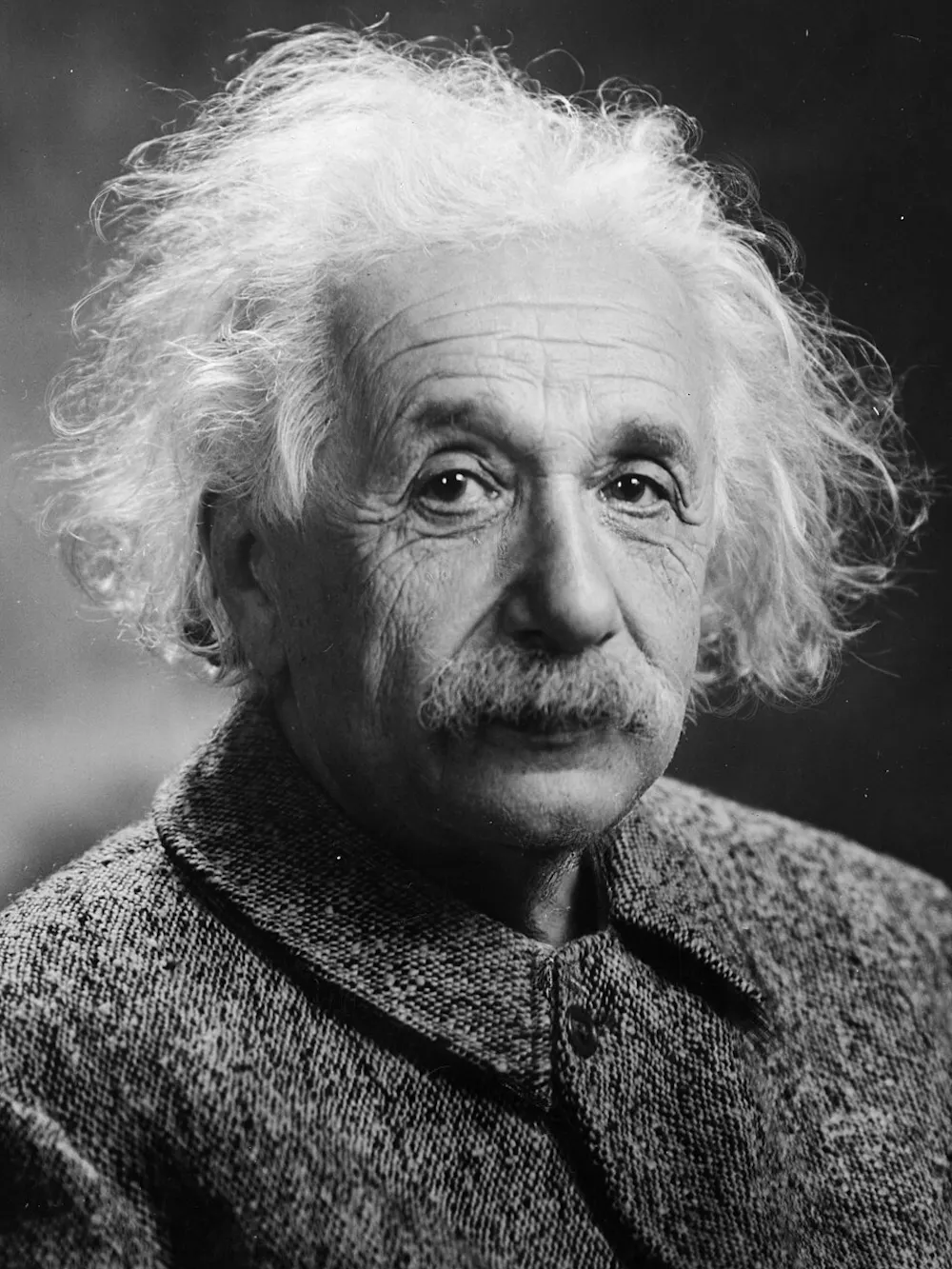
Einstein himself declared time to be an illusion. On the passing of his friend and fellow physicist, Michele Besso, he wrote:
“Now he has departed from this strange world a little ahead of me. That means nothing. People like us, who believe in physics, know that the distinction between past, present and future is only a stubbornly persistent illusion.”
Along with Einstein, physicists and philosophers have often used relativity to argue there is no such thing as true simultaneity. For example, if you could say that a star several hundred light-years away is exploding “right now,” you could also stand up and walk away from it and just as well conclude that it won’t explode for another minute or so.
By extension, if there is no objective now, and if all relative “nows” are on equal footing, then perhaps reality encompasses all of “spacetime” — every event that ever happens anywhere across the universe throughout all of eternity. Perhaps, as Einstein said, time really is nothing but a stubbornly persistent illusion.
From the perspective of modern cosmology, however, it seems that an objective “now” does exist.
Is the train really moving?
It is tempting to say that the drone hovering in a fixed place above the train in our scenario is “at rest” and that the train is “really moving.” But we know the Earth is rapidly spinning and orbiting the Sun, which is orbiting the Milky Way, which is moving relative to nearby galaxies and so on.
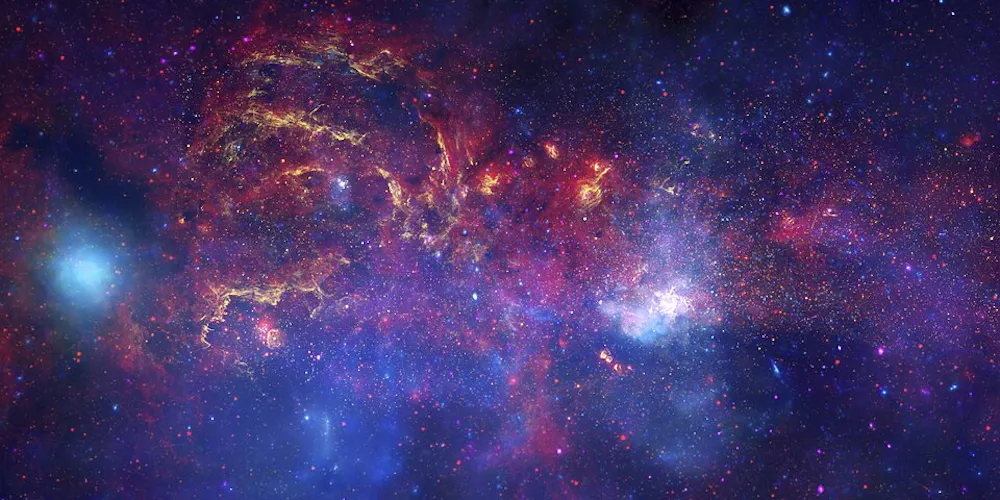
(NASA/JPL-Caltech/ESA/CXC/STScI)
Therefore, neither drone nor train can be defined as “the one that’s moving” or “the one at rest” in any absolute sense. We could define either as an equally valid relative state of rest.
On the other hand, if there was an absolute state of rest and an objectively well-defined “now,” we would require a concrete scientific measurement showing that the associated space has always persisted as such, along with a way to measure velocity through it from anywhere in the universe at any time. That would make the one state of rest objectively well-defined relative to all others.
Such a space could then be said to “exist” in the usual sense of the word, with Earth and all of us existing in it, and it would provide consistent definitions of “now” and of “motion.”
The cosmic now
Cosmology delivers this. We have already made the required measurements using the cosmic microwave background (CMB) — the cooled remains of the first light released after the Big Bang.
The CMB reveals that our universe — the three-dimensional expanding space where we live and evolve — has existed for approximately 13.8 billion years. It also shows the universe to have expanded by an integrated factor of about 1,100 since it formed; and that our solar system is moving through it with a velocity of 369.82 kilometres per second towards the Crater constellation.
(Wikimedia)
The integrated expansion of space throughout cosmic time has been so precise in every direction we look that across the sky we can measure “anisotropies” that were imprinted on the CMB at the time it was formed. These are tiny differences in the CMB’s temperature from one direction to another, of about one part in 100,000, which map the slightly denser and slightly thinner regions of the early universe.
It would be impossible to see this if space were not objectively defined and expansion had been different here and there.
This means that Einstein’s relativity of simultaneity still applies to local phenomena as a matter of relative perspective: neither the train nor the drone gets to say they are the one that is truly at rest, and both frames of reference can be used to describe reality, just as Einstein found.
However, contrary to his belief, time is more than a mere illusion. The implication from modern cosmology is that the universe exists, and events happen all across space in the course of cosmic time. These events may be described as synchronous or not, depending on one’s motion through the universe, although there is in reality one cosmic time and an objective measure of simultaneity.

Daryl Janzen does not work for, consult, own shares in or receive funding from any company or organisation that would benefit from this article, and has disclosed no relevant affiliations beyond their academic appointment.
Original source: https://analysis1.mil-osi.com/2026/11/10/does-time-really-exist-or-is-it-a-persistent-illusion/