

Source: The Conversation – Canada
Who do we forget on Remembrance Day?
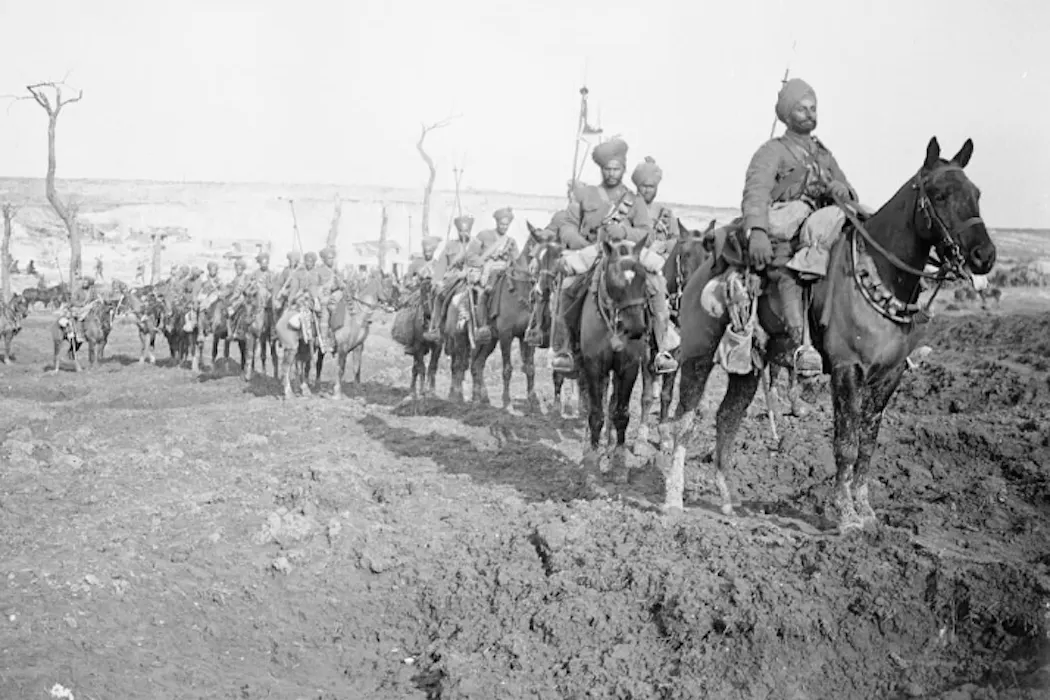
For a long time, histories of the First World War have been popularly understood in a Euro-centric manner. But descendants of Indian soldiers and researchers have long pushed for recognition for the approximately 1.4 million men from current-day India, Pakistan and Bangladesh who helped wage the First World War for the British Empire.
Yet when it comes to the war’s impact on British India, many of us still think of contributions as military and masculine.
The double portrait of two Sikh risaldars, Jagat Singh and Man Singh, currently on display at the Art Gallery of Ontario is a testament to such recognition.
The men hailed from Punjab, the hub of military recruitment known as the “sword arm” of the Raj.
The piece was painted in London by Phillip de László two months before the Battle of the Somme in 1916, when many Indian soldiers were wounded or lost their lives.
But remembrance is gendered. Historian Radhika Singha has revealed the overlooked role of non-combatants such as labourers, cooks, sweepers and many other essential “follower” roles in the war. Male and militarized remembrance also takes for granted the impact of the war on those women and families the men left behind.
As my preliminary research into First World War archives of letters, songs and reports indicate, women bore the consequences of the total war thousands of miles away from the Western Front. Early on, women recognized the gendered cost of the war, and were critical of the reliance on their husbands, sons and fathers to wage it.
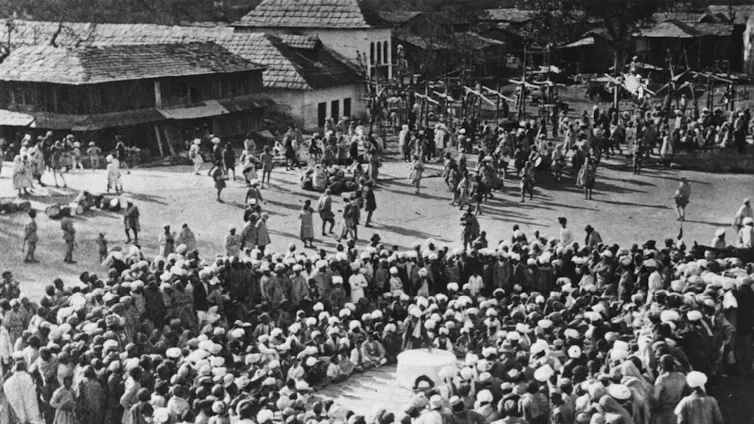
(Press Agency Photographer/India during the First World War, 1914-1918/Imperial War Museums)
Compounding gendered hierarchies
The impact of the First World War compounded the gendered hierarchies already existing in Punjab.
The state of Punjab in northern India was annexed by the East India Company in 1849. Colonial officials were keen to secure political and economic control by joining hands with existing patriarchs and landowners in this agricultural economy.

(Imperial War Museum)
But such developments were especially harmful for women. As feminist historian Veena Oldenburg has shown, measures such as the codification of customary law based on consultations with male household heads formalized the dominance of the male landowner. This contributed to making women dependent on the men around them.
Colonial officials were also fascinated by the Punjabi peasant because they believed that he embodied war-like qualities. The Darwinian “martial race theory” claimed that only certain men in India could be soldiers. Colonial authorities came to view the Punjabi peasant, who worked the land and had a history of a military tradition, as fighting material.
By the turn of the 20th century, these ideas culminated in what researchers termed the “Punjabization of the Indian Army.” On the eve of the First World War, about 60 per cent of the Indian army was made up of Punjabi men.
When war broke out, colonial authorities promoted recruitment of local men through further promises of land grants, cash rewards and secure pay, and linked it to the ideas of izzat or honour.
How did women respond to the war?
While middle class and elite Indian women led campaigns to encourage wives and mothers to send their husbands and sons to war, this response wasn’t universal. Many women in the villages of Punjab tried to prevent their husbands and sons from enlisting.
News and letters from the war front revealed the brutal conditions of trench warfare. According to colonial reports of the time, mothers and wives believed that men were not being adequately trained before they were sent off.
The colonial government denounced such beliefs as wild rumours. Yet historical evidence shows that women in Punjab tried to hinder recruitment efforts to such an extent that, by December 1914, colonial officials complained that the “tears of womenfolk” had become the biggest hurdle to recruitment.
In Amritsar, Punjab, in 1915, an official noted in his diary that women “would trail recruiting parties for several miles, patiently awaiting opportunities to lure away acquired recruits.”
Colonial intelligence reports show women would sing songs blaming King George for taking away their husbands and brothers. In these, women offered trenchant critiques of the colonial government, claiming that their men had been used as fodder by the firangi (colonizer).
In 2016, Berlin based Pakistani artist Bani Abidi displayed contemporary renditions of folk songs at the Edinburgh Art Festival. Entitled, “Memorial to Lost Words,” this exhibition moves beyond “stone engravings or statues” as sites of memory but combines translated letters and folk songs. Phrases from a translated folk song sing:
“Don’t go, don’t go, stay here my friend, the ignorant are packing up and leaving, flowers are withering, friendships are breaking.”
Scrambling for survival
Women whose husbands enlisted scrambled for money to survive. Delays in the receipt of remittances and pay added to their economic struggles. A collection of letters shows that one wife wrote to her husband in France that she had only received two months’ worth of allowances in six months and had to resort to pawning her jewellery to “keep myself alive.”
Conditions had worsened because the entire economy was geared toward the war effort. Famine, plague and influenza added to the troubles.

(Imperial War Museums)
But women did not suffer passively. They held their husbands accountable for going to the war. One woman complained to her husband: “I go round begging the neighbours for water and wood, yet you never think of all this.”
Some women even used the war to run away with their lovers while their husbands were away, which troubled the men and the colonial government alike.
Women’s efforts to hinder recruitment in Punjab, their critique of the colonial government and their letters reveal the complexities of women’s responses to the war.
Beyond remembering the male soldier who arrived in Europe, we should also remember those he left behind.

Umaima Miraj received funding from the Social Science and Humanities Research Council for this research.
Original source: https://analysis1.mil-osi.com/2026/11/08/how-women-bore-the-consequences-of-the-first-world-war-in-british-india/