

Source: The Conversation (Au and NZ)

One in five Australians lives with chronic pain, meaning pain that persists longer than three months. Among people with disabilities, the rate is far higher.
Yet this overlap between disability and chronic pain is still misunderstood.
Even if someone is on the National Disability Insurance Scheme (NDIS) for a disability, they may not get adequate support for how pain also affects their functioning and interacts with their other impairment/s. Many people with chronic pain are not eligible for the NDIS, despite it having a severe, ongoing impact.
Here’s why this approach doesn’t make sense – and how upcoming changes to NDIS funding could make it even more complicated for people to get the support they need.
The impact of ongoing pain
Chronic pain is far more than an unpleasant sensation.
Along with eroding physical health, living with pain can also disrupt relationships, work, financial security, mental health and wellbeing. People who live with chronic pain face a higher risk of unemployment and depression than those without it.
How severely pain affects someone depends on their personal and social circumstances, such as their age, sex, relationships, social connection and culture.
Disability and chronic pain are interrelated
Getting NDIS support depends on someone proving their impairment or impairments reduce their ability to do everyday tasks (their functional capacity). This includes self care, mobility, communication and taking part in community and social activities.
Chronic pain is generally not enough to qualify for NDIS support, unless you can prove it significantly impacts your functioning in this way.
But it can be tricky to disentangle the impact of chronic pain from other impairments. Pain can both arise from and contribute to long-term health conditions and disability. For example, living with pain can amplify other aspects of someone’s disability, such as mobility.
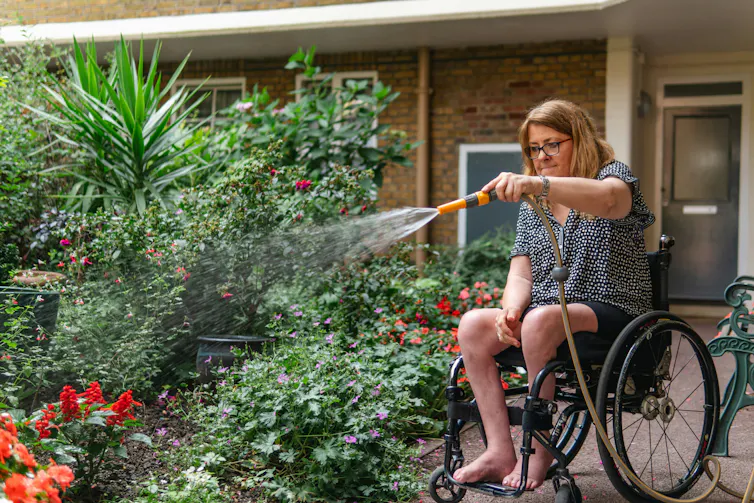
There also aren’t many effective medications to treat chronic pain; the way it’s managed often overlaps with disability support. This might include allied health (such as physiotherapy), home modifications and assistive technologies (including handrails, adapted utensils or transcription software), and direct support for tasks that exacerbate pain (such as gardening or cleaning).
So for some people who live with chronic pain and have permanent impairments, it doesn’t make sense to separate their pain and its impact from their disabilities.
Centre for Ageing Better/Unsplash
NDIS changes may hit people with chronic pain
Chronic pain is also often misunderstood as only a medical issue that needs to be “fixed” rather than a long-term condition.
From January 2028, to be eligible for NDIS services and supports, people will need to have “undertaken all appropriate treatment” for their condition and it must be assessed as likely to be permanent.
However, we don’t know what treatments could be considered “appropriate” for chronic pain related to impairment/s – or whether all such treatments would need to be tried before someone can access the NDIS.
New rules also say NDIS participants can only access supports that address needs arising “directly” from an NDIS-recognised diagnosis or impairment. However, this may not reflect the interconnected ways disability and chronic pain affect people’s lives.
NDIS participants may be able to get support for pain if it arises from the diagnosis or condition that made them eligible for the NDIS. But if pain occurs for a reason deemed unrelated to those accepted diagnoses, they may miss out.
Imagine an NDIS participant with multiple sclerosis (MS) who falls and sprains their ankle. Maybe they tripped and fell because of weakness or balance problems their MS caused. But it may be hard to prove the ongoing pain relates to MS.
Under the new legislation, it’s unclear if their existing physiotherapist could charge for treatment and rehabilitation from their ankle injury, how the person would prove it was related to MS, or if they’d require a separate appointment, not funded by the NDIS, to treat the ankle sprain.
Support outside the NDIS
So, what if you live with chronic pain but you’re not eligible for the NDIS?
People with chronic conditions can access Medicare-subsidised allied health through a GP chronic condition management plan. But this only covers five visits a year across a variety of allied health professionals and may incur out-of-pocket expenses.
Some people may pay for these services in full or receive some rebates through private health insurance or, if an injury is work-related, through workers’ compensation schemes.
But for people without NDIS funding, support for daily tasks such as personal care or chores are rarely affordable. Federal, state and territory governments have agreed to more supports in the community, outside the NDIS – known as “foundational supports” – but they have not yet been implemented for adults, and many questions remain about how they’ll work.
Read more:
What should ‘foundational supports’ look like for people ineligible for the NDIS?
We need better coordination
Amid significant NDIS reform – including tighter eligibility and funding cuts to allied health – there is a risk more people with chronic pain could fall through the cracks.
Without adequate support, we will see a flow-on effect. For people living with disability and chronic pain, their ability to take part in social life and employment, and to maintain their physical and mental wellbeing, is likely to be limited.
We need better coordination between different service systems including Medicare, private health insurance and the NDIS, and more support for those with complex needs.
Some may need health care, while others may require practical support with community access, mobility or personal care to take part in the community, move around, and do everyday tasks like dressing and preparing meals.
The goal should be simple: the support people receive should reflect the life they are trying to live, not just their diagnosis or disability.
We would like to acknowledge Helen Dickinson from the University of New South Wales and Alexandra Devine from The University of Melbourne for their contribution to this article.

Manasi Murthy Mittinty receives funding from the Centre of Research Excellence in Achieving Health Equity for All People with Disability (AHEAD) and the National Health and Medical Research Council Synergy Grant Intervention for better life-time mental health outcomes for young Australians with disability.
Anne Kavanagh receives funding from the National Health and Medical Research Council, National Disability Research Partnership, and Medical Research Future Fund.
Sophie Yates receives funding from the National Health and Medical Research Council.
Original source: https://analysis1.mil-osi.com/2026/11/05/why-chronic-pain-is-often-overlooked-as-part-of-disability-and-what-can-help/