

Source: The Conversation – UK

The stair climber has seen a huge surge in popularity on social media in recent years. Proponents of the exercise machine rave about its benefits – claiming it can boost cardiovascular fitness, strength and bone health.
Evidence shows the stair climber does have many benefits when it comes to health and fitness. While it doesn’t always win out over other types of cardio, there are a few key areas where it has an edge.
Cardiovascular fitness
One reason for the stair climber’s popularity is that it’s thought to provide a high-intensity way of boosting cardiovascular fitness.
But when researchers compared the cardiovascular effects of exercising at the same relative intensity on a treadmill versus a stair climber, they found that those using the stair climbers had lower heart rates and oxygen consumption scores. This meant that stair climbing put less stress on the cardiovascular system, which may ultimately lead to smaller fitness gains.
That said, stair climbing has still been shown to be just as effective as brisk treadmill walking in lowering blood pressure. A comparison of stair climbing versus treadmill running also showed it improved cardiorespiratory fitness and even promoted similar increases in running performance.
So the stair climber is about comparable to running when it comes to improving cardiovascular health.
Muscle and strength
Another reason the stair climber is preferred by many gym goers is because it’s said to improve muscle health and strength more than other forms of cardio.
Indeed, stair climbing has been shown to engage more lower body muscles than walking or running.
Stair climbing also engages these muscles for longer and with more forceful contractions than walking. The more a muscle is activated and the longer it is held in one position, the more tension it develops. The greater the tension, the larger the physiological adaptation.
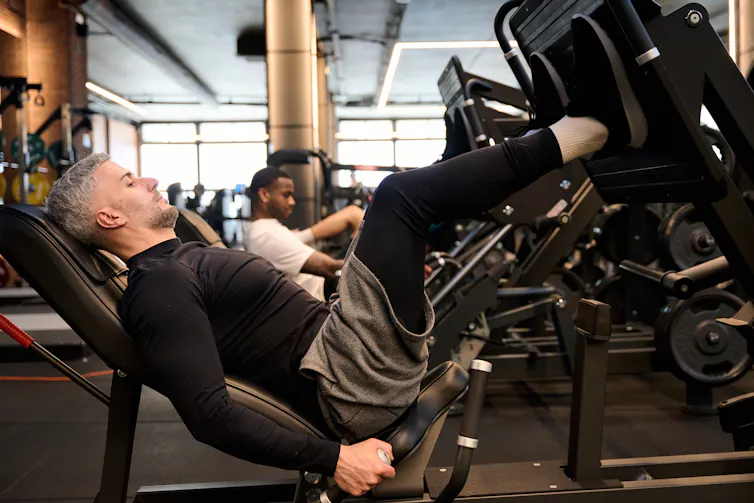
Perhaps unsurprisingly is that stair climbing has been shown to cause changes in muscle size that are similar to those seen in people who did conventional strength training using a leg press. These gains in muscle size were also associated with improvements in strength.
However, as this study was only conducted in older adults, it’s not clear if these results would also apply to younger people.
The changes in muscle size that are seen in stair climbers are greater than those seen in people who do treadmill walking or cycling.
alvarog1970/ Shutterstock
An additional benefit of the stair climber may come from using the machine backwards. Walking downstairs activates more muscles than walking upstairs does. This is because our muscles have the additional job of braking so we don’t fall or lose balance. This will improve stability while walking.
Joint stress
The stair climber is sometimes recommended because it’s said to place less force and stress on the joints and bones.
When you run on a treadmill, the impact force (when your foot hits the ground) is equivalent to around two to three times a person’s body weight. For stair climbing, the impact force is a little lower – around 1.6 times body weight.
Stress, on the other hand, reflects the amount of force that goes through a joint during an exercise. So although stair climbing appears to place less impact force on the joints, a comparison study found the stair climber placed eight times greater stress on the knee than running outdoors on level ground did.
This makes sense, as to climb each step the foot needs to be in contact with the stair for a longer period than it would be in contact with the floor while running. So if you want to avoid putting your joints under too much stress, the stair climber may not be for you.
However, stress and impact forces aren’t always a bad thing. Evidence increasingly shows that stress to joints and bones may be crucial in maintaining bone health and reducing the effects of osteopenia and osteoporosis. And, despite its lower impact forces, stair climbing has been shown to help control osteoporosis and osteopeania.
The stair climber is therefore a great exercise even if you have joint issues or experience some pain. Just remember to start off slowly, doing small amounts of exercise at a time.
Fat loss
Another reason the stair climber is popular is because it is claimed that the machine will help you burn more calories – and therefore lose more weight. But the evidence backing up this claim isn’t quite so favourable.
A small study of 30 men compared how many calories participants burned when working out at maximum effort on the treadmill versus on the stair climber. The study found that the stair climber group burned around two calories fewer per minute than they did on the treadmill.
The reason for this difference probably lies in the total amount of muscles being recruited during each exercise. When running on a treadmill, the whole body is engaged – including our upper body muscles. But during stair climbing, the upper body muscles are used far less. Many people even use the handrails for safety, so there’s little arm swinging for momentum.
So for people whose primary goal is weight loss or weight management, the treadmill may be the more effective option as you burn slightly more calories. Though long-term weight loss success will ultimately depend on maintaining a consistent exercise routine.
Despite the hype, the stair climber isn’t that much more beneficial than other types of cardio when it comes to our health and fitness. But it does appear win out over other forms of cardio when it comes to strength and muscle.
If you’re keen to give the stair climber a try, start out by doing just a few minutes at a lower intensity. As your fitness improves, you can gradually begin boosting the intensity.

The authors do not work for, consult, own shares in or receive funding from any company or organisation that would benefit from this article, and have disclosed no relevant affiliations beyond their academic appointment.
Original source: https://analysis1.mil-osi.com/2026/11/04/stair-climbers-are-said-to-boost-fitness-strength-and-bone-health-heres-what-the-evidence-actually-says/