

Source: The Conversation (Au and NZ)
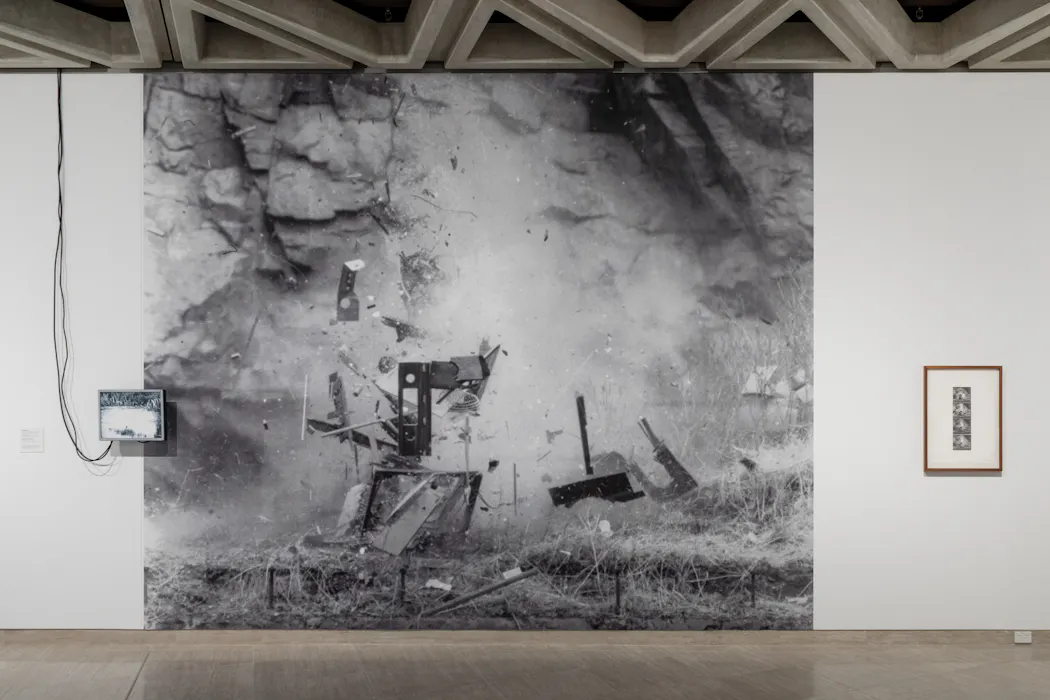
In 1972, the ANZAC Day ceremony in Sydney was delayed when wreaths laid at the Cenotaph memorial in Martin Place burst into flames – apparently without cause. The next day, local newspaper The Daily Mirror covered the incident under the headline “Bomb at Cenotaph”.
In fact, the conflagration was caused by flares with timing mechanisms hidden within the wreaths by Tim Burns and members of experimental art collective Tin Sheds. They were protesting Australia’s involvement in the Vietnam war. The wreaths were quickly extinguished and no one was hurt.
A year earlier Burns had set off smoke bombs in the Pool of Reflection ANZAC memorial in nearby Hyde Park. An obvious dig at the performance of war.
In the subsequent decades, Burns achieved public notoriety through works that employed shock tactics, at times gesturing towards violence to generate a sense of fear and uncertainty among spectators.
© Tim Burns/National Gallery of Australia
In 1973, he installed a minefield of gunpowder charges at Mildura sculpture park, as part of the Mildura Triennial. The work was dismantled before opening, when the organisers decided it was too dangerous.
But while his work has frequently made headlines, Tim Burns’ name is little known beyond the art world.
A solo exhibition at the Art Gallery of Western Australia puts his explosive art actions in the context of his broader practice as a conceptual artist.
Bigger than smoke bombs
Tim Burns: The Kinetic Moment, curated by Aimee Dodds, is the first retrospective survey of Burns’ wide-ranging six-decade practice. It spans painting, sculpture, film and video, performance and theatre.
Born in the wheat belt town of Cunderdin in Western Australia in 1947, he took up painting as a teen under acclaimed landscape artist Robert Juniper, and went on to study painting and sculpture at the Western Australian Institute of Technology (now Curtin University).
But as a young artist, he proved less interested in the object we look at and walk around in a gallery, and more interested in the dynamic exchange between the artist or artwork and its audience.
Burns describes himself a “context artist”: one who creates works that speaks to the social and political conditions of the time and incorporates public and critical reception.
Take for instance, his work Not ceasing to loiter (1975). After being arrested for loitering, Burns sent out invitations for people to attend his court hearing, turning his defence into a public performance.
The same year, he staged a lo-fi performance titled The possibility of a private/ public space in a curtained storage alcove in the National Gallery of Victoria. Hiding behind the curtain, he jiggled it periodically to engage the curiosity of passersby – who he then leered at, ignored or engaged in conversation.
Here Burns challenged the ideas around high and low art and “the genius artist”, and insisted on the performance being a mundane and messy sit-in.
Kerry Dundas/Art Gallery of NSW
Capturing the moment
The Kinetic Moment includes Burns’ written and photographic documentation of his performances, art actions and conceptual works; fragile ephemera and artist books that have deteriorated, faded or peeled apart.
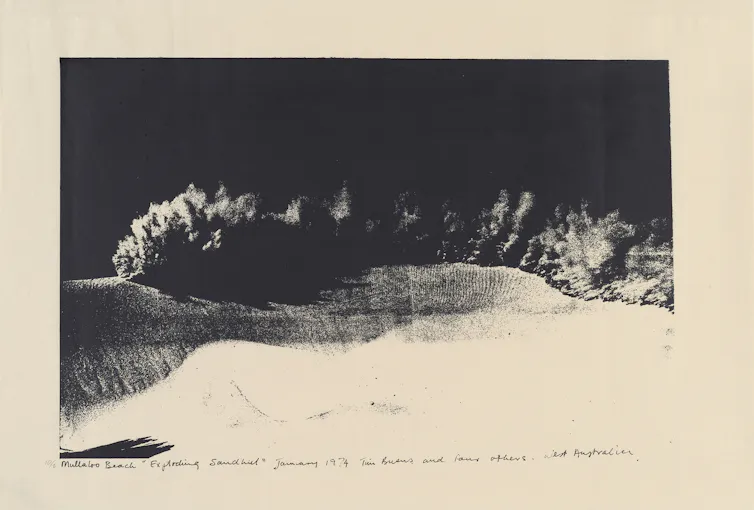
The exhibition attests to the way Burns has often incorporated lo-fi materials within reach. The artist book Mullaloo Beach, 1974, Postcards documents a mail art project he undertook while travelling around Australia. He sent postcards depicting his exploding dune work to people he knew, encouraging them to get in touch with one another.
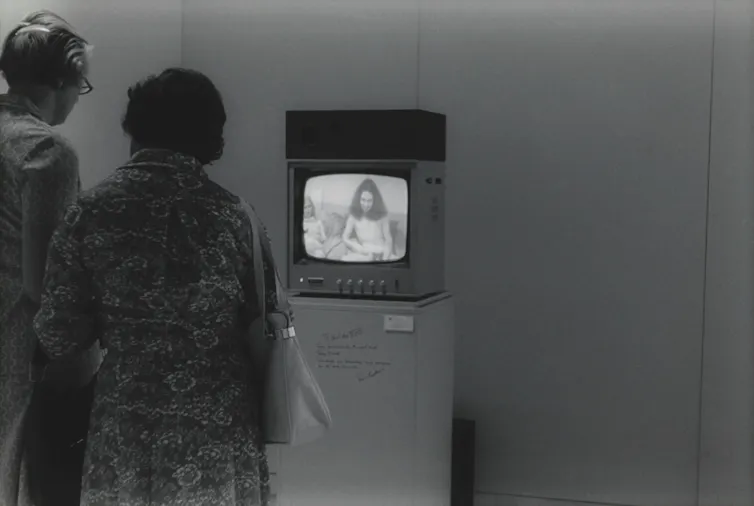
Video works are installed on small monitors and televisions and juxtaposed with pixellated prints.
Postcards, posters, articles and documentary photography capture his practice of making art collectively with friends, colleagues and public.
Seen together, these works showcase Burns’ disinterest in the aura of an original artwork and enthusiasm for art that is broadcast, handled, shared, sent, scribbled over and copied.
Experiments in power and politics
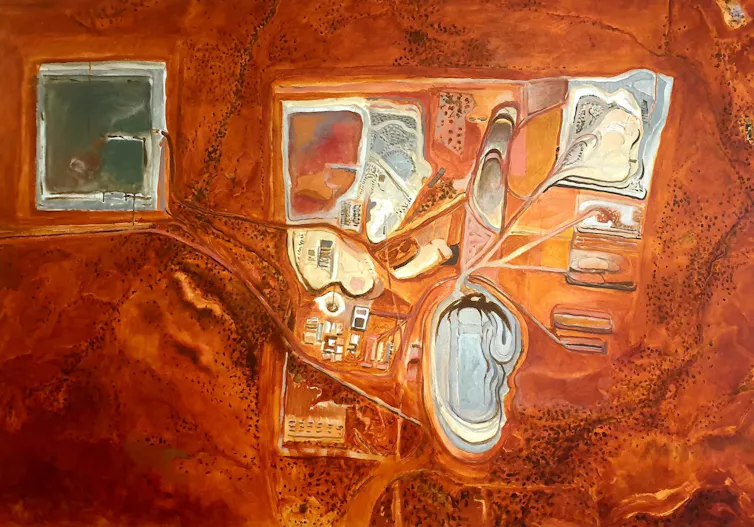
The political is never far from view in the exhibition, from documentation of Burns’ anti-war actions to paintings such as Death of a Miner (1969), Property is Theft (Pit 1) Before the Storm (2011) and Self Portrait as a Mine Site (2025), which probe questions of identity, extraction and colonialism.
His experimental super-8 feature Why Cars? CARnage (1977), screening as part of the exhibition, includes scenes in which Burns and his friends, dressed in Arab ghutras (headdresses) and white robes, play tourist in New York, posing in front of iconic buildings and expensive cars; and crowd into a New York bar, while the artist delivers a dystopian monologue about capitalism. The film collapses themes of East and West, peace and terror, civilian and actor.
Tim Burns/Art Gallery of Western Australia
An unusual resume
At the centre of the exhibition is Resumé 73-77: a single-edition artist book that documents the conceptual works made during Burns’ most defiant and provocative period. The book has been deconstructed, its pages arranged across the gallery wall at eye level. They include notes, documentary photographs and newspaper coverage.
Acquired by the gallery in 1980, this work had never been exhibited in full until now.
As a centrepiece to the exhibition, Resumé 73-77 calls attention to Burns’ zest for questioning social pressures around what an artist should do, make and say.
In 2026 people are accustomed with artists making work that is profitable or responsible. This work, and this exhibition, is a reminder that artists can and have pushed back against these social pressures.
Tim Burns: The Kinetic Moment is showing at the Art Gallery of Western Australia, Perth, until February 28, 2027.

Christina Chau does not work for, consult, own shares in or receive funding from any company or organisation that would benefit from this article, and has disclosed no relevant affiliations beyond their academic appointment.
Original source: https://analysis1.mil-osi.com/2026/11/04/bigger-than-bombs-tim-burns-exhibition-explores-the-artist-behind-explosive-art-actions/