

Source: The Conversation – UK
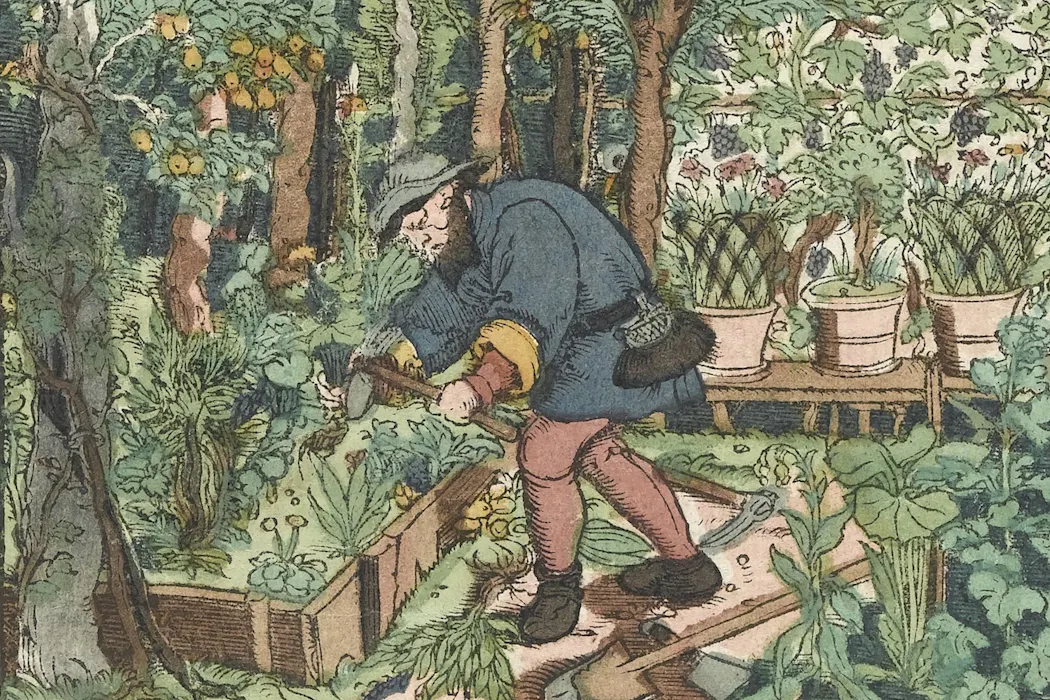
For whatever the land you possess, whether it be where sand
And gravel lie barren and dead, or where fruits grow heavy
In rich moist ground; whether high on a steep hillside,
Easy ground in the plain or rough among sloping valleys –
Whereever it is, your land cannot fail to produce
Its native plants…
These words come the Hortulus: The Little Garden written by Wahlafrid Strabo (c. 808-849), who was a Benedictine monk from the monastery of Reichnau on an island in Lake Constance.
The 9th-century Hortulus is considered one of the most important European historical documents on gardening and plants, combining practical advice with its poetry. It continues to inspire modern gardeners in planting and design. The writings offers a tour of the monastery garden and the qualities of its plants. Twenty-nine plants are named, from Indian pepper to grapes, nettle, pennyroyal and peach. For the most part these are medicinal, though Wahlafrid includes some culinary observations, and a final detail about the rose as a source of soothing oil and symbol of the Virgin Mary.
The descriptions of the fresh and delightful taste of melon and gourds (bottle gourd or calabash) sit alongside longer discussion of the use and preparation of herbs and vegetables for health.
As a flavour of the way in which these observations were made, take the plant Southernwood (Aretemisia Abrotanum), not commonly known these days but common enough in the medieval period. Strabo notes that: “It has power against fevers, banishes stitch, and if your limbs ache with the elusive and mysterious pain of gout, it will bring relief.”
Other instructions show how monks used plants as medicine including mixing fennel-root with wine to relieve a rasping cough, and the use of betony as a treatment for a septic wound.
Around 350 years later, in his large work On the Nature of Things, Alexander Neckham, a English Augustinian canon (so, not strictly a monk), wrote a description of a garden, probably recalling his days as a scholar in Paris. His list includes parsley, coriander, savory, cress, sorrel, ponlions, leeks, garlic and purslane, medlars, quinces and citrus fruits. He notes a number of herbs (spices) which do not grow in Europe, including ginger, clove, zedoary and myrrh. Neckham emphasises the importance of hard work in the garden, but also the importance of studying plants and their uses.
This combination of book learning, community knowledge and experience can be found in what is known as “the Herbal”, which refers to historical writings on the science and health qualities of plants. These were copied, and added to, by hand. One of the earliest is On Medical Matters compiled by Dioscorides (c.40-c.90 AD), written in Greek and translated into Latin and Arabic.
This became a standard reference text, some with illustrations, in medieval Europe. Much of the focus lies on the medicinal usage of herbs, but also uses in cooking.

Wellcome Collection
The plant lore of the monastic library might be supplemented by longer traditions of Roman science, for example the Natural History of Pliny the Elder (d.79 AD).
And the tradition continued with authors such as Henry of Huntingdon, a 12-century archdeacon, whose work the English Garden deals with six times the number of plants as Strabo, in a more elaborate literary tour of the garden and its plots.
Works by four other key botanists, Isidore, Bede, Macer, and Dioscorides, are to be found in the mid-12th century catalogue of the monastic library at Durham Cathedral Priory.
Then as now, health and eating were considered closely related. Most monasteries kept gardens. For instance, on the famous ninth-century architectural plan of an idealised monastery layout, known as the Plan of St Gall, a main kitchen garden as well as an orchard are shown.

Wikimedia
Knowledge of plant lore was passed down through the centuries by monks. This was part of a wider monastic approach to the natural environment, which has some resonance with gardening movements of today, by combining spirituality and mental health with growing and eating plants.
The 12th-century theologian William of St Thierry describes shady woodland, recognising the idea of spirituality gained from the natural world. He wrote that the “silent valley spoke to them of the simplicity and humility in the buildings, mirroring the simplicity and humility of those living there”.
Another order, the Grandmontines, lived in communities of no more than 12. They believed in no excess and a self-sustaining community, which lived on what it grew. This idea of sustainability and self-sufficiency is popular again today.
Looking after their land
Monastic houses managed their land, livestock, mineral rights and waterways.
Monasteries also maintained detailed records to pass down knowledge to those that came after them.
These medieval monastic communities also exercised considerable influence over the ecology of their estates, using land and resources carefully.
The valley of the Rie (now Rye) in North Yorkshire, the home of Rievaulx Abbey, is a good example of managed woodlands. It was coppiced and used as foraging grounds for pigs over many years of monastic stewardship. Terracing made the land more usable in the valley. Water channelling ensured sanitation as well as supplying the fulling mill, to help make textiles and clothing, and for the tanning vats, containers used to treat animal skins to make leather.
In Durham monks from the Cathedral Priory were at the heart of a change in the path of the river Wear. Evidence of this emerged in 2009 when heavy rain caused the ancient river’s route to come to light. It appears that the river’s course had been changed in medieval times to prevent the wooded peninsula of Durham from turning into an island.
A wealth of evidence survives showing just how important gardens and land were to medieval monasteries. While herbals and other historical literature show just how carefully monks used plants in everyday life, many of those ideas, such as sustainability, self-sufficiency and finding spirituality in green spaces, have been absorbed into modern gardening books and are embraced by gardeners today.

Giles Gasper receives funding from the Arts and Humanities Research Council, UK; the John Templeton Foundation; and the Castle Studies Trust.
Original source: https://analysis1.mil-osi.com/2026/11/02/medieval-monks-were-early-ecologists-and-left-a-wealth-of-knowledge-for-later-generations-of-gardeners/