

Source: The Conversation (Au and NZ)
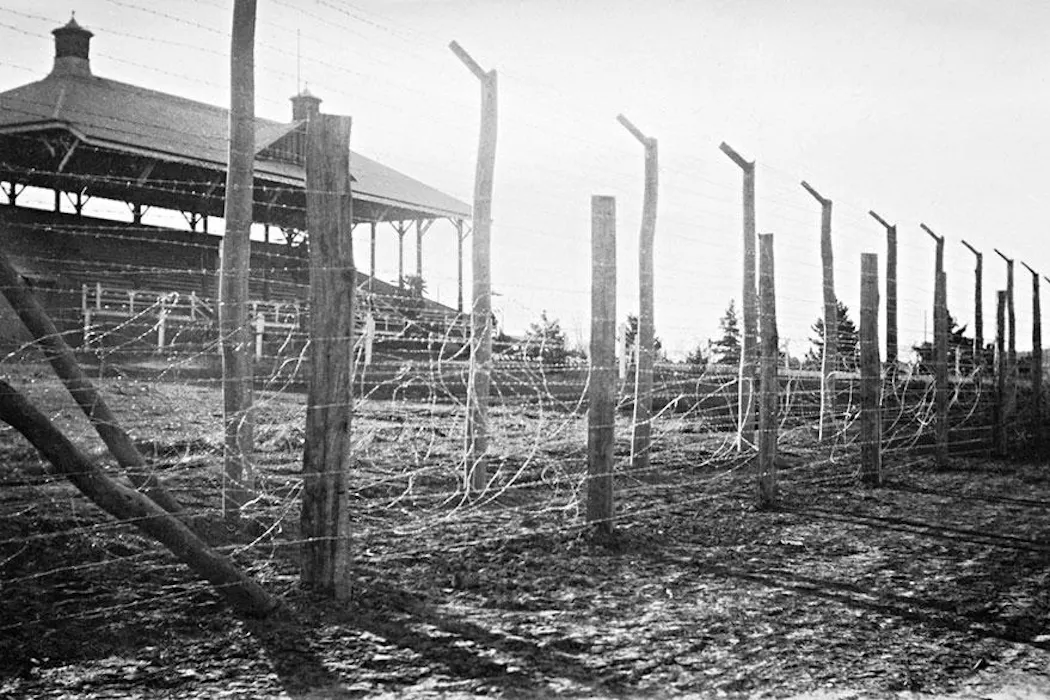
Between transit, immigration detention and life in camps, most refugees and asylum seekers are denied reliable ongoing access to education.
In response, some refugees set up schools for themselves. For instance, in 2014, Afghan Hazara refugees established a school in the West Java town of Cisarua – which has since expanded into a network. It’s one example from a long tradition.
In a new podcast called Emergency Exit, my colleagues and I explore the history of refugee-led universities set up in Australia’s internment camps during the second world war.

Mitchell Library, State Library of New South Wales, PXD 1539/no. 42
The Dunera boys
In the lead-up to WWII, more than 70,000 German nationals had fled to Britain to escape Nazi persecution.
With the outbreak of war in September 1939, they would be classified “enemy aliens”, and many were interned in British camps.
Australia followed suit; anyone here with German or Austrian nationality became an “enemy alien”. Many were also interned in camps.
As British camps became overcrowded, these men had to be transported elsewhere. So on July 10 1940, some 2,500 detainees embarked from Liverpool on the HMT Dunera, bound for Australia.
Among them were accomplished scholars, professors, musicians, linguists, artists and tradespeople. Some were teenagers whose education had been interrupted by the war.
During the Dunera’s 57-day journey, the refugees drafted their own constitution and established a university onboard the ship.
They continued to run these universities in internment camps in Tatura, Victoria, and Hay, New South Wales, teaching an eclectic program that included Malay, Greek, mathematics, bookkeeping, jazz and fashion drawing.

Australian War Memorial, CC BY
Leonhard Adam and the Collegium Taturense
At Tatura, the camp university was named the Collegium Taturense. Leonhard Adam was appointed pro-rector.
Adam was a distinguished lawyer and judge from Berlin. But because of his Jewish ancestry, he was disbarred from legal practice in 1933 under Nazi racial laws.
He fled to England, but was classified an “enemy alien” when the war broke out. Adam was interned on the Isle of Man before being transported to Australia on the Dunera.
In the Collegium Taturense, Adam taught jurisprudence, commercial law, Chinese and ethnology. He also painted scenes of life in internment.

Tatura Irrigation and Wartime Camps Museum
By the time Adam arrived at Tatura, he already had some knowledge of First Nations laws and practices, which he’d acquired conducting fieldwork among prisoners of war during WWI.
In 1917, in Germany, he met Ngarrindjeri man Roland Carter and Ngadjonji man Douglas Grant, both First Nations members of the Australian Imperial Force.
Adam would later publish an article in a German law journal documenting their laws and customs, followed by his book Primitive Art (1940). The term “primitive law” was used at the time to describe Adam’s expertise within ethnology and anthropology.
After Adam’s release from internment in Australia in 1942, he was appointed as a researcher at the University of Melbourne. He gathered what would become a major collection of First Nations art and artefacts.

Australian War Memorial, CC BY
Margaret Pierce, advocate for interned refugees
An important goal of the Collegium Taturense was to support the education of teenage boys whose schooling had stalled.
Many of them had been rescued to Britain as part of the Kindertransport scheme. But once war was declared, those aged 16 and over were caught up in the “enemy alien” category. Some were interned and transported.
One of these boys was Kurt Henle, a teenager who aspired to study medicine.
At the Collegium Taturense, camp internees (supported by refugee advocates) ensured Henle followed the Victorian curriculum so he could formally seek admission to university.

University of Melbourne Archives, Papers of Felix Behrend, UMA-ACT-19760019
His mother Clara Henle, who had fled to New York, corresponded with Margaret Pierce, an Australian Quaker who supported interned refugees. Clara thanked Pierce for showing “a most motherly feeling toward my son”, and urged her to make sure Kurt continued his studies.
This correspondence collection survives in the State Library of Victoria, and documents the bureaucratic cruelties that sabotaged Kurt’s academic ambitions.
Pierce campaigned for Kurt’s admission to study medicine at the University of Melbourne. The university did offer Kurt a place – as part of a war effort to increase the number of doctors – but Kurt needed to be released from internment to accept it.
Pierce appealed to the Australian government, only to be told that since Kurt had now turned 18, the only justification for his release would be to serve in the Australian military.
After the war, Kurt returned to England to study, later moving to the United States to become a professor of gastroenterology.
Access to education for refugees today
Bureaucratic categories continued to obstruct refugees seeking access to education for many decades.
In 1999, Australia introduced the temporary protection visa, which treated “unauthorised maritime arrivals” as full-fee-paying students – placing university education out of reach.
Decades of activism saw this regime end in 2023, after which Commonwealth-funded access to higher education became accessible to some 31,000 refugees.
More recently, the government began trialling a new university-based resettlement pathway. In it, the government matches prospective refugees with a participating university, and their student orientation includes their resettlement in Australia.
Refugee-led education continues in detention centres in Australia and overseas, such as at the Villawood detention centre in NSW, where visitors are taught about Australian refugee policies by detainees.

Katherine Biber receives funding from the Australian Research Council.
Original source: https://analysis1.mil-osi.com/2026/10/22/interned-as-enemy-aliens-in-australia-these-wwii-refugees-built-their-own-universities/