

Source: The Conversation (Au and NZ)
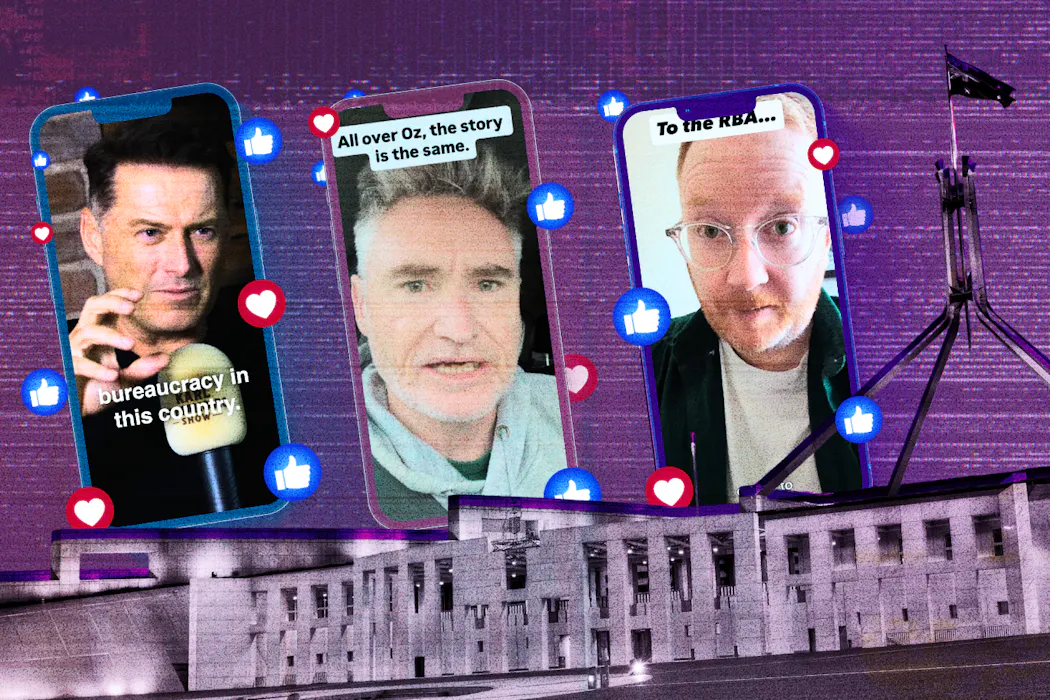
In recent months, many Australians would have seen or heard celebrities such as Dave Hughes, Karl Stefanovic and Kyle Sandilands becoming more involved in Australia’s political debate.
While it is not new for celebrities to express political opinions, social media has changed how they engage in public debate.
They can influence people even if they don’t officially endorse a political party or appear at a campaign rally.
But what is particularly interesting is these personalities are engaging with politics in different ways.
Capitalising on social grievance
Many Australians are frustrated by cost-of-living pressures, housing affordability and declining trust in political institutions.
Celebrities often use humour, criticism and relatable commentary to channel those frustrations.
They position themselves as speaking for ordinary Australians, rather than political elites. Genuine public concerns can be expressed through outrage-driven narratives.
But this approach can reinforce dissatisfaction rather than encourage informed political debate. For those on the conservative side of the political spectrum who benefit from these engagements, it has been described as “right-wing grifting”.
What are Hughes, Stefanovic and co doing?
Hughes has become increasingly outspoken in his criticism of Labor, focusing on policy and economics. He maintains his political stance is driven by opposition to government mismanagement, rather than opposition to the political left.
He recently attended a Victorian Liberal Party campaign event but stopped his engagement because of concerns it might breach the state’s political donation laws.
Hughes has described himself as a “former lifelong Labor voter”.
Once one of the highest paid Australian television presenters, Stefanovic has moved further into political commentary through his podcast.
With guests including political figures and former government officials, he has tackled controversial topics. He recently hosted the conservative CPAC conference in Brisbane.
Controversial radio host Sandilands is another interesting example, having shifted from his public friendship with Prime Minister Anthony Albanese to expressing support for Pauline Hanson and One Nation.
He claims he even assisted the party with its political messaging, demonstrating how celebrity influence can extend beyond public commentary into political strategy.
More recently, comedian Luke McGregor – who has a degree in economics – has attracted attention for his criticism of the Reserve Bank’s approach to inflation and unemployment. His commentary is more policy-focused than party-politics, demonstrating political influence does not necessarily require an explicit political allegiance.
The changing face of media consumption
These celebrities have all developed relationships with audiences outside politics. Their followers already know their personalities as both celebrities and content creators.
Audiences understand their humour and may feel a sense of familiarity with them. This creates opportunities to introduce politics into spaces where people might not otherwise actively seek it.
The University of Canberra’s 2026 digital news report highlights how significant the shift towards non-traditional media has become.
It found:
-
43% of Australian consumers access news from creators and influencers
-
48% of 18–24 year-olds use TikTok for news
-
among people consuming influencer-led news, 59% consider it more entertaining, 55% more relatable and 56% easier to understand than traditional news
-
people who distrust mainstream news tend to view influencers as more trustworthy and authentic than traditional media.
A report from Griffith University and Sentiment Agency, an Australian strategy agency, provides further evidence.
It examined 564 political creator posts during the 2025 federal election. The findings show creators outpublished traditional media on election and leadership content by four to one on social media. Audiences also identified creators as particularly influential sources of political information.
The research highlights that while traditional media may be seen by many as more credible, creators connect with audiences. This shapes what people pay attention to, rather than necessarily changing how they vote.
This strategy is not new
Research shows United States president Donald Trump’s media strategy helped him win the so-called first “influencer election” in 2024.
But his engagement with celebrities and content creators is not as simple as podcast appearances or algorithms. Instead, it reflects longstanding relationships with online communities, including those surrounding powerful celebrities such as Joe Rogan and Elon Musk.
Political influence is more than borrowing a celebrity’s audience. It is about accessing the cultural relationships and credibility they have established.
It doesn’t always result in election wins, though. The “Kamala is Brat” phenomenon – which emerged after singer Charli XCX called Kamala Harris “brat” following the release of her Brat album – shows how celebrities, memes and popular culture can make politicians more relevant to younger audiences.
It comes with risk
Political commentary can alienate existing audiences. People may enjoy someone’s comedy or television appearances without necessarily trusting their political judgement.
There are other grey areas too. As political commentary increasingly occurs outside traditional journalism, celebrities and creators do not operate under the same editorial expectations around accuracy, verification and balance.
Ultimately, the greatest influence of these celebrities may not be changing individual votes. It is likely in shaping the conversations that precede them. They influence which issues dominate attention, how audiences perceive political leaders, and whose explanations they find credible.
In an increasingly fragmented media environment, that is actually a significant form of political power.

Susan Grantham does not work for, consult, own shares in or receive funding from any company or organisation that would benefit from this article, and has disclosed no relevant affiliations beyond their academic appointment.
Original source: https://analysis1.mil-osi.com/2026/10/22/hughesy-karl-and-co-what-happens-when-celebrities-turn-political/