

Source: The Conversation – UK
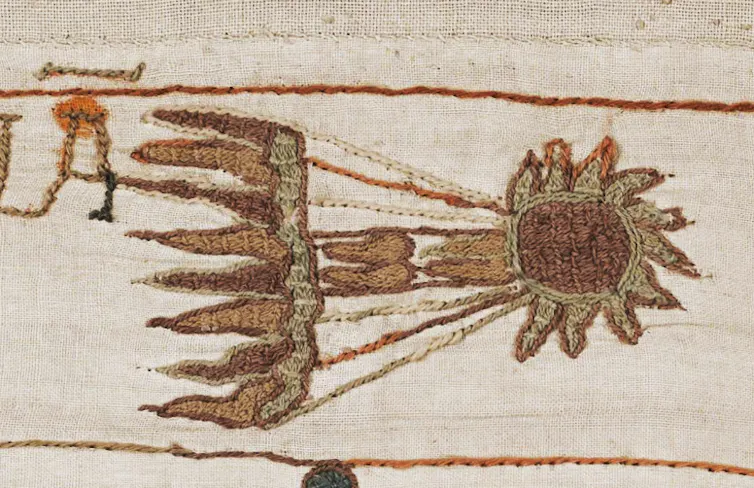
A sequence on the Bayeux tapestry shows King Harold alongside a crowd gazing at the sky, beneath the embroidered caption Isti mirant stella (“those people marvel at the star”). Above Harold sits Halley’s comet, with ghost-like invasion boats in the border below – a Norman framing of Harold as a doomed usurper whose betrayal invited destruction.
A comet, or the regum terror (terror of kings) as the contemporary Norman writer William of Poitiers put it, was widely taken as a portent of change in human affairs.
The accurate record of the appearance of the comet is not the point of the depiction in the Bayeux tapestry. As most western European sources concur, the comet appeared in the evening sky from April 24, 1066. It remained visible for one or two weeks – four months or so after Harold’s coronation.
Modern computation indicates that the comet came within about 15 million kilometres from Earth, supporting a contemporary Chinese report that it was as bright as Venus, with a tail extending 15 degrees across the sky. The sudden appearance of such a bright comet must have made a deep impression on those who witnessed it.
Wiki Commons
How the comet was recorded and described by medieval writers tells us a great deal about how medieval astronomy operated, its links with astrology and the wider context of global observation and book-learning in which it should be placed.
Interpreting the comet
William of Poitiers interpreted the comet as a portent of Harold’s ill-fated kingship. It is mentioned only in a section of his narrative set after the battle and the attempts to retrieve the fallen king’s body. He also noted the good fortune the comet indicated for Harold’s opponent.
Contemporary historian William of Jumièges saw the comet appear in the north-west with a three-forked tail. It stayed for 15 days. He believed it signified that changes were to come in rulership.
The Anglo Saxon Chronicles D and C (sets of annals in Old English), however, recorded the appearance of the comet but made no connection with regime change. The “haired-star”, they wrote, was “a sign such as men never saw before”.
Chroniclers of the next generation elaborated further on the comet as a portent. The English monk Orderic Vitalis (1075-c.1142) noted that it “learned astrologers who investigate the secrets of natural science” had declared it an omen of the transfer of a kingdom.

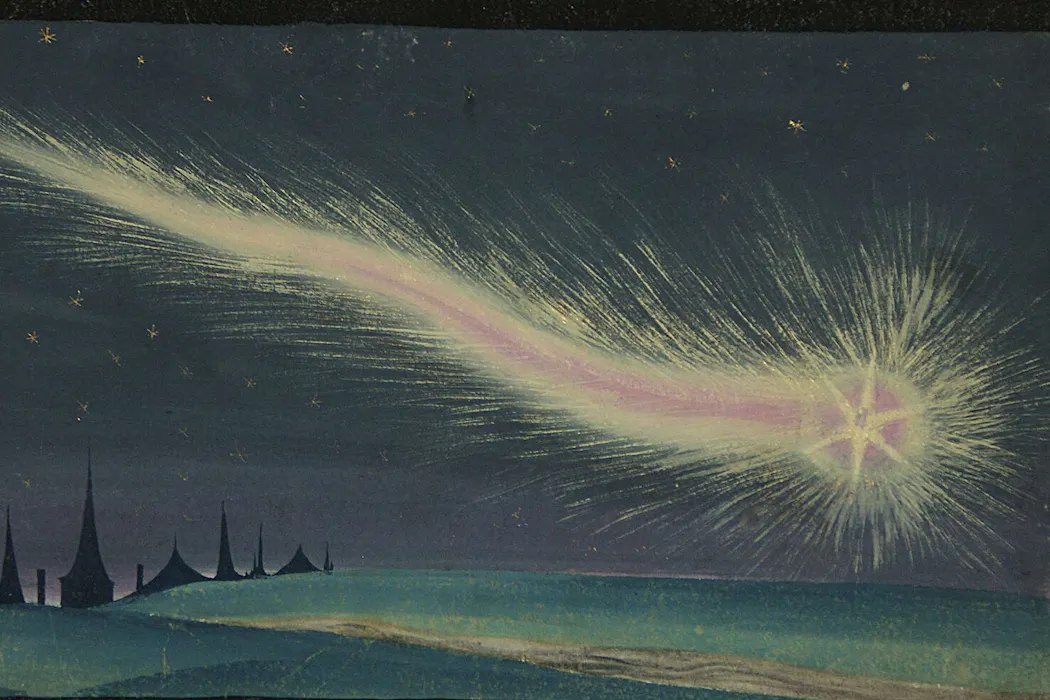
Bibliothèque de l’Arsenal
The English historian William of Malmesbury (c.1095-1143), meanwhile, stated that comets foretold “either a pestilence in the kingdom or a change in the kingship”. With regard to 1066, William puts the portent into the words of Aethelmaer, a monk: “It is a long time since I saw you; but as I see you now you are much more terrible, for I see you brandishing the downfall of my mother-country.” It is plausible that Aethelmaer had seen a comet before, perhaps the long-tailed, but faint, comet of 1018.
The medieval cosmos
Astronomers of medieval Christendom kept records of date, time, appearance and the comet’s effect. These records were conditioned by inherited learning and the conception of the ancient and medieval universe.
The medieval universe was considered divided into two realms. First, the superlunary – the realm of the planets and fixed stars, composed of the now debunked element ether. It was considered pristine and not subject to decay, moved only with diurnal motion (the apparent east-to-west movement of the planets and stars). Second, the sub-lunary, with spheres of the four elements, fire, air, water and earth, the latter still and at the centre and all subject to decay.

Istanbul University Library
Everything below was affected by what was above in this universe, so human affairs were affected by the influence of the planets. This was a universe understood in astrological and alchemical terms.
Eleventh century medieval writers had an accumulation of texts on which to draw from ancient Rome and the early church. Works by theologian Isidore of Seville and the medieval scholar Bede, informed William of Malmesbury’s statement that comets presage pestilence or a change in royal power. Behind Isidore lies ancient discussion of comets, Greek and Roman, both of which were the inheritance of the European Middle Ages.
Differences in fundamental understandings of comets emerge in this inheritance. For the ancient Greek Aristotle, comets were a meteorological, sub-lunary phenomenon, on the grounds that the perfect spheres above the moon could have no place for intermittent comets. This was a position challenged by the Roman stoic philosopher Seneca and medieval Islamicate thinkers who placed comets as complex celestial phenomena occurring in the heavenly spheres above the Moon.
Different interpretation of comets, revealing of different theories on how the universe worked, were then bequeathed to the world of medieval Christendom.
The 12th century saw a very significant increases in intellectual resources for European scholars, with translations into Latin of Aristotle’s works on natural philosophy and many scholars writing in the medieval Islamic world as well. These included astrology as the companion to astronomy. The writings of the Persian astrologer Abu Ma’shar (787-886) on astrology and horoscopes was especially popular.
This richer inheritance is seen neatly in the English philosopher Robert Grosseteste’s (c.1170-1253) treatise On Comets, written after “the occasion of the great comet”, probably the reappearance of Halley’s comet in 1222.
The treatise attempts to reconcile how an intermittent phenomenon like a comet is possible in the super-lunary realm where things are constant and unchanging. Grosseteste outlines and rejects three ancient theories of comets largely on the grounds of logical inconsistencies. His preferred version blends alchemical and astrological language. Comets are a combination of earthly matter drawn upwards, he argued, and sublimated to celestial power directed by particular planets or stars. They cause dread among the people over whose regions they appear.
The doom embroidered into the Bayeux tapestry was far more than medieval superstition. In a cosmos where the heavens directly affected the life of the human world below, Halley’s comet, a portent of change, was easily interpreted as a fatal sign for Harold Godwinson.

Giles Gasper receives funding from the AHRC, The Leverhulme Trust, NERC, The Castle Studies Trust and the John Templeton Foundation.
Brian Tanner does not work for, consult, own shares in or receive funding from any company or organisation that would benefit from this article, and has disclosed no relevant affiliations beyond their academic appointment.
Original source: https://analysis1.mil-osi.com/2026/10/20/terror-of-kings-why-the-1066-appearance-of-halleys-comet-terrified-the-medieval-world/