

Source: The Conversation – Canada
Unofficial results from the Alberta independence referendum indicate a resounding victory for the remain side. Three in four voters chose to stay in Canada.
The 50-point margin is the largest of its kind in similar secession referendums. Most questions with answers this clear are never asked in the first place.
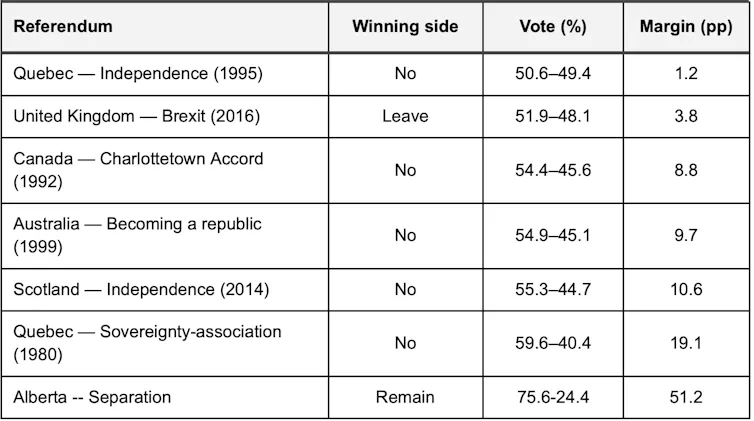
(Jared Wesley), CC BY
How did a vote that captured so much attention around the world end in such a lopsided result? Blown out at the polls, what lies ahead for the separatist movement in Alberta? To understand this, we need to appreciate the power of far-right populism in the province.
The role of far-right populism
Separatists constitute a far-right populist movement in Alberta — a loose network of anti-establishment, anti-pluralist factions that have more in common with the MAGA movement in the United States than they do with secessionist movements elsewhere in the world.
Far-right populism is a worldview that divides society into virtuous people, on one hand, and dangerous outsiders on the other. The outsiders threaten ordinary folks’ ways of life and livelihoods from above (corrupt and distant elites) and beyond (immigrants, globalists).
In this mindset, liberal democratic institutions are rigged against the public interest and must be weakened, captured or eliminated. In short, far-right populism sees the true will of the people distorted or thwarted by strangers who control “the system.”
In Alberta separatist circles, the main villains are federal government operatives — and the federal system itself — along with immigrant outsiders. In their view, after more than a decade of sending members of Parliament to sit on the opposition benches to watch idly while Justin Trudeau’s Liberal government ran roughshod over the province, most Alberta separatists have given up hope of the Conservative Party forming a national government.
To them, becoming an independent country was the only way to undo legislative changes they view as threatening Alberta’s economy and culture — increased immigration, environmental regulations, brakes on oil and gas production, progressive social programs, wealth redistribution out of the province.
Read more:
Albertans disapprove of Donald Trump — and his brand is weakening separatism, too
Unpopular in Alberta
While western alienation is deeply rooted in Alberta’s political DNA, the separatist solution has been unpopular for generations.
Separatist parties have only ever elected one member to the provincial legislature (a brief stint following a byelection in 1982). Public opinion polls show support for forming an independent country has ranged between 10 and 25 per cent throughout much of the past quarter century in Alberta.
Even on the eve of the referendum call, barely one in five Albertans indicated support for forming a new country. Of these citizens, a sizeable proportion regarded support for separatism as a means to other ends, aimed at sending a message to the rest of Canada that Albertans are unhappy with their treatment in Confederation.
So how did the views of a small minority manage to capture the political agenda? As with the rise of far-right populism in the United States and United Kingdom, the answer has much to do with internal party politics. The future of both separatism and far-right populism will now depend on how Alberta Premier Danielle Smith manages her party’s coalition in the days ahead.
‘Grassroots’ UCP
The United Conservative Party (UCP) has governed Alberta since 2019. Formed by the merger of conventional Progressive Conservatives and the right-wing Wildrose Party, the UCP attempted to blend the popularity of the PCs with the populist impulses of Wildrose.
Dubbing itself a “grassroots party,” the organizational structure provided unprecedented access to the leader. Article 5.7 in the party’s bylaws allows a small group of activists to effectively replace the leader after a vote of non-confidence.
These measures hold the leader’s feet to the fire. The UCP’s first leader, former premier Jason Kenney, discovered this near the end of the COVID-19 pandemic. Motivated by the success of the so-called Freedom Convoy movement, a far-right faction within the party ousted him in favour of their preferred leader, Smith.
Since then, Smith herself has been beholden to this most active portion of her party’s increasingly powerful base, whose policy objectives are drawn largely inspired by MAGA.
Since extracting major policy changes to limit transgender and voting rights, the far-right populists’ biggest demand of Smith has been to hold an independence referendum — something they have negotiated with American Republicans. Officials in U.S. President Donald Trump’s administration have not so subtly supported these efforts.
Smith amended legislation to make it easier for separatists to petition the government to hold a referendum. When the courts stepped in to prevent the separation petition from proceeding on the grounds it breached First Nations treaty obligations. Smith called the referendum anyway but softened the question, asking if Alberta should remain in Canada or proceed to a second binding provincial referendum on whether the province should separate.
Other questions
In a move reminiscent of former British prime minister David Cameron’s position on Brexit, Smith positioned herself as a champion of the “remain” side. Unlike Cameron’s side, hers won.
Smith chose to table more than one question as part of Alberta’s referendum, however. Nine others received their own ballots, including five dealing with the treatment of immigrants in Alberta and four dealing with proposed changes to Canada’s Constitution.
Smith campaigned for the “yes” side on these questions which, if passed, would empower her government to wrest control over immigration from Ottawa, restrict immigrants’ access to public services and seek a major devolution of powers from the federal government to the provinces.
At the time of writing, the “yes” side is ahead by slim margins on most but not all of these nine questions. This suggests Albertans are comfortable staying within Canada — but less comfortable about the province’s power within it.
What next?
It’s clear the referendum results are a rejection of the separatist belief that Canada is irreparably broken. Most Albertans view it as fixable and worth repairing.
At the same time, the fact that initial results suggest a slim majority of voters want Alberta to reduce immigrants’ access to healthcare and education reveals the limits of their tolerance for pluralism.
Smith’s post-referendum message will likely be aimed at setting her agenda for the year ahead, which by law must include a provincial election.
Does she view the outcome as a call to rebalance federalism or a mandate for internal provincial reform? Will she pursue formal constitutional negotiations or use the outcome as leverage for non-constitutional changes?
The UCP’s far-right populists will likely push her to pursue major reforms to the Constitution. To them, problems with healthcare and education are attributable not just to a flawed immigration system, but to immigrants themselves.
Separatists must now choose between fighting within the UCP or through new parties. To build momentum for a future referendum, they may leverage failed constitutional gambits and immigration reforms to argue Canada cannot accommodate Alberta.
Albertans will vote on these issues in the next election. That election campaign — and the clash between far-right populists and moderate pluralists — is already under way. The referendum only inflamed existing tensions.

Jared Wesley receives funding from the Social Sciences and Humanities Research Council of Canada. He is affiliated with LeadNotLeave.ca.
Original source: https://analysis1.mil-osi.com/2026/10/20/albertans-soundly-vote-to-stay-in-canada-many-are-asking-why-they-had-to-vote-in-the-first-place/