

Source: The Conversation – USA
Curious Kids is a series for children of all ages. If you have a question you’d like an expert to answer, send it to CuriousKidsUS@theconversation.com.
Why haven’t farm animals evolved to protect themselves against humans? – Sarang, age 15, Latur, Maharashtra, India
Have you ever wondered why dogs get the zoomies or wag their tails? One answer comes from a rather unexpected source: foxes.
A team of scientists bred captured silver foxes for tameness, choosing the least fearful and aggressive animals to become parents. They repeated this process with each litter of pups, avoiding any training and limiting their exposure to people.

Lee Alan Dugatkin/Evolution: Education and Outreach, CC BY-SA
Within six generations, the foxes began to show some familiar, doglike behaviors. Some wagged their tails as people approached, licked their hands and even liked to be petted.
These silver foxes are a remarkable example of selective breeding, where people choose animals with particular traits to produce the next generation of animals.
Selective breeding is the driving force behind domestication: the process through which animal populations adapted to life alongside people over many generations. Dogs are considered the first animals that humans domesticated, originally descending from wolves.
Domestication and evolution
Another team of scientists studied the genes of ancient animals to understand how domestication has shaped farm animals over time. They examined the genetics of a wide range of traits, from coat color in goats and horses to aggression and egg production in chickens.
Farmers might selectively breed chickens for more eggs, or cows for more milk. They may also favor calmer animals because they are easier to handle. Because animals with these traits are chosen more frequently by farmers for breeding, their genes have a better chance of reaching the next generation.

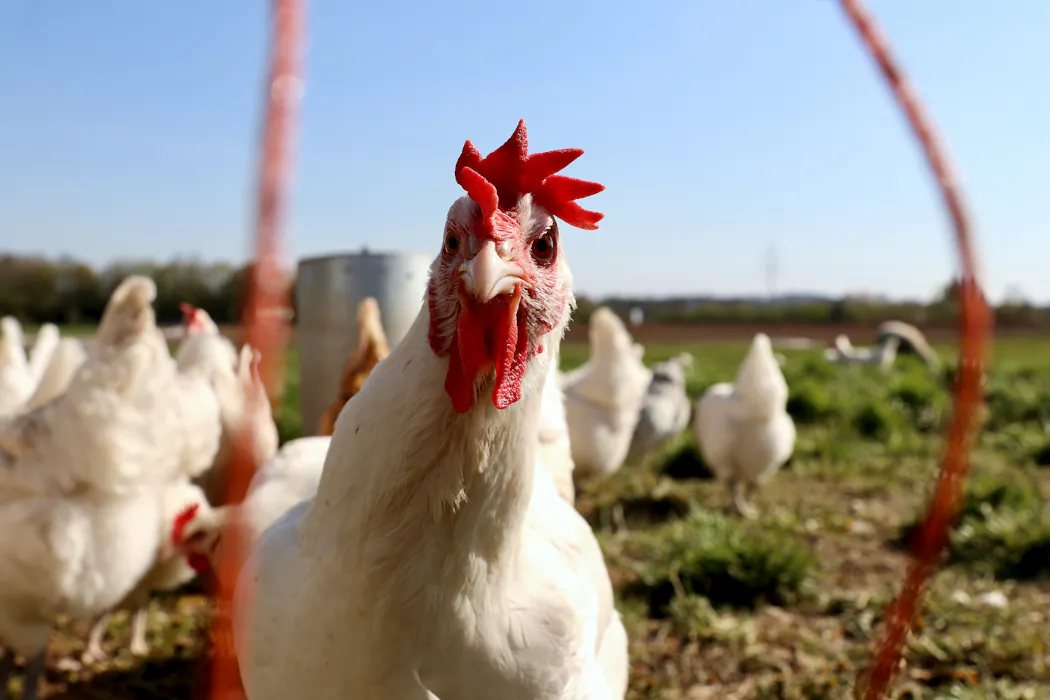
Michael Fousert/Unsplash, CC BY-SA
This process is domestication in action: Inherited traits such as tameness, producing more food or having a coat color preferred by people become common over generations.
Farm animals that are aggressive or don’t produce much food may be less useful to humans, thereby “protecting” themselves from being used by people. But with people in charge, these animals will also likely be excluded from breeding and have less of a chance of passing their genes on.
On the farm, people hold all the power. Because of the process of domestication through selective breeding, farm animals cannot evolve to protect themselves from humans.
Human influence in the wild
People can influence evolution in the wild even without deciding which animals to breed.
Animals with traits that help them evade humans who are trying to hunt or capture them will tend to pass on their genes to the next generation. This means that, in the wild, animal populations may evolve more protective characteristics, since people aren’t directly involved in selecting which animals will breed and pass on their genes.
Consider the elephants of Gorongosa National Park in Mozambique, a species I study in my work as an evolutionary biologist. During the country’s civil war, poachers hunted large numbers of elephants for their ivory tusks.

Gorgo/Wikimedia Commons
Some females were naturally tuskless, making them less likely to be targeted. As a result, these tuskless females had a better chance of surviving, reproducing and passing on the genes associated with tusklessness. Over generations, tusklessness became more common in the population.
While these elephants did not deliberately evolve a defense against hunters, tusklessness provided a survival benefit. Therefore, evolution favored an existing trait that offered some protection.
From friendly foxes to tuskless elephants, human choices can shape how animal populations evolve. Sometimes people do this deliberately, by breeding animals for desired traits. Other times, human impact on the environment alone can change which animals survive and reproduce, and therefore shape how species evolve.
Next time your dog snuggles up, remember those foxes!
Hello, curious kids! Do you have a question you’d like an expert to answer? Ask an adult to send your question to CuriousKidsUS@theconversation.com. Please tell us your name, age and the city where you live.
And since curiosity has no age limit – adults, let us know what you’re wondering, too. We won’t be able to answer every question, but we will do our best.

Alida de Flamingh does not work for, consult, own shares in or receive funding from any company or organization that would benefit from this article, and has disclosed no relevant affiliations beyond their academic appointment.