

Source: The Conversation (Au and NZ)
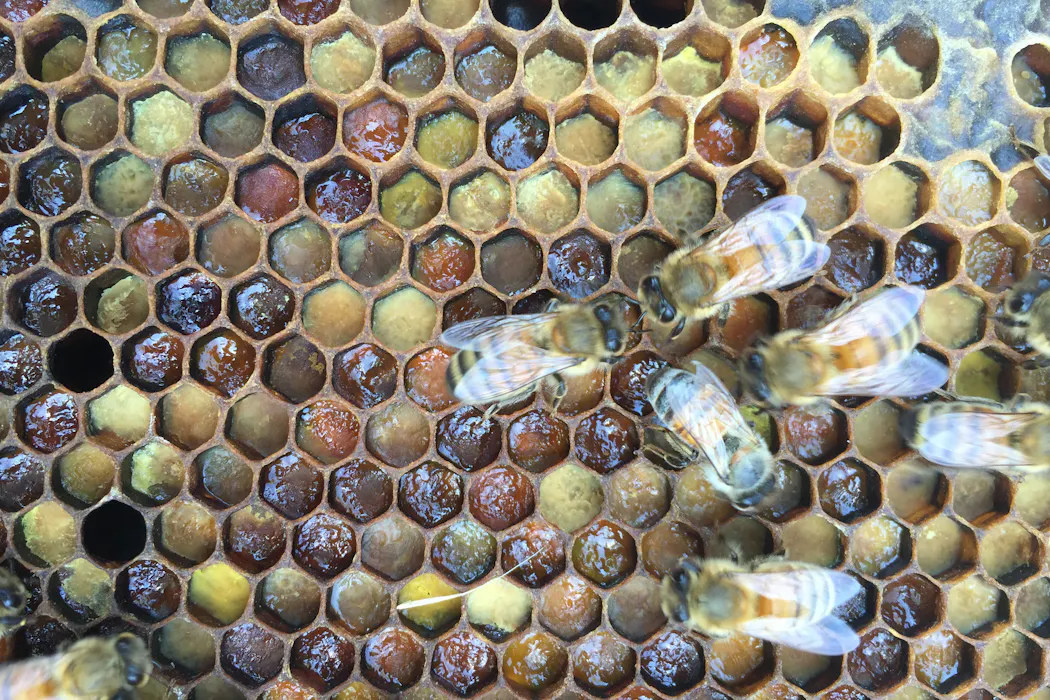
Open a honey bee hive on a warm afternoon and the first thing you’ll notice is movement.
Thousands of bees stream across the frames, tending brood, processing nectar and pollen, building wax, and maintaining the colony. A constant hum of activity and the smell of honey fill the air.
But this bustling environment is also home to something much smaller: a vast community of bacteria and fungi.
Some are harmless. Some are essential. Others can cause serious disease.
For honey bees, living together in such dense numbers creates an obvious problem. An infection that enters a colony has tens of thousands of potential hosts. Yet healthy honey bee colonies are remarkably good at keeping harmful microbes under control. How do they do it?
Our new research, published in ISME Communications, suggests that part of the answer lies in the way the hive is organised.
Mapping the hive’s defences
To understand how a colony keeps microbes under control, we first need to look at the hive as a whole.
The hive is not one place. Thousands of hexagonal wax cells are packed into combs, serving as nurseries, pantries, and storerooms.
At the centre is the brood, tended by nurse bees. Beyond it are the food stores, and at the edge is the entrance, where foragers come and go. Bees modify these spaces with materials they collect and produce.
Plant resins are turned into propolis, a sticky antimicrobial glue used to seal cracks and line parts of the hive. Nectar becomes honey, and pollen is fermented into “bee bread”.
Each of these materials has been studied before, but we wanted to know whether they work together as part of a coordinated defence system.
So we sampled 24 colonies from five apiaries in New South Wales, collecting honey, propolis, pollen, wax, and nurse and forager bees.
We used DNA sequencing to map bacterial and fungal communities, tested the ability of hive materials to inhibit microorganisms, and used nuclear magnetic resonance spectroscopy (a chemical fingerprinting technique) to investigate their composition.
This allowed us to look at the hive as one connected system.
A floor plan for fighting disease
What we found was striking.
A healthy hive is not a sterile one. Many of the microorganisms living in and around a colony are harmless or beneficial, so eliminating them all would be neither possible nor desirable.
Instead, the colony uses different kinds of defence in different places: selective protection around the vulnerable brood and broader antimicrobial activity in more exposed parts of the hive.
Different materials also have different antimicrobial chemistry. For example, honey relies heavily on hydrogen peroxide – the same molecule in a bottle of antiseptic.
Propolis leans on flavonoids, the same class of plant compounds that give red wine and green tea their antioxidant kick.
Pollen’s defences look more like fermented food, rich in the short-chain acids produced by fermentation.
Rather than relying on one all-purpose disinfectant, the colony combines multiple types of antimicrobial activity across different parts of the hive. In effect, the hive has a chemical floor plan for disease defence.

Kenya Fernandes
The landscape becomes part of the defence system
Perhaps the most important finding emerged when we looked beyond the hive.
The strongest predictor of the chemical potency of hive materials wasn’t disease history or health status. It was which apiary the hive came from.
This points to the surrounding landscape. Bees typically forage only a few kilometres from home, so local plants determine not only what they eat, but also the raw materials available for their chemical defences.
A colony surrounded by diverse flowering plants may therefore have access to a broader chemical toolkit than one foraging in a simplified landscape dominated by a single crop.
In other words, much of a colony’s chemical defences are built from what is growing outside its front door.
A broader view of bee health
We often think about threats to bee health in direct terms: the varroa mite, pesticides, and pathogens.
But our findings suggest that the ecological complexity of the landscape around a hive may also shape its ability to cope with disease.
As native vegetation is cleared and flowering resources become less diverse, bees lose access to a wider range of plants and the resources they provide. Maintaining diverse habitat around bee colonies could therefore be an important part of supporting healthy colonies.
And this idea may extend beyond honey bees. Ants, termites and stingless bees also use antimicrobial compounds to protect their colonies, often drawing on materials collected from their surroundings.
For these animals, the landscape may provide more than food and shelter.
It may provide part of their medicine cabinet.

Kenya Fernandes receives funding from the New South Wales Bushfire Industry Recovery Package Sector Development Grant and the Australian Research Council.
Original source: https://analysis1.mil-osi.com/2026/10/19/honey-bee-hives-have-living-immune-systems-which-defend-against-disease/