

Source: The Conversation – Canada
Jared Wesley, a professor of political science at the University of Alberta, is on the award-winning Conversation Weekly podcast discussing the Alberta independence referendum being held on Oct. 19 and his work in community town halls throughout the province leading up to the vote. The following is a truncated version of that compelling conversation. It’s been edited for length and clarity.
The Conversation: What’s the mood in Alberta right now just a few days before the referendum?
Jared Wesley: There’s a lot of uneasiness in most Alberta communities. This is the largest exercise in direct democracy in Canadian history. Never before in one event have we seen so many questions put to the public for a vote. So I think there’s a lot of confusion.
TC: There are 10 referendum questions in total, five related to immigration. Tell us a bit about them.
JW: They aren’t particularly concisely worded and a lot of folks are struggling to understand them. A lot of my work at community town halls is trying to provide a non-partisan perspective on why the government has introduced these questions and how people can make sense of them. Public opinion polls show quite consistently over the last two years that about 70 to 75 per cent of Albertans want to remain in Canada. And so folks in Alberta are either animated and ready to come out to the polls and vote to remain, or they’re quite confused as to why an issue that’s only supported by about 25 per cent of the population has made its way onto a referendum ballot and captured the world’s attention. So there’s a lot of confusion around the process and why we’re holding this vote in the first place.
TC: Let’s rewind a bit to the 1970s when there were first calls for Alberta’s independence. What was that movement about?
JW: The sense of what we call western alienation has really been part of Alberta’s political DNA since it joined Canadian Confederation, all the way back in 1905. These sentiments were captured by a political cartoon that featured a giant cow, and this cow was positioned across the entire country of Canada. It’s eating in Western Canada. It’s being fed hay by some burly farmers. It’s being milked in central Canada, particularly in Ottawa but also the financial capitals of Toronto and Montréal. So the, the notion has always been that the West has been feeding more into central Canada in terms of natural resources; originally agriculture, but now it’s oil and gas. So western alienation is imbued with this sense that Albertans put more into Canada than they get out, and we’ve seen versions and manifestations of that over time.
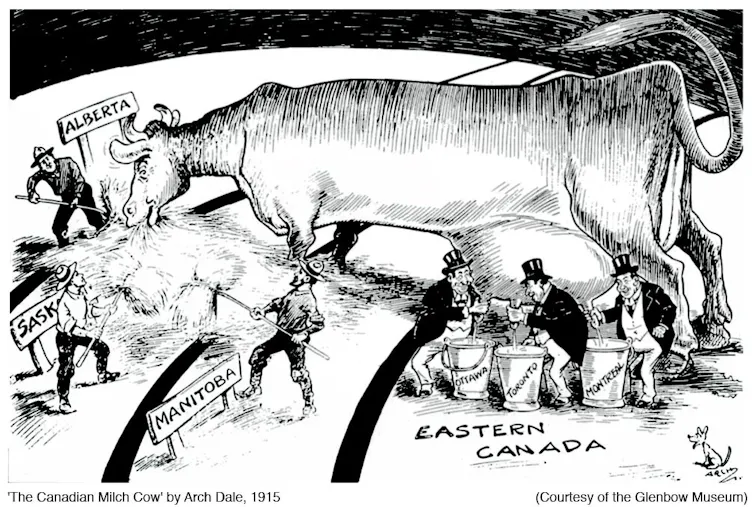
(Glenbow Museum)
TC: There’s a successful separatist party in Québec. Why never in Alberta?
JW: Similar parties have been tried in Western Canada, but they failed to win seats. Looking at other far-right populist movements in the United States and in the United Kingdom, folks started saying: “We don’t need to start our own political party to make this work. We simply need to infiltrate mainstream parties, and in particular, governing parties.” That change in strategy by groups called Take Back Alberta and others was the start of a new approach to Alberta separatism and one of the main reasons why we’re now seeing separatism on the public agenda.
TC: Where are separatist groups getting money? Is there funding and support from both inside and outside Canada?
JW: Alberta and Canada have some fairly strict campaign finance laws. And so since the campaign started, disclosures have been made available publicly so we can see who’s donating. Most separatist organizations are drawing fairly large amounts of money — the maximum contributions of about $5,000 dollars per person. But what’s less clear is where the initial funding for these organizations came from. How did one of the largest separatist organizations, the Alberta Prosperity Project, start off with a million-dollar endowment? Where did that money came from? We do have reports that Russian and American operatives are active, particularly in social media misinformation campaigns, and that’s been confirmed by academics.
TC: Are these campaigns working?
JW: We haven’t seen an increase in support for separatism, despite all the fundraising and spending; despite all of the attention. It seems the more Albertans seek out information about separatism, the less likely they are to support it. And this is very different from what we saw in the case of Brexit in the U.K., where that interest was converted into public support.
TC: What do Alberta separatists think of Donald Trump?
JW: Most Alberta separatists want to form an independent country. While they want to have strong trade ties with the United States, they don’t want to become the 51st state. But there’s a strong faction, about 20 per cent, that do firmly believe that Alberta should be a 51st state and should be integrated into the United States more directly. So it’s dividing the movement itself. Separatists are more likely to tune into far-right American-based news sources like Fox News, Newsmax and other sources, where they’re hearing a lot of far-right populist narratives that they seem to want to import into Alberta politics. Those concerning immigration, re-migration, the great replacement theory, and so on.
TC: What about average Albertans? And how has U.S. involvement played a role?
JW: A lot of Albertans who would have otherwise been persuaded that voting in this first referendum to support independence would send a message to Ottawa are really withholding that support because they worry about what message a divided Canada sends to the United States. We know that the Trump administration likes to exploit weaknesses. And that’s why State Department officials have made comments about how an independent Alberta would be a welcome addition to the North American economy. They’re not passive bystanders. They would like nothing more than to see Canada divided.
TC: Have federalist forces cited Donald Trump as a reason to vote no to separation?
JW: There’s no doubt about it. In the closing weeks of the campaign, a lot of federalist organizations are running ads that feature Donald Trump very prominently.
TC: Danielle Smith has said she’s voting to remain in Canada and it seems she may have proceeded with this referendum to please the separatist faction of her party. Is she essentially trying to call their bluff?
JW: The premier has indicated that she’s feeling pressure from within to to settle this issue, and that’s one of the reasons why she’s holding this referendum. She is facing a faction within her party that wants to separate from Canada. Some polls show that up to half or even more than half of her party’s supporters would vote to leave Canada if given the choice.
So that’s a lot of internal pressure. The other half wants to stay in Canada, so how do you resolve those disputes? One way is to throw it to the broader public.
TC: What do we know about the typical pro-separatism voter in Alberta?
JW: About 20 per cent of Albertans are what we would call hardcore separatists. They will vote to leave. Another 10 or 15 per cent who would vote to leave to send a message to the rest of Canada, to say: “We don’t really want to leave, but we want a better deal within Confederation, and you need to take notice and, and listen to some of our demands when it comes to federal policy.” If we look at that hardcore 20 per cent, demographically, these folks tend to be in rural areas. They tend to be white. They tend to be married. They tend to be more religious than the general population, and they tend to work in blue-collar jobs; that is, in oil and gas or in agriculture.
TC: What does either outcome mean for Alberta, Danielle Smith and Prime Minister Mark Carney?
JW: A lot depends on how the vote is split. Very few polls show a reasonable prospect for this first referendum passing. However, in a low turnout situation, the gap narrows considerably. Some modelling suggests if turnout is in the 50 per cent range, this becomes a coin flip in a very real sense. The premier holds a lot of power when it comes to interpreting the results of these non-binding referendums. Will she interpret a narrow result as a reason to continue moving forward with negotiating for a better deal within Canada? Does she look at a strong remain result as a reason to move on to other priorities? The prime minister needs to look at the result and decide whether Alberta independence is a genuine threat, whether his government must continue to take steps to assuage separatist demands or whether it’s time to put this behind us.
Listen to the podcast here:

Jared Wesley receives funding from the Social Sciences and Humanities Research Council of Canada. He is affiliated with LeadNotLeave.ca.
The Conversation Canada does not work for, consult, own shares in or receive funding from any company or organisation that would benefit from this article, and has disclosed no relevant affiliations beyond their academic appointment.
Original source: https://analysis1.mil-osi.com/2026/10/15/qa-with-an-alberta-politics-expert-taking-the-provinces-pulse-as-the-referendum-approaches/