

Source: The Conversation – UK
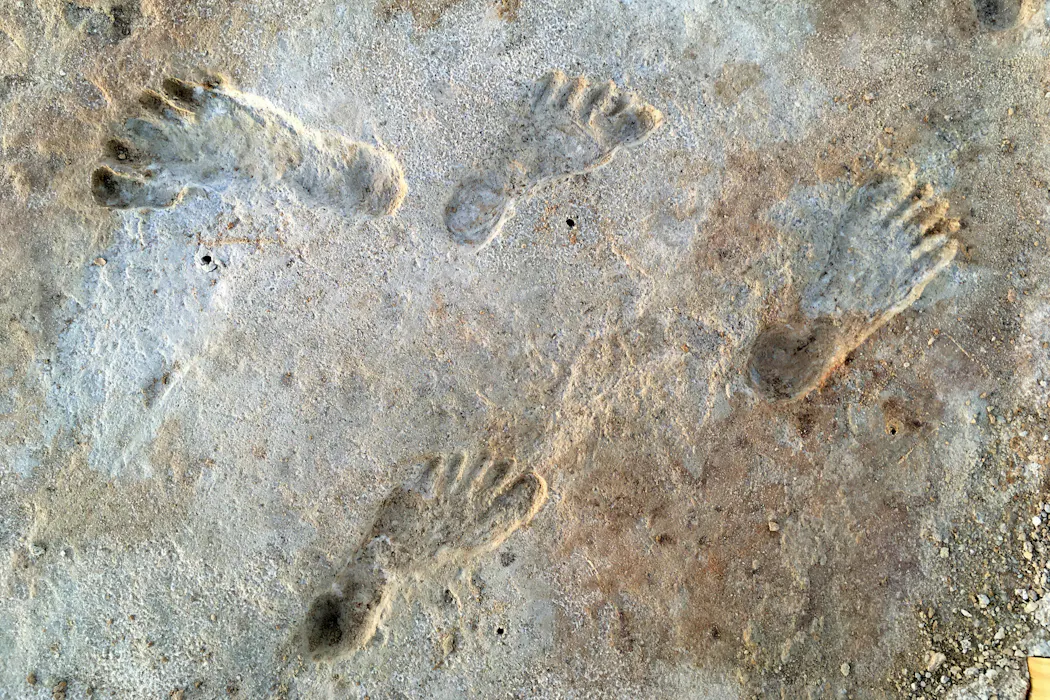
Some 23,000 years ago, during the coldest part of the last ice age, people walked across the muddy margins of an ancient lake in what is now White Sands national park, New Mexico.
The footprints they left behind have transformed our understanding of when people first reached the Americas. When we reported dates for the White Sands footprints in 2021, our findings were met with controversy. They placed people in North America thousands of years earlier than other widely accepted sites.
Subsequent work using several independent dating techniques strengthened that chronology. Our latest research takes the story a step further. Rather than simply asking when people were at White Sands, we can begin to ask: what sort of world did they experience?
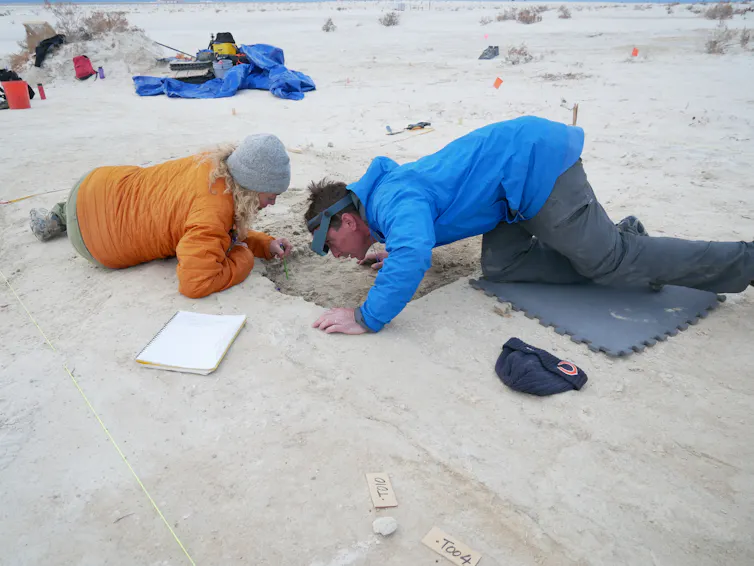
The answer is a surprisingly dynamic one that was marked by periods of rapid climate change. Our expanded excavations at White Sands have identified 20 different horizons or packages of sediment containing human footprints. Together they span almost two millennia, from about 23,500 to 21,700 years ago, firmly within the last glacial maximum (the height of the last ice age).
Alongside the footprints, the sediments contain a remarkable archive of
environmental change. Pollen records the vegetation growing around the basin,
while organic molecules preserved in the sediment – including waxes originally
produced by plant leaves – provide information about temperature and rainfall.
Together, these allowed us to reconstruct the landscape through which people were
walking.
At the beginning of the record, White Sands looked very different from today. A large body of water, Lake Otero, occupied much of the basin. The surrounding mountains supported conifer forests and average annual temperatures were around 4°C colder than today.
But conditions did not remain stable. From around 23,600 years ago the lake began
to shrink as temperatures rose. Conifer forest declined and was increasingly
replaced by oak and sagebrush.
As a result of this warming, the basin became progressively drier as evaporation increased. Superimposed upon this longer term change were much sharper climatic swings.
Around 23,200 years ago, for example, White Sands experienced a short but severe drought. Rainfall declined, the lake became more saline and drought-tolerant vegetation expanded. This dry period coincided with a rapid climatic change recorded thousands of miles away in Greenland ice cores.
And people were there. Indeed, the earliest footprint horizon in our expanded
sequence occurs around this climatic transition. Footprints continue to occur at
intervals as the lake retreated and the environment changed.
Our new evidence therefore shows that people visited this landscape repeatedly while experiencing substantial environmental change.

Datawrapper
Rapidly changing world
The footprints capture a world changing on timescales that could have been noticed by the people living there at the time. It is tempting to go one step further.
Were people particularly attracted to White Sands during difficult climatic episodes? Did the shrinking lake concentrate animals, plants or other resources that made the basin especially important during drought?
Perhaps. But footprints come with an important catch. What gets preserved is not
necessarily a full picture of what happened. In a separate recent study, we used an agent-based computer model to explore what a footprint record such as White Sands actually represents. Agent-based models are rather different from conventional models that attempt to predict something such as tomorrow’s weather.
National Park Service
Instead, they populate a simplified world with individual “agents” following basic rules. Complex patterns can then emerge from their collective behaviour. Our virtual world consisted of people moving around a fluctuating lake.
When they crossed mud they left footprints. Those footprints gradually disappeared unless changing water levels created the right conditions for them to be buried and preserved.
The result was revealing. People could be active around the lake while leaving
virtually no fossil record. At other times, relatively few people could produce large numbers of preserved footprints. What mattered was not simply whether people
were present, but whether their presence happened to coincide with the right
geological circumstances.
Arriving in pulses
Preservation was particularly likely during environmental transitions. A dry period
could expose large areas of footprint forming mud. Subsequent wetting and
sedimentation could then bury the tracks and preserve them. When we compared
this model with the real White Sands record, we found something striking.
The footprint surfaces occur as irregular pulses that tend to cluster around periods of climatic and hydrological change – just the pattern predicted by the model.
Footprints are snapshots, not a movie. But this study changes how the White Sands record should be interpreted. The footprints demonstrate unequivocally that people were present at particular moments.

National Park Service
But the gaps between footprint surfaces do not demonstrate that people were absent. Nor does a surface covered in footprints necessarily indicate a population boom. A handful of people repeatedly crossing soft ground can leave hundreds of tracks.
So we should be cautious about turning the correlation between footprints and
climate into a simple story in which people arrived at White Sands whenever drought
struck. Instead, there are two histories intertwined here.
One is a human history: people repeatedly inhabited this landscape for almost two millennia while the lake shrank, vegetation changed and the regional climate swung between wetter and exceptionally dry conditions. The other is a geological history determining which tiny fragments of those human lives happened to survive.
Footprints provide an intimate connection with ancient people, but they are not a continuous record of their lives. They are individual frames – moments when human behaviour, mud, water and chance came together.

Matthew Robert Bennett receives funding from UK AHRC.
Sally Christine Reynolds receives funding from the Art and Humanities Research Council grant: “The Peopling of the Tularosa Basin”
Original source: https://analysis1.mil-osi.com/2026/10/15/early-humans-in-america-endured-climate-chaos-new-research/