

Source: Asia Pacific Report
Asia Pacific Report
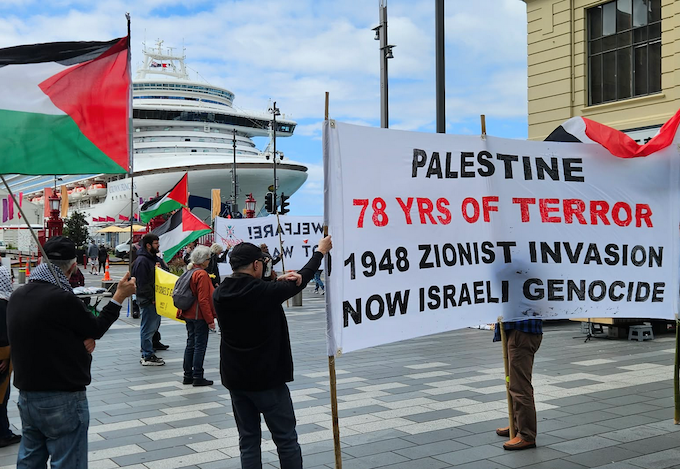
Labour will recognise Palestine, put in place economic sanctions on Israel, and join South Africa’s genocide case against Israel at the International Court of Justice.
These are among highlights of Labour’s foreign policy stance and the action the party says it will take if elected as the government next month.
Labour’s foreign policy spokesperson Vanushi Walters made that clear in her recent speech alongside the Labour leader, Chris Hipkins, as part of Diplosphere’s foreign policy election series at Parliament.
- READ MORE: Labour sums up its foreign policy approach as ‘independent, principled and unafraid’
- The full Labour foreign policy speech
- Other Gaza genocide reports
Explaining what was meant by “restoring our independent foreign policy”, she said independence was pivotal to New Zealand’s foreign policy approach.
Independence was about agency.
New Zealand’s silence this term on breaches of the United Nations Charter “has been noticed” globally.
“This government’s silence as one after the other States recognised Palestine has been noticed.”
Silence over Palestine
She said the National-led coalition government’s “silence in failing to stand up [with] a sanctions regime, following the ICJ [International Court of Justice] decision on the ethnic cleansing in the West Bank, continues to be loud”.
“New Zealand’s abstentions this term, on the floor of the UN whether it be about the reappointment of the High Commissioner of Human Rights or a vote abstaining on indigenous participation at the UN, have been met with confusion by our colleagues in the international space.
“We do not grow our agency if we stand for nothing because that too is a choice that has consequences.
“We lose our reputation as an honest broker and a consistent champion of international law. Make no mistake, the choice to shrink from the moral challenges we face will diminish our agency not expand it.”
Walters said a Labour government would “make full use” of the foreign policy tool box.
“There is a time for quiet diplomacy and there is a time when quiet diplomacy must bend to moral clarity — that is undeniably the case when the scale of human rights abuses is so stark that it amounts to genocide, to ethnic cleansing.
“Labour will recognise the State of Palestine. Labour will place economic sanctions on Israel and ensure the NZ Super Fund and ACC divest from holdings on the UN list of companies operating in the occupied territories.
Labour to join South Africa at ICJ
“Labour will intervene in support of South Africa’s case at the [ICJ] in respect of a breach of the Genocide Convention.”
Walters said that in this time of tension, “we must also remember there are seeds being planted”.
“International Courts continue to perform with diligence the duty of their statutes, people protest with astonishing courage in defence of their rights, humanitarians place everything on the line in the pursuit of development and peace for all, like-minded countries have begun acting on their desire to revisit creative diplomacy in defining new alliances,” she said.
She acknowledged Foreign Minister Winston Peters for his service during this term and under prior governments.
“We disagree on critical aspects regarding the role New Zealand must play in a fraught world, but not on all aspects of foreign policy, and I want to acknowledge in particular the breadth of his travel and the relationships he has maintained in the Pacific as hallmarks of his time in the role.”
Original source: https://analysis1.mil-osi.com/2026/10/08/labour-will-not-shrink-from-moral-challenges-it-will-recognise-palestine-statehood/