

Source: The Conversation – UK

With Prime Minister Andy Burnham’s plans for adult social care reform in England, including a move towards a national care service, much of the focus has been on who receives care and who provides it.
A missing piece of the jigsaw, however, is where that care is provided. Any care revolution is going to fail without the right homes to conduct the care in.
At a time when a health and social care services are under intense pressure, and the UK’s ageing population brings increasing support needs, this missing piece becomes ever more important. Where care takes place shapes how easily it can be delivered, and how long someone can live in their home with dignity and confidence.
Housing is also central to preventing other harmful effects of ageing, such as social isolation. Home improvements can be an important way of fostering a “sense of home”.
Strong foundations
Since his time as mayor of Greater Manchester and now through his national social care reform programme, Burnham has consistently argued that health and social care outcomes cannot be improved through healthcare investment alone.
He has spoken publicly about his family’s experiences of dementia care, and has highlighted the need to help people to live well.
His reform idea positions a national care system founded on four principles: enabling people to move seamlessly between hospitals, home care and community services; full and sustainable funding; supporting people to live independently for longer and ensuring citizens are at the heart of the plans.
The key theme running through these principles is a shift from reactive care services towards prevention, independence and planning for older people living.
Housing, neighbourhoods and community facilities are essential factors in health and wellbeing. The strongest evidence to support national social care reform concerns home design and adaptations.
As the prime minister said last year, “housing is the foundation on which everything else is built”.
This foundation must include inclusive, accessible and flexible homes that support health and a person’s care needs as they change.
Housing studies consistently demonstrate that well-designed housing can delay or prevent the need for formal social care. Well-designed housing can reduce the risk of falls and make it more comfortable with effective heating. It can also help to promote mental wellbeing, increased physical activity, greater social participation and better management of long-term conditions.
The prime minister’s ambition for a system which enables people to move seamlessly between hospitals, home care and community services requires an integrated approach across the NHS and social care, as well as building regulations.
Often, delayed hospital discharges occur where the home environment is not suited to provide the free access needed to get home safely. It may also not support basic activities of daily living as the person recuperates.
Unfortunately, the process of fitting adaptations itself is often seen as a battle that doesn’t work for those delivering or receiving adaptations. A stepped entrance or even a low-level shower tray can lead to discharge delays. And home modifications can be subject to long statutory consent approval times.
That’s why a preventative social care approach is a must – one that invests in accessibility, care and repair services, assistive technologies such as voice controls, and access to occupational therapy. To do this, construction industry needs to embrace accessible housing for older people. Change can be achieved once everyone – builders, urban planners and the health sector – recognises this as a public health priority.
Housing design features in keeping with a preventative social care approach were first introduced in the UK in the 1960s, and later integrated into British Standards requirements.
cunaplus / Shutterstock
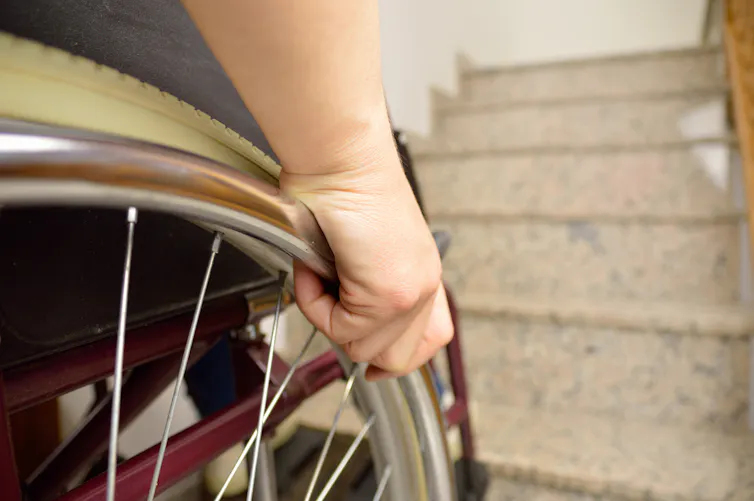
Features can include step-free access, accessible bathing rooms, improved natural lighting and acoustics, design specific for dementia sufferers and safe outdoor space. So-called walkable neighbourhoods, where shops, schools and parks are easily accessible, also help. These features are known to support independent living and reduce future care demand, but they continue to be considered adaptations rather than being the minimum design standard.
Residents of areas where walkable neighbourhoods with facilities within a short walking distance, are created, exercise more and report reduced rates of obesity. This approach directly supports Burnham’s objective of enabling people to remain at home for longer while reducing pressure on hospitals and care services.
A study found an emerging consensus that housing design can directly support healthy cognitive ageing, and help people live well with dementia for longer. Consequently, living well at home in housing designed for residents with dementia represents an important bridge between housing policy and social care reform.
Bringing care home
Housing should not be considered a separate sector, but as care provision to enable the new national care service to deliver upon its objectives.
The challenge is to carry that into a rounded approach to national care reform. The government has an opportunity to treat housing as part of the care system, and make accessible, inclusive design part of the investment needed in both people and places.

Lesley Palmer consults to INCH Architecture and Design – a social enterprise architecture practice based in Scotland. Lesley is a member of the RIAS and RIBA.
Vikki McCall receives funding from the Economic and Social Research Council (ESRC) as Principal Investigator on the Intersectional Stigma of Place-Based Ageing (ISPA) project (2022-2027) and the Balancing Trust and Accountability: Charities, Regulators, and Society project (2025-2027). She is also conducting Spend to Save research on adaptations and equipment for the Scottish Government (2026).
Original source: https://analysis1.mil-osi.com/2026/10/07/success-for-andy-burnhams-national-care-service-will-depend-on-home-essentials/