

Source: The Conversation – USA
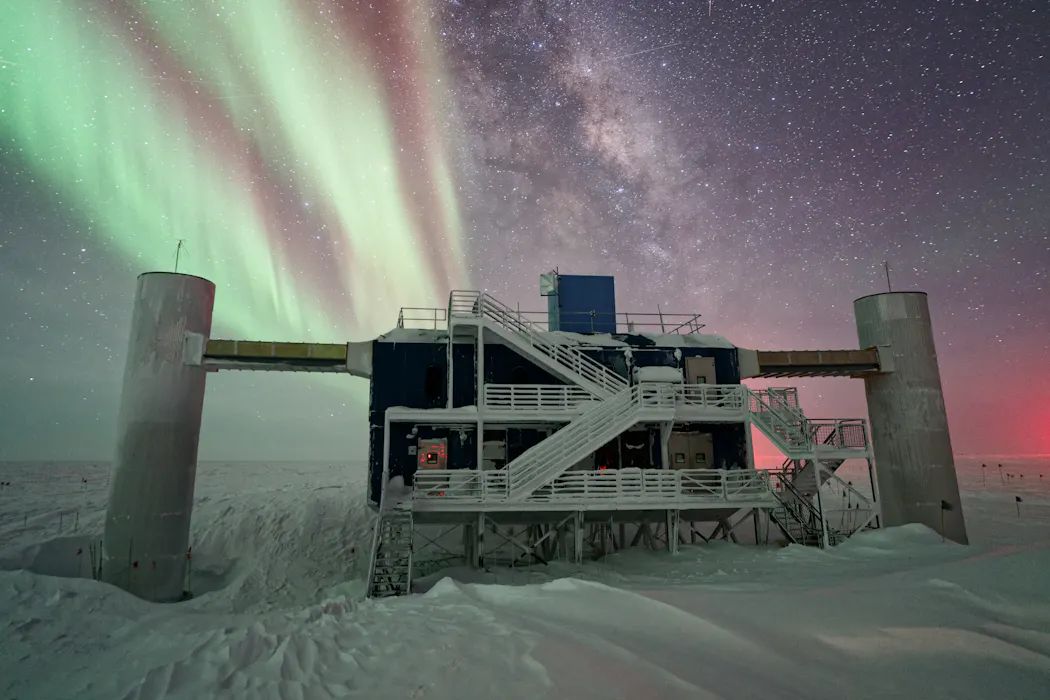
Standing at the South Pole is the next-best thing to being on another planet. If you walk a few hundred yards away from the National Science Foundation’s research station, you see a featureless plain of snow and ice, most likely empty of living creatures larger than microbes for hundreds of miles.
With nothing but snow for sound waves to echo off, there’s an eerie silence. It’s easy to get lost in reverie, contemplating the stark landscape. But then I remember that I’m here for a reason: to work on what may be the world’s weirdest telescope, watching for some of nature’s most mysterious subatomic particles.
This wintry landscape is home to the IceCube Neutrino Observatory. This unusual telescope is the brainchild of Francis Halzen, recipient of the 2026 Nobel Prize in physics for his work spearheading this project and discovering high-energy neutrinos of astrophysical origin.
I’m an astrophysicist and part of the international team of scientists who started building IceCube in 2005 and continue to operate it today. Although the detector is designed to be operated mostly remotely, some work must be done in person: maintaining and replacing electronics, installing new hardware and upgrading instruments.
Every student and scientist who comes to the South Pole feels that same sense of awe. Even when we’re analyzing data back in our offices at home, images from our time at the pole lurk in the back of our minds.

Jeff Cherwinka, IceCube/NSF, CC BY-NC
Neutrinos hint at where cosmic rays come from
Every second, more than 10,000 high-energy particles – protons and atomic nuclei – rain down from space on every square meter of the Earth’s atmosphere. Some of them carry more than a million times the energy of the protons at the most powerful particle accelerator, the Large Hadron Collider at CERN, the European Organization for Nuclear Research. Fortunately, the atmosphere absorbs most of them, but a few stray particles pass through your body every second.
Scientists discovered these particles, known as cosmic rays, more than a century ago.
But the magnetic fields that fill the universe deflect cosmic rays on their journey, so the direction they’re traveling when they reach Earth’s surface doesn’t tell us where they were originally produced.
Since the cosmic rays themselves don’t point back to their sources, we look instead for neutrinos, a type of subatomic particle that should be produced as a byproduct of cosmic ray acceleration, wherever it’s happening.
Neutrinos are very strange – they’ve been called ghost particles. They very rarely interact with other matter, so to see them, you need a very large detector. Our telescope is called IceCube because we use a cubic kilometer – a billion tons – of the Antarctic ice cap to catch neutrinos.

Jim Haugen, IceCube/NSF, CC BY-NC
Most neutrinos pass invisibly through IceCube, but by chance a few of them will smash into a proton or neutron in the ice, releasing a shower of high-energy electrons, photons and other particles the detectors can see. By measuring the number and direction of these visible particles, we can determine the direction the original neutrino came from, its energy and its type, also called its “flavor.” One by one, we build up a picture of the sky as it shines in neutrinos, rather than starlight.
Halzen proposed the idea of building a neutrino telescope in Antarctica in 1988. The South Pole may not sound like the obvious place to build such a telescope, but in fact it’s the easiest place to do it. The United States maintains a scientific facility there, home to several other experiments besides IceCube.
Most importantly for us, the South Pole station sits on top of nearly 1.8 miles (3 kilometers) of the purest, clearest ice in the world – a perfect neutrino target just waiting to be used.

Mark Krasberg, IceCube/NSF, CC BY-NC
Good for science, tough for people
But “easiest” is not the same as “easy” – the South Pole is a challenging place to work. Traveling to the pole from the U.S. usually takes a week or more. The last leg of the trip is on a special ski-equipped LC-130 cargo aircraft, operated by the Air National Guard, which lands on a runway made of compressed snow.
These aircraft can only reach the pole for four months of the year: at midsummer – January in the Southern Hemisphere – the average temperature is a balmy minus 15 degrees Fahrenheit (minus 26 degrees Celsius), but by March, temperatures have fallen to minus 50 F (minus 45 C), too cold for LC-130s to operate.

Martin Wolf, IceCube/NSF
We pack our work into those summer months, then hand IceCube off to two hardy “winter-over” scientists. Our winter-overs are part of a team of 45 people who stay at the station for the rest of the year, cut off from the rest of the world for eight months except for internet and radio communications.
In the summer, the station population expands to around 150 people. The South Pole is a high-altitude desert, so the air is thin and very, very dry. But the cold isn’t the toughest part of working at the South Pole – at least in the summer. The strangest thing, at least for me, is the constant daylight.
At the South Pole, the Sun stays up for six months, circling along the horizon and slowly spiraling down until it sets at the autumn equinox. Then our winter-overs get six months of constant darkness until sunrise in the spring. This plays havoc with circadian rhythms; I’ve awoken to see the clock read 3:00, not knowing whether it’s a.m. or p.m., whether I’ve slept for four hours or 16.
Despite being one of the most isolated places on Earth, the station is also very crowded in the summer. It takes a lot of expensive fuel to heat the buildings, so space is at a premium – and needless to say, most of us work indoors. It also takes fuel to melt water, so showers are rationed to two minutes of running water twice a week, contributing to the unique working atmosphere at the South Pole.

Nicolle R. Fuller/NSF/IceCube
Results rolled in
The road to the IceCube Neutrino Observatory was a long one. Halzen started work at the South Pole in 1993 with a project called AMANDA, which I joined in 1997. AMANDA showed we could detect neutrinos in the ice, but it was too small to see any sources – it was like using binoculars when what we needed was a serious telescope.
We needed to go big. Halzen built a team that could scale up the process and convinced scientific agencies in the U.S. and other countries that the results would be worthwhile. IceCube was fully commissioned in 2011, on schedule and on budget, with Halzen coordinating the efforts of over 300 scientists around the world.
Two years after IceCube was completed, we announced that we’d identified neutrinos from outside the solar system – the original entries in our map of the neutrino sky. We named the first two Bert and Ernie.
By now, we’ve seen thousands of neutrinos coming from the cosmos, some with hundreds of times more energy than the protons accelerated at CERN. But it’s been surprisingly difficult to determine where, exactly, they come from. No individual sources immediately stand out in the sky – most of the neutrinos form a diffuse glow, like seeing sky glow at night rather than distinct constellations of stars.
IceCube is making progress pinpointing the origins of some of the cosmic rays by identifying their neutrino emission. One high-energy neutrino came from a blazar – a supermassive black hole sucking in matter from its host galaxy and spewing some of it into a jet thousands of light-years long and pointed straight at Earth. Others came from nearby galaxies and a few even from our own Milky Way.
But these sources can only account for a small fraction of the neutrinos IceCube detects. Many questions remain, and more work is needed to answer them.

E. Krupczak/NSF-IceCube
In the 2025-26 South Pole summer, we installed the IceCube Upgrade, an extension designed to bring the sky into sharper focus by improving the detector’s calibration. Plans for another, even larger IceCube Gen2 Observatory are under development, and there are a handful of other neutrino telescopes under construction around the world, including KM3NeT, Baikal-GVD, TRIDENT, and a new project I’m working on called P-ONE.
IceCube has given us our first peek behind the curtain at the most powerful neutrino sources in the universe, and I’m excited to see what other surprises are in store.
This is an updated version of an article originally published on Nov. 13, 2015.

Tyce DeYoung receives funding from the National Science Foundation. He is a member of the IceCube Collaboration and the P-ONE Collaboration.